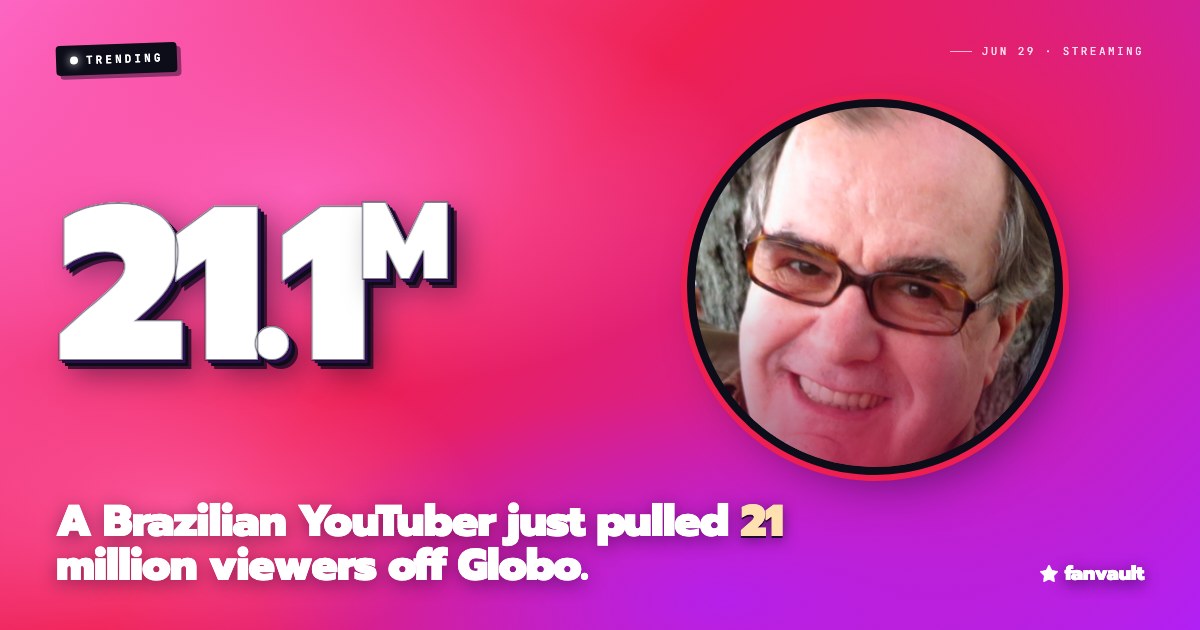
CazéTV, the YouTube channel Rio streamer Casimiro Miguel co-founded four years ago, peaked at roughly 21.1 million concurrent viewers on June 29 during Brazil's Round of 32 win over Japan. That is believed to be the largest live stream in YouTube's history, and it's roughly six times what Casimiro pulled at the 2022 World Cup. A guy who blew up on Twitch reacting to Big Brother Brasil is now the biggest sports broadcaster in Brazil, and he is beating Globo on Globo's home field.
⚡ Key Takeaways
- CazéTV peaked at 21.1M concurrent viewers on Brazil vs. Japan, believed to be the largest live stream in YouTube's history.
- That's roughly 6x what Casimiro Miguel drew at the 2022 Qatar World Cup, and more than 2.5x YouTube's prior all-time livestream record.
- Globo still holds 86% of Brazil's total World Cup audience, but the 18 to 24 demo split is 38% CazéTV to 27% Globo.
- CazéTV signed more Brazilian World Cup sponsors than Globo did for the 2026 cycle, and took LaLiga rights off Disney through 2032.
- Rights holders used to pick broadcasters. Now the audience picks the rights holders.
What actually happened?
Brazil beat Japan 2-1 at Houston Stadium on June 29 to advance out of the Round of 32. CazéTV's stream peaked at about 21.1 million simultaneous connected devices, according to Terra Esportes. That eclipses the record CazéTV itself set a week earlier, when Brazil vs. Scotland peaked around 17.8 million on the same channel per Rio Times. The prior all-time YouTube livestream ceiling, an ISRO rocket launch at roughly 8 million, has been passed by more than a dozen individual CazéTV broadcasts this month per Streams Charts.
The group-stage stack was already record-breaking. Brazil vs. Morocco peaked near 12.5 million viewers, Brazil vs. Haiti near 16 million, and Brazil vs. Scotland at roughly 17.8 million, itself smashing YouTube's prior all-time football-stream record. Then the Japan knockout blew past all of it. CazéTV now occupies effectively every slot in YouTube's top 10 biggest concurrent livestreams.
The channel isn't a scrappy side project either. CazéTV is the only broadcaster in Brazil, digital or traditional, with rights to all 104 matches of the 2026 FIFA World Cup, and it streams every one of them free on YouTube per FIFA. Casimiro co-founded it in November 2022 with sports marketing firm LiveMode (Cristiano Ronaldo is a minority shareholder). The channel now sits at 39M+ subscribers, according to Tubefilter.
Why does this matter for creators?
For more than half a century, Globo owned the World Cup in Brazil. Now a 32-year-old ex-games-journalist who dropped out of journalism school is beating them, in their own market, on their own product. That's not a niche story, it's a signal about who gets to build a media company in 2026.
Casimiro's origin is the twist that should terrify every incumbent. He was an Esporte Interativo games journalist who got throttled off Twitch for co-streaming football, moved to YouTube, and rode Big Brother Brasil reactions and street-food videos into a 39M-subscriber channel. By the 2022 Qatar World Cup, his stream of Brazil vs. Serbia peaked at 3.48 million concurrent viewers, then a world record for a YouTube football stream. Four years later that number is roughly six times larger, and it's on a stream he has exclusive national rights to.
Rights holders used to pick broadcasters. FIFA, LaLiga, and the sponsors now chase the audience, and the audience lives on the creator's channel.
CazéTV took LaLiga rights in Brazil through 2032, per Sportcal, pulling them off Disney. It also signed more Brazilian World Cup sponsors than Globo did for the 2026 cycle. The direction of the arrow has flipped.
"The new generation wants to watch and participate in a broadcast."
Edgar Diniz, Founding partner, LiveMode
What's the bigger picture?
Globo still reaches roughly 86% of Brazil's total World Cup audience across TV and digital combined, per Fortune. But the youth split is the tell: Ampere Analysis reports 38% of Brazilian sports fans aged 18 to 24 watched CazéTV in the past month, versus 27% of fans aged 35 to 64. In the demographic that decides the next decade of media, the streamer is winning outright.
The 2026 pattern is clear: audience is upstream of distribution, and distribution is upstream of rights. Whoever owns the audience relationship gets to write the terms. Rights holders showed up at Casimiro's door because he already had the eyeballs, not the other way around.
What does Fanvault think?
The CazéTV moment is a proof point for what Fanvault has been arguing since 2025: creators who own their audience relationship set the terms, and the platform underneath them should take the smallest possible tax. Casimiro's stack (free-to-viewer, sponsor-monetized, host-led, meme-native, no linear middleman) is the mega-scale version of what a Fanvault storefront gives creators who don't have FIFA on speed dial. Paid subs, paid DMs, wishlists, and authenticated memorabilia drops turn that same audience relationship into monthly revenue at an 8% platform fee, versus Fanvue's 15% and Fanfix's roughly 20%. Whether the product is the World Cup or a signed match-worn jersey, the shape is identical: platform-of-one, minimum tax on the creator, maximum ownership of the fan.
Globo has broadcast every World Cup in Brazil since 1970. It might broadcast the next one too. But it will do it next to a solo creator who now sits above it in the demographic that decides the next decade, and the sponsors are already voting with their checks.
Frequently Asked Questions
How many people watched Brazil vs. Japan on CazéTV?
CazéTV's YouTube stream of Brazil's 2-1 Round of 32 win over Japan on June 29, 2026 peaked at roughly
Who is Casimiro Miguel?
Casimiro Miguel is a 32-year-old Rio de Janeiro streamer, born October 20, 1993. He started as a games journalist at Esporte Interativo, dropped out of journalism school, and blew up on Twitch during the pandemic co-streaming football and reacting to Big Brother Brasil.
After Twitch throttled his account for co-streaming football, he moved to YouTube. In November 2022 he co-founded CazéTV with sports marketing firm LiveMode; Cristiano Ronaldo is also a minority shareholder in the venture.
Does CazéTV have the rights to every match of the 2026 World Cup?
Yes. CazéTV is the only broadcaster in Brazil, digital or traditional, with rights to all 104 matches of the 2026 FIFA World Cup, and it streams every one of them free on YouTube, per FIFA. Globo runs a traditional linear TV package in parallel.
Is Globo actually losing the World Cup audience?
Not the total. Globo still reaches roughly
But the youth split is where the trend line lives. Ampere Analysis reports 38% of Brazilian sports fans aged 18 to 24 watched CazéTV in the past month, versus 27% of fans aged 35 to 64. That's the demographic that decides the next decade of media consumption, and CazéTV has already won it.
What does the CazéTV story mean for smaller creators?
It's the ceiling of what an audience-first creator company can become. Casimiro started with no studio, no ad sales team, and no rights portfolio. Four years later he owns exclusive national World Cup rights, took LaLiga rights off Disney through 2032, and out-drew the incumbent broadcaster in the youth demo.
The playbook underneath it is portable. Rights holders and sponsors now chase the audience, and the audience lives on the creator's channel. Whether that channel monetizes via FIFA rights or via a Fanvault storefront (paid subs, DMs, wishlists, authenticated memorabilia drops), the shape is the same: platform-of-one, minimum tax on the creator, maximum ownership of the fan.