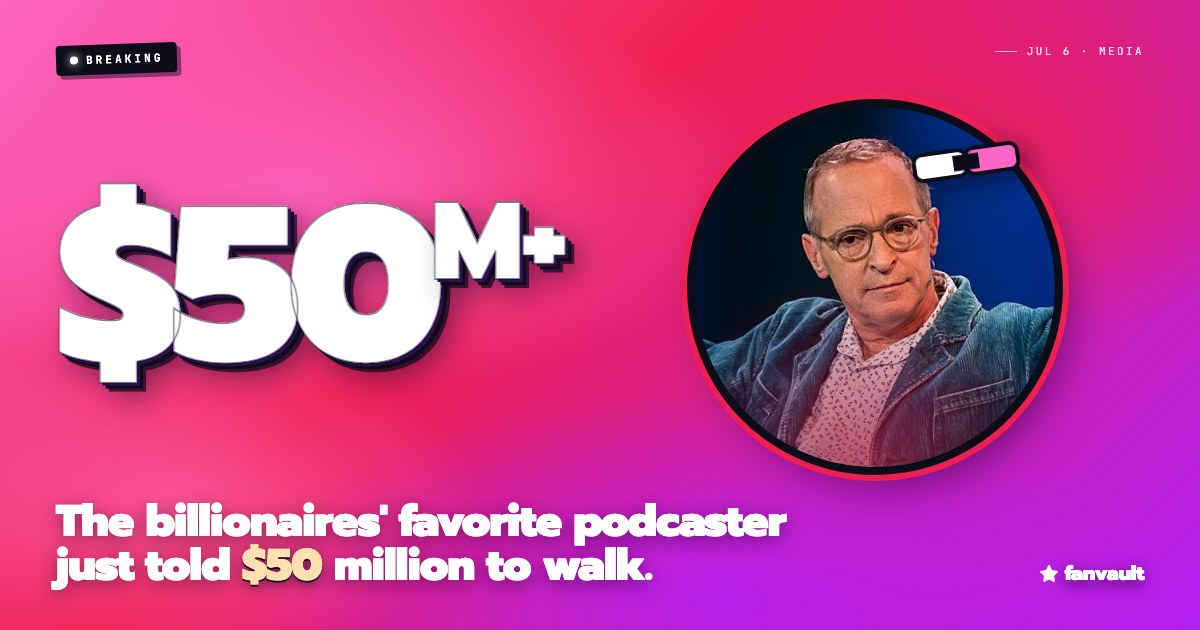
David Senra just told $50 million to keep walking. The solo host of Founders, the podcast Jeff Bezos, Tobi Lütke, and Brian Armstrong actually listen to, has rejected roughly 15 acquisition and investment offers, including one valued above $50M, according to Fortune. His show generates millions in annual profit. He is the only employee.
⚡ Key Takeaways
- Founders host David Senra turned down roughly 15 acquisition and investment offers, including one valued above $50M.
- One employee, millions in annual profit, listeners include Bezos, Lütke, Armstrong, Dell, and Ek.
- Ramp ($44B) single-sponsors episodes on flat annual deals, zero CPM, one advertiser per show.
- Serial founder Brad Jacobs credits a single Founders episode with generating $750M in listener investments.
- OpenAI bought TBPN for low hundreds of millions in April 2026; Senra took zero equity in the show he championed early.
- Ownership-first creator businesses are running circles around venture-backed ones on margin per employee.
What actually happened?
Two Fortune profiles landed back-to-back this week. The July 5 piece by Lily Mae Lazarus laid out how Senra built Founders by reading one business biography a week for a decade, alone, and turning it into a millions-in-profit business. The July 6 follow-up dropped the kicker: he has turned down every acquisition offer he has ever received, roughly 15 in total, including one valuing the show above $50M. Senra told the outlet the show is "part of my soul."
Founders launched in September 2016 under the original title Autotelic. For the first five and a half years, almost nobody listened. Then tech operators found it, and the audience list started reading like an S&P index. Coinbase CEO Brian Armstrong, Michael Dell, and Spotify CEO Daniel Ek are all subscribers now.
Two subcontractors handle clips and thumbnails. Everything else runs through one person. Ramp, valued at $44B, is his largest advertiser and buys episodes on flat annual deals, one sponsor per show, no CPM. When serial founder Brad Jacobs wrote How to Make a Few More Billion Dollars, he credited a single Founders episode with directly generating $750M in listener investments.
Why does this matter for creators?
The prevailing 2026 script says raise capital, hire a team, and sell to a strategic. OpenAI just validated that script by acquiring TBPN, the daily tech talk show, in April for what the WSJ reported as low hundreds of millions of dollars. Senra had championed TBPN when it had fewer than 1,000 listeners and personally introduced its hosts to Ramp. He took zero equity in that show, out of principle.
Senra ran the opposite playbook and ended up with the same audience without a term sheet. That is the point most creators keep missing. Ownership is not just a values pose, it is a competitive strategy that beats the venture-backed version on margin per employee.
"If someone gives you money, they want influence. I'm not interested in doing my life's work any way other than the way I want to do it. I couldn't have investors or a corporate parent."
David Senra, Host and sole employee, Founders Podcast
What's the bigger picture?
Look at the compensation math. TBPN was reportedly on track for more than $30M in 2026 revenue before OpenAI acquired it. Founders clears millions in profit with a headcount of one. On margin per person, Senra is running circles around every venture-backed creator business in his weight class.
His flat-rate, one-sponsor-per-show model also breaks the CPM industry that funds the rest of podcasting. When Ramp hired him to audit its podcast strategy, he recommended firing 32 shows and doubling down on three. That is what conviction looks like when you have not sold your audience to anyone.
Senra himself keeps circling back to the same theory. Founders who obsess over quality and refuse outside capital tend to end up with the money on the back end. The venture-backed creator playbook takes it upfront in equity. On a compounded basis, the ownership route wins more often than pitch decks want to admit.
The next question is who copies him. Podcasting is not a category, it is a template that maps onto any content format where a single creator with real taste beats a team. Newsletters and long-form video are the obvious next stops. The next wave of ownership-first creators is going to study Senra's model and skip the venture route entirely.
What does Fanvault think?
Senra is exactly the creator Fanvault was built for: someone whose audience is smaller than the venture playbook demands but worth more retained than sold. Fanvault's 8% platform fee (creators keep 92%) beats every named competitor in the frame, Fanvue at 15%, Passes at 10% plus $0.30, Fanfix at roughly 20%. The full monetization stack, memberships, paywalled posts, paid DMs, tips, wishlists, plus an authenticated memorabilia storefront, lets a creator like Senra earn from every layer of the audience without giving up a cent of ownership. This is the ownership-first thesis we are betting on.
Senra has read 415 biographies of what he calls anti-business billionaires and keeps arriving at the same lesson. Keep control, keep the margin, keep the soul. The check clears anyway.
Frequently Asked Questions
How much has David Senra turned down for Founders Podcast?
According to Fortune, Senra has rejected roughly 15 offers to acquire or invest in Founders, including at least one that valued the show above
Who actually listens to the Founders Podcast?
The audience skews heavily toward operator-CEOs. Fortune's July 5 profile names Jeff Bezos, Shopify CEO Tobi Lütke, Coinbase CEO Brian Armstrong, Michael Dell, and Spotify CEO Daniel Ek as regular listeners. Serial founder Brad Jacobs credited a single episode with generating
How does Founders make money without a big team?
Senra runs annual flat-rate advertising partnerships with one sponsor per show, no CPM, no auction dynamics. Ramp, valued at
Why did OpenAI buying TBPN matter to this story?
The April 2026 TBPN acquisition was the biggest recent validation of the venture-backed creator playbook: raise, scale, sell to a strategic. Senra had personally championed TBPN when it had under 1,000 listeners and introduced the hosts to Ramp. He took zero equity in the show. Then he turned down all his own acquisition offers, and the contrast is the whole point.