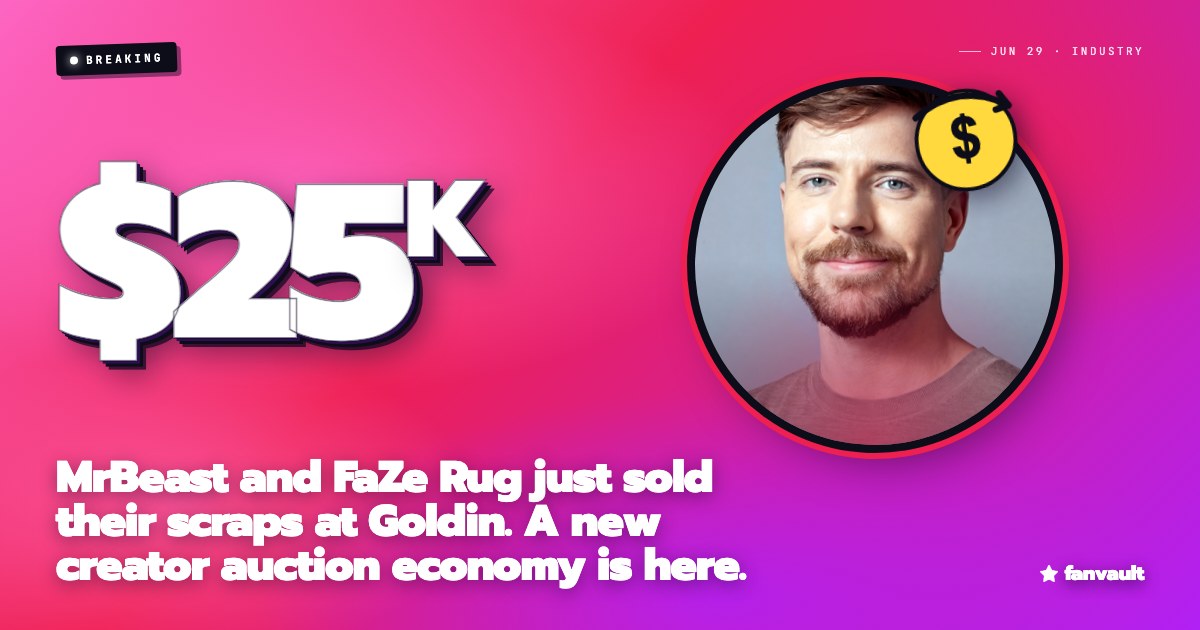
Goldin, the eBay-owned auction house that made sports memorabilia a $30B industry, just closed its first-ever creator-focused sale. Twelve lots pulled from YouTubers MrBeast, FaZe Rug, Jake Paul, and Salish Matter raised roughly $25,000 for Make-A-Wish on June 29. The top-selling item was a half-eaten In-N-Out burger, encased in acrylic, that went for $7,000. Category creation, not novelty.
⚡ Key Takeaways
- Goldin, eBay's auction arm, closed its first creator-focused sale on June 29, raising $25,000 for Make-A-Wish across 12 lots.
- FaZe Rug's half-eaten In-N-Out burger, plaque-mounted in acrylic, topped the entire sale at $7,000.
- MrBeast's four items (worn Yankees hat, size-12 Air Force 1s, two Naruto Shippuden long-sleeves) collectively pulled close to $8,000.
- The whole play was a test of whether YouTuber memorabilia can survive as a $30B-sports-model collectible category. It cleared.
- Fanvault's storefront was built for exactly this: authenticated memorabilia, proxy-bid auctions, 92% to the creator, no middleman required.
What actually happened?
Goldin partnered with YouTuber Airrack (Eric Decker) to run a two-week online auction tied to his viral video "I Broke Into Famous YouTuber Houses." Every lot came with a signed Letter of Provenance from Airrack, and all proceeds went to Make-A-Wish. The sale closed on June 29, 2026 with roughly $25,000 raised across 12 items, per Dexerto.
FaZe Rug's half-eaten In-N-Out Double-Double, plaque-mounted in acrylic with his name on it, topped the entire sale at about $7,000. MrBeast's four lots (a worn New York Yankees hat, size-12 Nike Air Force 1s, and two used MrBeast x Naruto Shippuden long-sleeves) collectively pulled close to $8,000, per Briefs. Salish Matter's signed yellow "Sincerely Yours" hoodie, from her Sephora-distributed skincare line, cleared $1,500. Airrack's one-of-one "Infinite" Pizza Hut Card, minted after he hit 10M subscribers, hit nearly $4,500.
Jake Paul's contributions included personally used boxing gloves and sealed hand wraps from his Georgia training facility, rounding out a 12-lot slate that read like a highlight reel of YouTube's biggest names. The auction was a two-week online affair, not a black-tie ballroom event, and it lived on Goldin.co next to the Mantle rookies and Ruth-signed baseballs. That framing was deliberate.
Why does this matter for creators?
For a decade, creators have monetized attention (subs, ads, tips, brand deals) and then digital ownership (drops, tokens, one-of-one merch). Physical objects with a documented chain of custody, the exact category that turned athletes and musicians into a $30B+ collectibles industry, have been almost totally absent. Goldin, run by the person who arguably built modern sports auctions, just pointed that entire infrastructure (provenance letters, live bidding, authenticated encapsulation, resale liquidity) at YouTubers.
The signal is bigger than the check. A beat-up hat, a scuffed sneaker, a preserved burger: these are the low-drama, high-provenance items that anchor sports memorabilia sales. Someone paid $7,000 for a burger because it had a plaque, a signature, and a video that millions of people watched. That is the exact economic logic that made a Mickey Mantle rookie card an eight-figure asset.
"MrBeast, YouTube Stars Auction Personal Items in Goldin's Creator Sale."
Bloomberg headline, framing the auction as Goldin's inaugural creator category
Where does this go from here?
eBay acquired Goldin in April 2024 with founder Ken Goldin staying on as CEO, per Sportico. That deal now looks like a distribution bet: eBay owns the biggest resale marketplace in the world, and it just proved YouTuber items clear real prices on it. Expect more creator sales. Expect authenticators to move in, and expect the phrase "game-worn" to migrate to "stream-used."
Read the roster and it's obvious this wasn't a random novelty run. MrBeast became the first individual YouTube creator to cross 500M subscribers on June 12, per the YouTube Official Blog. Salish Matter, 16, just signed a Netflix deal and launched a Sephora-distributed skincare line, per Business of Fashion. Goldin picked the highest-provenance names on the platform to seed a market, not to test a joke.
What does Fanvault think?
Goldin ran a one-off charity swing through their own house, their own bidder pool, and their own back office. That's a proof-of-concept, not an operating system. Fanvault built the operating system: an 8% storefront with authenticated memorabilia, proxy-bidding auctions with anti-snipe extended windows, buy-it-now drops, provenance metadata on every listing, and integrated Shippo fulfillment, all inside the creator's own profile alongside their subs and paid DMs.
The comparison isn't rhetorical, it's mechanical. Fanvault ships with the same primitives Goldin used: authenticated listings, proxy bidding, anti-snipe timers, provenance metadata (signed, worn, condition), Shippo fulfillment, and Stripe Connect payouts. The only difference is where the transaction lives, and who takes the cut. Fanvault creators keep 92%, and Goldin's cut, whatever it was, wasn't 8%.
If Goldin proved someone will pay $7K for a preserved burger, the next question is whether creators need an auction house to broker every drop, or whether they can run the same play themselves as a recurring revenue line. The infrastructure exists. It's already built into the profile.
The first authenticated YouTuber burger sold for $7,000. The next one won't need a middleman.
Frequently Asked Questions
What sold at Goldin's first creator-focused auction?
Goldin's 12-lot online auction, run in partnership with YouTuber Airrack, closed on June 29 after two weeks of bidding. The headline item was FaZe Rug's half-eaten In-N-Out Double-Double, preserved in an acrylic case with a name plaque, which sold for roughly
Airrack's one-of-one 'Infinite' Pizza Hut Card fetched nearly $4,500, and Salish Matter's signed 'Sincerely Yours' skincare-line hoodie cleared $1,500. Jake Paul contributed personally used boxing gloves and sealed hand wraps from his Georgia training facility. Every lot shipped with a signed Letter of Provenance from Airrack, and all proceeds went to Make-A-Wish.
Why did a half-eaten burger sell for $7,000?
Because it wasn't just a burger. It was FaZe Rug's half-eaten burger, preserved in acrylic, mounted on a wooden plaque with his name on it, tied to a video with tens of millions of views, and shipped with a signed Letter of Provenance from Airrack. Strip any of those elements out and the price collapses. Together, they turned a food item into a memorabilia lot with the exact chain-of-custody profile that anchors sports auctions.
That's the same economic logic that made a Mickey Mantle rookie card an eight-figure asset. Sports collectors don't pay for the cardboard, they pay for the story the cardboard is attached to. Goldin just showed that story translates to YouTubers.
Is YouTuber memorabilia actually a new asset class?
The Goldin sale is the first legible price signal that it might be. Ken Goldin publicly framed the auction as a test of whether creator memorabilia could become a new collectible category, per Bloomberg. The infrastructure that made sports collecting a $30B+ industry (auction houses, authentication, provenance letters, resale liquidity) is now getting pointed at people whose fanbases treat them the way fans treat athletes and musicians.
eBay owns Goldin, so any category that clears prices at Goldin has a natural distribution path to the world's biggest resale marketplace. Expect more creator sales, and expect 'stream-used' to become the new 'game-worn.'
How is Fanvault different from a Goldin auction?
Fanvault ships the same primitives Goldin used (authenticated listings, proxy bidding, anti-snipe timers, provenance metadata like signed, worn, and condition, plus Shippo-powered fulfillment and Stripe Connect payouts), but wraps them inside every creator's own storefront alongside their subs, paid DMs, tips, and wishlists. The platform fee is
Goldin routed the Airrack sale through a two-week Goldin.co event, their own bidder pool, and their own back office, then took whatever their cut was. A Fanvault creator runs the same play as a recurring revenue line, inside the same account fans already use to follow them. No auction-house middleman required.