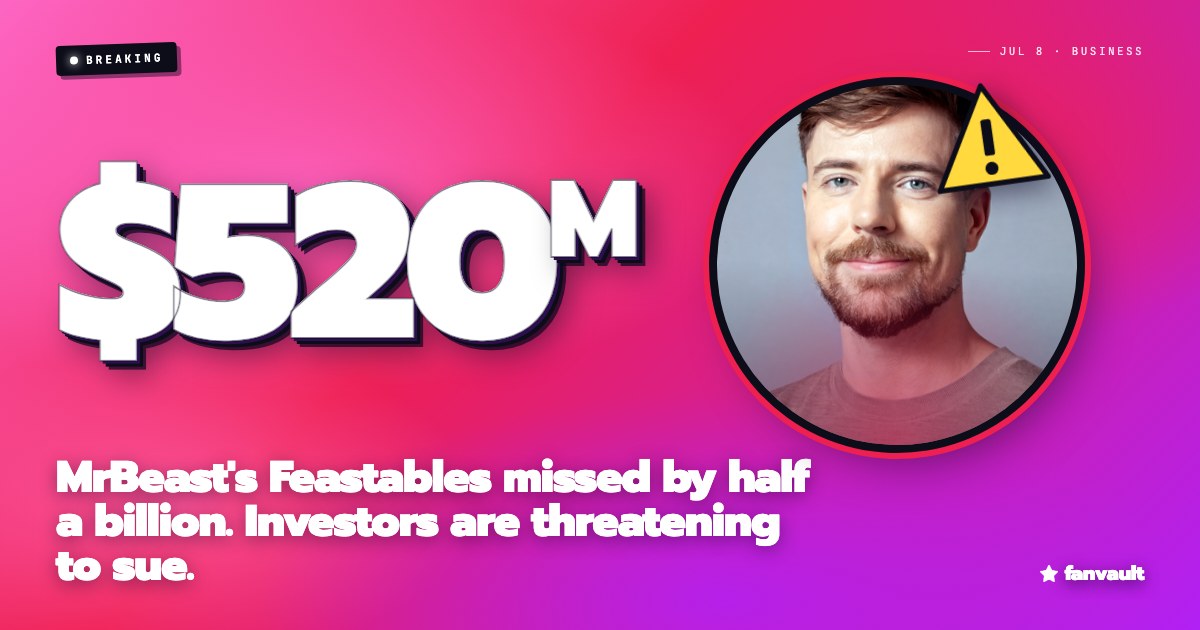
MrBeast's snack empire just cracked. Early Feastables investors have retained counsel and are preparing formal legal action against Jimmy Donaldson, alleging he breached image-rights and exclusivity clauses that required Feastables to stay his central commercial focus. The trigger: Feastables was pitched to hit $520M in 2025, per the Beast Industries pitch deck first reported by Tubefilter. It missed by hundreds of millions.
⚡ Key Takeaways
- Early Feastables investors have hired counsel and are preparing formal legal action against Jimmy Donaldson over alleged image-rights and exclusivity breaches.
- The 2024 Beast Industries pitch deck projected $520M in 2025 Feastables revenue; sources say actual 2025 sales came in well below that, by hundreds of millions.
- Feastables did roughly $250M in revenue and $20M in profit in 2024, making it more profitable than MrBeast's core YouTube business.
- Investors say Donaldson's focus drifted to Beast Games on Amazon Prime and other Beast Industries verticals, in violation of exclusivity clauses.
- Beast Industries is valued at ~$5B and is currently raising a $200M round; Donaldson owns "a little over half" of the holdco.
- This is the first live legal test of the "creator holdco" thesis: how enforceable is a contract that pins a superstar creator's attention to a single CPG P&L?
What actually happened?
Feastables closed 2024 at roughly $250M in revenue and about $20M in profit, making the snack brand more profitable than MrBeast's core YouTube business, per the pitch deck later covered by TechSpot. The same deck projected Feastables would double to $520M in 2025 as the anchor of a $900M+ Beast Industries year, on the road to $1.6B in 2026. Sources briefing ARY News and NewsBytes say 2025 sales came in well short of that number. The gap is the entire case.
Investor complaints center on three things. Donaldson's on-camera attention was diverted to Beast Games on Amazon Prime and other Beast Industries verticals. Exclusivity agreements guaranteeing Feastables as his primary commercial product were allegedly violated. And image and likeness usage strayed from what backers were promised, per reporting from TechStory.
"Jimmy didn't make these deals, his previous managers did, and it is pretty rich that it's coming up right now."
Source close to Jimmy Donaldson, cited by NewsBytes
Why does this matter for creators?
This is the first real stress test of the "creator holdco" thesis. Feastables sold investors a bet that MrBeast's face, voice, and on-platform focus could be contractually pinned to a single CPG P&L. The complaint alleges that once he had a $5B valuation and a Prime show, that focus drifted. The growth curve drifted with it.
Every creator raising against their own image and likeness now has a live legal precedent forming. How enforceable is "central commercial focus" when the creator is also, by definition, a media company, a game show host, a philanthropy, and a personal brand? Donaldson owns "a little over half" of Beast Industries at roughly a $5B valuation, per Will Ventures. That personal stake is exactly what makes this the most dangerous kind of story for the empire narrative.
Where does this go from here?
Beast Industries has already professionalized the org chart around the problem. Former eBay executive Jeff Housenbold took over as CEO in late 2024. Damien Atkins came in as Chief Legal Officer. And in November 2025 Michelle St. Jacques, formerly of Molson Coors, joined as President of the Consumer Goods Division running Feastables.
Insiders framing the story to reporters say the disputed contracts predate this new bench. That may be true and still not save Donaldson, image-rights clauses attach to him personally, not to the executives who negotiated them. Meanwhile Donaldson is raising a reported $200M round at the same $5B valuation, per Entrepreneur. Every prospective LP will now read this filing before wiring.
Layer the timing. Donaldson is already facing a $100M+ countersuit tied to MrBeast Burger and a class action from Beast Games contestants. The Feastables filing opens a third legal front, on the P&L Beast Industries pitched as its safest one. That is the reordering of risk that will keep bankers awake.
What does Fanvault think?
Fanvault reads the Feastables saga as a warning about the shape of creator infrastructure itself. Feastables required Donaldson to personally promote it in perpetuity, from a specific number of thumbnails, on a specific cadence, in a specific tone. That's not a business, that's a lease on a person's attention. And attention doesn't scale with valuations.
Fanvault gives every creator a storefront (subs, PPV, paid DMs, tips, wishlists, and authenticated memorabilia auctions) at an 8% platform fee, so 92% flows to the creator without a stack of exclusivity contracts deciding where their focus has to point next quarter. Content Capital, Fanvault's sister platform, runs the content engine autonomously across Instagram, TikTok and X. A creator's revenue keeps working even when they, like Donaldson, get pulled into a bigger project.
Infrastructure that assumes a creator will personally sell forever is structurally fragile. Infrastructure that automates the selling and lets the creator keep the upside is where the next decade of creator revenue actually lives.
Frequently Asked Questions
What are Feastables investors actually alleging?
A group of early Feastables backers say Jimmy Donaldson breached three types of contract terms: image-rights clauses over how his face and likeness could be used, exclusivity clauses requiring Feastables to remain his central commercial focus, and general performance representations tied to the growth projections in the 2024 fundraising materials.
Reporting from TechStory and ARY News ties the flare-up specifically to the gap between the $520M pitched 2025 revenue and what Feastables actually delivered. A source close to Donaldson has blamed "previous managers," framing the disputed terms as legacy contracts from before the current executive team.
How much did Feastables miss its 2025 target by?
The Beast Industries pitch deck first reported by Tubefilter projected
Feastables did roughly $250M in 2024, so the deck was betting on the brand more than doubling in a single year. That curve never materialized, which is the specific claim investors are now using to argue Donaldson's promised commercial focus didn't show up.
Does this threaten Beast Industries' $5B valuation?
Potentially yes, but not immediately. Donaldson is already raising a reported $200M round at the
If the case moves forward and reveals internal projections were unrealistic, the "creator holdco" premium (the multiple that treats Donaldson as a durable CPG operator rather than a YouTuber) is exactly what gets compressed first. That is a specific, targeted valuation risk, not a general reputational one.
What does this mean for other creators building CPG brands?
Every creator raising against their own image and likeness now has a live precedent forming. The core legal question is how enforceable "central commercial focus" clauses actually are when the creator is simultaneously a media company, a game show host, a philanthropist, and a personal brand.
Fanvault's read: infrastructure that assumes a creator will personally promote a product forever is structurally fragile. That is why Fanvault's storefront model charges an