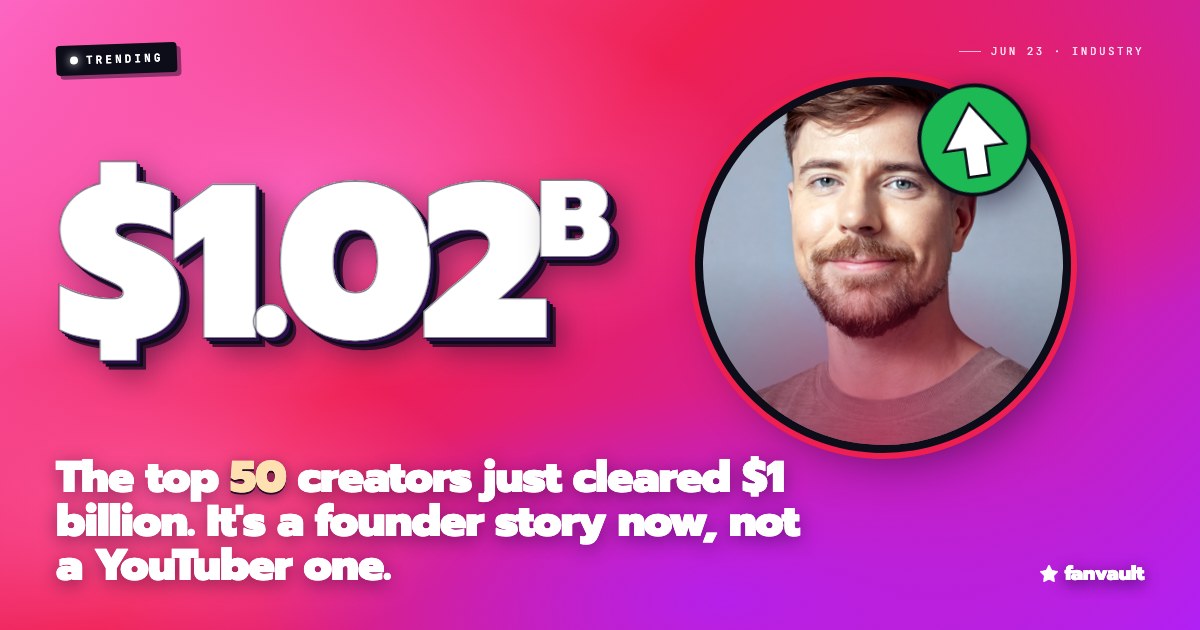
Forbes' Top 50 Creators list just crossed $1.02 billion in combined earnings for the first time, up 20% from last year and 80% from 2022. MrBeast alone booked $300 million of it. But the real story isn't the milestone. It's that the people at the top of this list stopped being video makers years ago, and Forbes finally started counting the businesses they built instead.
⚡ Key Takeaways
- Forbes' 2026 Top 50 Creators list crossed $1.02 billion in combined earnings, up 20% from 2025 and 80% from the debut 2022 list.
- MrBeast pulled in $300M by himself, roughly 29% of the entire list, driven by Feastables, Beast Games, and Viewstats, not YouTube ad share.
- Dhar Mann ($65M) is running a 200-person studio; Steven Bartlett ($52M) sits atop a $425M holding company called Steven.com.
- Newcomers like Ms. Rachel ($26M), Alix Earle ($12M), and Ashton Hall ($10M) prove the list isn't a single archetype anymore.
- Goldman Sachs projects the total creator-economy TAM will hit $480 billion by 2027; the top-50 milestone is one thin slice.
- The Fanvault read: the number is a floor, not a ceiling, for what direct monetization looks like when creators stop paying middle-layer rent.
What actually happened?
Forbes dropped its fifth annual Top Creators list on June 23, timed to Cannes Lions, and the top-line hit a number the creator economy has been circling for years. The 50 highest earners combined for $1.02 billion, a 20% jump from 2025's $853 million and an 80% surge from the $570 million total on the debut 2022 list. Aggregate audience climbed too, up 7% to 3.6 billion followers across platforms.
Forbes and its knowledge partner Influential score creators on three axes (gross earnings, entrepreneurship on a 1-to-4 scale, and clout measured as follower plus engagement ratio), estimated across the March 2025 to March 2026 window. Crucially, Forbes counts revenue from every channel a creator touches. That includes ad share, sponsorships, owned products, IP licensing, streaming shows, and books, not just what a platform pays out. That is why the ranking now reads less like a Top YouTubers list and more like a Top Media Founders list.
| Rank | Creator | Est. earnings | What's actually making the money |
|---|---|---|---|
| 1 | MrBeast | $300M | Feastables, Lunchly, Beast Games (Amazon), Viewstats |
| 2 | Dhar Mann | $65M | 200-person studio, Fox microdrama deal, Samsung TV channel |
| 3 | Steven Bartlett | $52M | Steven.com holdco ($425M), Diary of a CEO, investment arm |
| 4 | Markiplier | $38M | YouTube, film production |
| 5 | Rhett and Link | $37M | Mythical Entertainment franchise |
Why does this matter for creators?
MrBeast's $300 million is not an AdSense number. It's a Feastables and Beast Games and Viewstats number, propped up by a snack line that per Boardroom's reporting did $251 million in revenue in 2024 with internal projections of $520 million in 2025. Dhar Mann's $65 million #2 finish is a 200-person studio pumping out roughly 300 million weekly views and a Fox deal for 40 microdramas, per Tubefilter. Steven Bartlett's $52 million is now attached to a $425 million holding company called Steven.com.
Read down the top ten and the pattern gets impossible to ignore. Markiplier at $38M, Rhett and Link at $37M, Codie Sanchez at $31M off a business-education franchise, all operating like founders as much as creators. Even the newcomers, $26M Ms. Rachel or $10M wellness creator Ashton Hall, are running production shops, not Patreon pages. The list stopped rewarding audience size in favor of what a creator does with it.
"Creators continue to harness their communities, creativity and a bold entrepreneurial spirit to steer the direction of media, entertainment and advertising."
Steven Bertoni, Assistant Managing Editor, Forbes
Where does this go from here?
Goldman Sachs projects the total creator-economy TAM will hit $480 billion by 2027, roughly doubling from $250 billion today. The Forbes $1B milestone is one narrow slice of that (the top 50), but it is the slice everyone below is trying to model themselves after. The through-line: platform revenue is a floor now, not a ceiling. Every list-topper in 2026 was earning most of their money off-platform, in businesses that use the audience as a distribution channel, not a paycheck.
The list is also diversifying past the traditional YouTuber archetype. New entrants this cycle include chef Tini Younger, Love Island USA's Leah Kateb (now Chief Creative Officer at Skylar Perfume), and TikTok food creator Jordan Howlett at $12.4M, per Complex. Alix Earle cleared $12M on lifestyle content, and a wave of educators now sit inside deals with Netflix and Amazon Prime. The next $1B in this list is going to come from creators who never posted a vlog in their lives.
What does Fanvault think?
The Forbes number is not a ceiling, it's a floor for what direct monetization can look like when a creator stops splitting revenue with the middle. That is exactly the setup Fanvault was built for. Fanvault takes an 8% platform fee and creators keep 92%, with a single account that runs tiered memberships, paywalled posts, paid DMs, tips, wishlists, and authenticated memorabilia auctions. Compare that against Fanvue at 15%, Passes at 10% plus $0.30, and Fanfix at roughly 20%, and it's clear why creator-owned storefronts are where the next hundred thousand founders on this list are going to build.
Only 50 creators cleared the top of Forbes' ranking. The gap between that and Goldman's $480B projection is where the actual work happens, and the platform you build on is going to matter more than the platform you post on.
Frequently Asked Questions
How much did the top 50 creators earn in 2026, and how does that compare to previous years?
Forbes' 2026 Top Creators list, released June 23 at the Cannes Lions Festival, put the combined earnings of the 50 highest-paid creators at
Aggregate audience across the list rose 7% year over year to 3.6 billion followers across YouTube, Instagram, TikTok, Twitch, X, and Snap. Estimates cover the March 2025 to March 2026 window and score creators on gross earnings, entrepreneurship (1-to-4), and clout (follower plus engagement ratio).
How is MrBeast pulling in $300 million a year?
The
Feastables alone did roughly $251 million in 2024 revenue per Boardroom's reporting, with internal projections of $520 million in 2025 and $780 million in 2026. The YouTube channels still turn over 5 billion views a year, but they function as the top of a funnel that ends in owned products and IP.
What does the $1B milestone mean for creators who aren't in the top 50?
Two things. First, the earnings ceiling in this industry is now bounded by how many businesses a creator can operate, not how many views a video pulls. Every top-10 name on Forbes' 2026 list is running a studio, a product line, a holdco, or all three.
Second, the platforms that take the biggest cut of your revenue are the ones you should worry about most, because at scale a fee difference of 5% to 10% is millions of dollars. Creators building today are watching the top of the list and realizing the answer is a storefront they own, not a payout they wait for.
Which platforms charge creators the lowest fees?
Fanvault takes an
Fanvault also bundles tiered memberships, paywalled posts, paid DMs, tips, wishlists, and authenticated memorabilia auctions in the same account, so creators can turn a fanbase into recurring revenue without stitching together five separate tools.