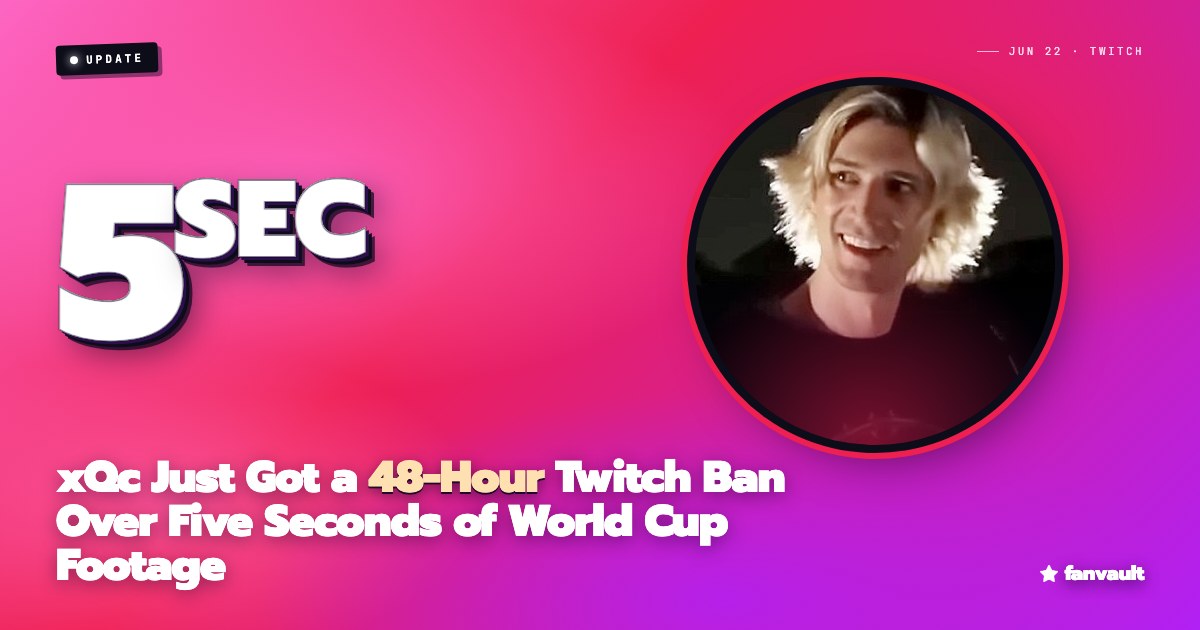
Felix 'xQc' Lengyel just lost his Twitch channel for 48 hours over five seconds of footage he didn't even film. On June 22, the streamer pulled up a clip of Kylian Mbappé's France-vs-Iraq World Cup goal that was already circulating on X. Within moments his channel went dark, a DMCA strike landed, and his second active copyright strike was on the books. The biggest variety streamer on the platform got nuked over someone else's repost.
⚡ Key Takeaways
- Felix 'xQc' Lengyel got hit with a 48-hour Twitch ban on June 22, 2026 after a five-second Mbappé World Cup clip played on stream.
- The DMCA notice referenced 'FIFA World Cup 2026 Copyright Protected Match Footage' and was filed by a claimant named Jonathan Schmitz.
- Twitch reversed the suspension in under three hours, but the copyright strike stayed. It's xQc's sixth lifetime Twitch ban and his second active strike.
- xQc kept streaming through the entire thing on Kick, where his 2023 two-year, $100M non-exclusive deal lets him multistream.
- If the biggest variety streamer on Twitch can be knocked offline by a five-second X clip he didn't even host, smaller creators building sports-reaction pipelines have to assume the risk is total.
- The durable creator-economy lane in live sports is owned IP and direct fan monetization, not borrowed footage and the hope that rights holders don't notice.
What actually happened?
The takedown notice was filed under 'FIFA World Cup 2026 Copyright Protected Match Footage' by a claimant named Jonathan Schmitz, per the email Primetimer reviewed. xQc was multistreaming on Kick at the same time, so when Twitch killed his stream his real-time reaction landed live on a platform Twitch couldn't touch. He pulled up the email, read it out to chat, and locked onto the offending duration in disbelief. Deltia's Gaming captured the moment the channel briefly displayed Twitch's "content removed at the request of the copyright holder" splash.
Twitch reversed the suspension in under three hours, but the strike stayed on record. This is his sixth lifetime Twitch ban according to StreamerBans, and his second active copyright strike per Sportskeeda. The France-vs-Iraq fixture had been dragged into a long live broadcast by severe weather delays, so the match was technically still in progress when the clip ran. That's exactly the window FIFA's rights holders police hardest, and xQc didn't film it, upload it, or even host the original X post.
Why does this matter for creators?
xQc signed a two-year non-exclusive $100M Kick deal in 2023 (roughly $70M base plus $30M in performance incentives, per PC Gamer), and the platforms still don't care. The DMCA framework treats five seconds the same as five minutes. The strike doesn't ask whether you commented over the footage, whether it was already trending on X, or whether you even pressed play yourself. If the biggest variety streamer on Twitch can be knocked offline mid-stream, smaller creators trying to build a sports-reaction pipeline cannot afford the bet.
The deeper problem is asymmetric enforcement. A creator who never touches sports content can run a clean channel for a decade, while one mid-match reaction can torch a year of sponsor commitments overnight. The platforms aren't going to fight FIFA on this in 2026, and they won't fight the NFL or the Premier League either. The math for any creator whose lane brushes up against live sports just changed.
"Five seconds. That's crazy."
Felix 'xQc' Lengyel, on his live Kick stream, via Gamer.org
What's the bigger picture?
Co-streaming has matured into a real revenue lane for esports watch-alongs and creator boxing, but traditional rights holders like FIFA still treat any unauthorized rebroadcast as automatic takedown bait. A five-second X clip a streamer didn't even host isn't the edge case anymore, it's the new floor. Reaction-economy creators have been operating on the assumption that platforms let small infractions slide as long as watch hours stay good. June 22 just nuked that assumption from the top down.
This isn't a Twitch-only problem either. YouTube's Content ID has been firing on creator-uploaded analysis videos for years, and Kick won't be immune the moment FIFA decides to file claims there too. The reactor's playbook of grabbing a viral X clip and hitting "go live" was never a strategy, it was a loophole. June 22 made it clear how quickly that loophole closes when a single rights holder decides to file.
The deeper signal is that the next phase of creator-economy growth in live sports won't come from reaction streams. It will come from creators and platforms that build owned, licensed, or original IP that can't be DMCA'd by a rights holder in another time zone. Athlete-driven and creator-driven storefronts, paywalled posts, and native commentary on owned footage are the durable lanes. The reaction economy that grew up on Twitch in the 2010s has a structural cap, and 2026 keeps finding new ways to enforce it.
What does Fanvault think?
The reaction economy was built on borrowed IP, and that's the bug, not the feature. Fanvault's bet, an 8% platform fee, paywalled posts, paid DMs, and an authenticated memorabilia storefront sitting inside every creator profile, is that durable creator revenue comes from owned content and direct fan monetization, not from praying a rights holder doesn't notice the five-second clip. When a $100M streamer can lose his channel over footage he didn't even host, the lesson for everyone else is simple: build a business on what you actually own. The platform that runs itself only works when the IP is yours.
xQc walked it off because he has Kick. Most creators don't.
Frequently Asked Questions
Why was xQc banned from Twitch?
Twitch hit xQc with a 48-hour suspension on June 22, 2026 after a roughly five-second clip of Kylian Mbappé's France-vs-Iraq World Cup goal played on his stream. The takedown notice was filed under 'FIFA World Cup 2026 Copyright Protected Match Footage' by a claimant named Jonathan Schmitz, per Primetimer. The strike landed on the channel even after Twitch reversed the suspension itself within three hours.
How long was xQc actually banned for?
The original suspension was set at
Why is showing five seconds of footage enough to trigger a copyright strike?
Under the DMCA framework, any unauthorized rebroadcast of copyrighted footage can be removed at the rights holder's request, and there is no 'small clip' carve-out for live sports. FIFA's broadcasting deals for the 2026 World Cup are among the most aggressively enforced rights in entertainment, and an in-progress match is the exact window claimants police hardest. A clip that travels across X within minutes of a goal can still trigger a strike when it lands on a livestream, even when the streamer never downloaded or hosted the original.
Wait, xQc was still streaming on Kick during the Twitch ban?
Yes. His 2023 Kick deal is non-exclusive and explicitly allows multistreaming, which is why his reaction to the Twitch ban landed in real time on a platform Twitch couldn't touch. PC Gamer reported the original Kick contract at roughly
What does this mean for smaller streamers who want to react to sports content?
The risk bar just got significantly lower. If a creator with a $100M Kick deal can be taken off Twitch for five seconds of footage he didn't even host, a mid-size streamer reacting to an NFL or Premier League clip is operating on borrowed time. The durable lane is content the creator actually owns: original commentary on licensed footage, athlete partnerships, owned IP, and direct monetization. The reaction-stream playbook of grabbing a viral X clip and hitting 'go live' carries more risk than reward in 2026.