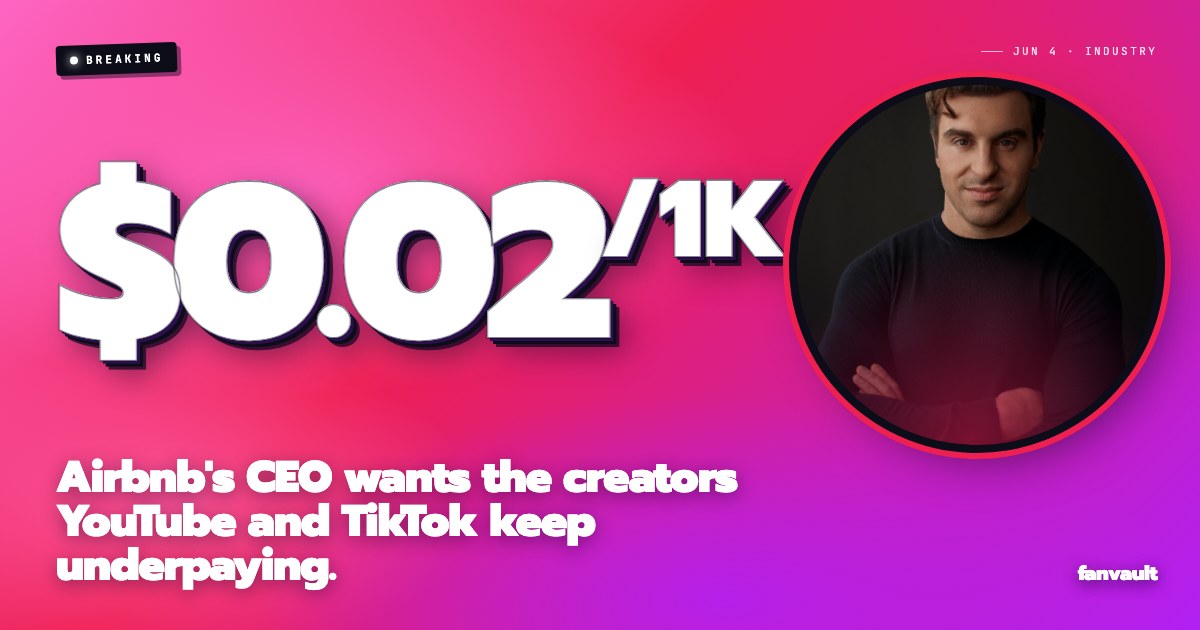
Airbnb CEO Brian Chesky just said the quiet part loud. The economics of posting on YouTube, TikTok, and Instagram are "starting to go down," and his $100B+ company is recruiting hundreds of creators to host paid experiences instead. Tubefilter surfaced his Skift roundtable quotes on June 4, and they read like a permission slip for every creator to stop pretending the platform-pay model is sustainable.
⚡ Key Takeaways
- Airbnb CEO Brian Chesky publicly told a Skift roundtable that posting on YouTube, TikTok, and Instagram is 'waning' and 'the economics are starting to go down.'
- Airbnb is recruiting hundreds of creators to host paid Experiences at a 20% platform fee, betting fans book in their home city to spend time with the creator.
- TikTok's Creator Fund pays $0.02 to $0.04 per 1,000 views, YouTube Shorts pays $0.06 to $0.10, Instagram Reels bonuses sit between $0.01 and $0.09. The per-view economy is over.
- Only 34% of creators name platform ads as their primary income; brand partnerships now drive ~70% of total creator earnings, per Statista and Archive.
- Goldman Sachs projects the creator economy hits $480B by 2027. Almost none of that growth is going back to ad revenue, it's flowing to commerce, storefronts, and direct-to-fan products.
- Fanvault's 8% take and 92% creator share is the bet that follows logically from the Chesky thesis: own the relationship, not the feed.
What actually happened?
At Airbnb's annual summer release event in San Francisco the week of May 21, Chesky sat for a media roundtable with Skift and confirmed Airbnb is signing up hundreds of social-media creators to host paid Experiences. The platform fee for hosts on Experiences is 20%, with Services charging 15% and a $6 minimum, per Smoobu. Then he reframed the pitch: posting on the big social platforms is "waning a little bit," and the money is fading.
The receipts back him up. YouTube long-form CPMs sit between $1.50 and $6 per 1,000 views in 2026, per Mediacube, and YouTube Shorts pays $0.06 to $0.10 per 1,000 views. The viral-video lottery pays better in vibes than dollars.
TikTok's Creator Fund pays roughly $0.02 to $0.04 per 1,000 views, per InfluenceFlow. Instagram's invite-only Reels bonuses run $0.01 to $0.09 per 1,000 plays, according to Metricool. The aggregate signal: per-view ad revenue is a rounding error for almost everyone outside the top 1% of accounts.
Why does this matter for creators?
Because the CEO of a public company with $2.678B in Q1 2026 revenue (up 18% year over year) is now publicly arguing that the three platforms that defined the creator economy don't pay anymore, per Airbnb's own newsroom. When a trillion-dollar-adjacent operator with $1.7B in quarterly free cash flow says the model is breaking, it's not Substack discourse, it's strategy. He's recruiting based on it.
The data lined up months ago. Only 34% of creators say platform ad revenue is their primary income, per a Statista creator-economy survey cited by Epidemic Sound. Brand partnerships now account for roughly 70% of total creator income, per Archive. The feed isn't the bank anymore, it's the funnel.
"The posting is waning a little bit. The economics are starting to go down."
Brian Chesky, CEO and Co-founder, Airbnb (speaking at a Skift media roundtable, San Francisco)
What's the bigger picture?
Goldman Sachs projects the creator economy will hit $480B by 2027, per Influencers Time. None of that growth is going back to per-view ad payouts. It's going to commerce: storefronts, paid communities, IRL events, memorabilia, paid DMs, and a stack of products that monetize attention directly. Airbnb is making the most expensive product-market-fit bet on this thesis a public company has made yet, betting that fans will pay to spend time with the creator in their own city, not just to watch their videos.
There's a catch. Airbnb's 20% take is steep next to direct-to-fan tools, and the creator-experiences pilot is not yet a formal fourth category alongside landmarks, food, and events, per Hospitality.today. Strong early conversion is real. So is the platform tax.
Creators stacking income streams in 2026 should treat Airbnb as one channel, not the channel. The ones who learned this lesson on YouTube are not going to learn it twice on Experiences.
What does Fanvault think?
Chesky just ratified what Fanvault has been built around since 2025: the per-view ad model is a declining asset, and the creators who win are the ones who own the relationship with the fan. Fanvault charges an 8% platform fee, creators keep 92%, and the storefront covers tiered subscriptions, paywalled posts, paid DMs, tips, wishlists, and authenticated memorabilia auctions in one account. A Telegram and in-app automation layer handles listing items, scheduling content, and triaging fan DMs through a chat interface, so creators aren't reinventing the back office every Sunday. When a CEO with Chesky's footprint says the social-platform model is fading, the creators who win are the ones who already moved their economics off the feed and onto a stack they actually own.
The CEO of Airbnb just gave creators a hall pass to leave the feed. The question isn't whether to take it. It's where to land.
Frequently Asked Questions
What did Brian Chesky actually say about YouTube, TikTok, and Instagram?
At Airbnb's annual summer release event in San Francisco in late May 2026, Chesky told a Skift media roundtable that posting on the major social platforms is "waning a little bit" and "the economics are starting to go down." His read is that creators need new income channels, and Airbnb Experiences is positioned to be one of them. Tubefilter surfaced the quotes on June 4 in the context of Airbnb's broader creator-recruiting push.
How much does Airbnb charge creator-hosts for Experiences?
Airbnb Experiences charges hosts a
Are platform-pay rates really that low?
Yes. YouTube long-form CPMs run $1.50 to $6 per 1,000 views in 2026 per Mediacube, and YouTube Shorts pays $0.06 to $0.10 per 1,000 views. TikTok's Creator Fund sits at $0.02 to $0.04 per 1,000 views per InfluenceFlow, and Instagram Reels bonuses pay $0.01 to $0.09 per 1,000 plays per Metricool. Only the top 1% of creators see meaningful revenue from ads alone.
What does this mean for the future of creator income?
The economics are shifting from ad-share to direct commerce. Brand partnerships already drive ~