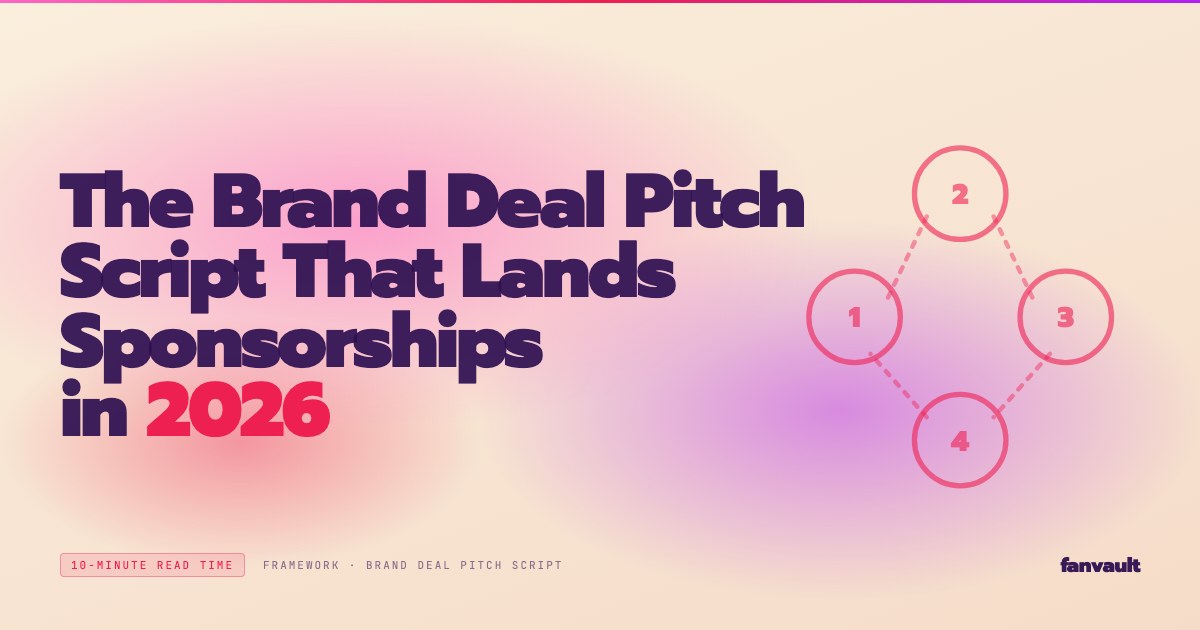
A brand deal pitch script is a four-line outreach template, built on the AIDA framework (Awareness, Interest, Desire, Action), that proposes a specific deliverable, price, and timeline in under 90 words. In 2026, personalized pitches built this way land 35-45% reply rates per Influencer Marketing Hub, versus 6-12% for generic creator outreach. The script works because brands are spending more (U.S. creator marketing hits $21.10 billion in 2026 per eMarketer) but reading less. Here is the structure that gets opened, replied to, and closed.
⚡ Key Takeaways
- Generic creator pitches get 6-12% reply rates; personalized AIDA-structured pitches land 35-45% per Influencer Marketing Hub.
- U.S. creator marketing spend hits $21.10 billion in 2026, with nano- and micro-creators winning 49.9% of that budget (eMarketer).
- The script is four lines: Awareness (specific campaign hook), Interest (your engagement number), Desire (exact deliverable + price + timeline), Action (binary close).
- Cap usage rights at 30-90 days. Perpetual rights for one-time payments are the single largest revenue leak in creator contracts.
- Engagement rate above 3% now outweighs follower count as the primary brand-side rate-setting factor (Stack Influence).
- 63% of creators prefer long-term deals; close every pitch with the ladder, test campaign first, quarterly ambassador retainer second (Aspire).
Why does the old cold-pitch template fail in 2026?
Inbox volume has crushed long-form outreach. The average cold-email reply rate fell to 3.1% in 2026, down from 8.5% in 2019, per Cleanlist. Brand managers now scan the first two sentences and move on.
Generic creator pitches sit in the same 6-12% reply band. The pitches that break through share one behavior: 10-15 minutes of pre-pitch research per brand, then a one-line hook tied to something the brand actually just did. That single change moves reply rates into the 35-45% zone tracked by Influencer Marketing Hub.
What is the four-line AIDA pitch script?
Every line does one job. No throat-clearing, no "I'd love to collaborate," no follower-count brag in line one. The structure:
- Awareness (line 1, the hook): Name the brand's specific recent campaign, product launch, or post. Prove you did the homework.
- Interest (line 2, the proof): One number from your own content that maps to what they sell. Reel CTR, swipe-up rate, or a comparable case study with a measured outcome.
- Desire (line 3, the deliverable): Exact format, exact platform, exact length, exact price, exact timeline. One Reel (15-45s) + 2 Stories, $X, live by [date].
- Action (line 4, the close): A binary ask. "Worth a 15-minute call this week?" or "Yes/no on $X for the deliverable above?"
How specific does the deliverable line need to be?
Very. Brands burned by vague 2023-2024 contracts now demand specificity in the first email. The 2026 default is one short Reel or TikTok (15-45 seconds), one to two Stories, and a usage clause capped at 30-90 days.
Indefinite or perpetual usage rights for one-time payments are the single largest revenue leak in creator deals. Counter-proposing a 30/60/90-day cap is now expected, not pushy. InfluenceFlow's 2026 template testing shows pitches with fixed deliverable + fixed price + 7-day delivery outperform open-ended "let's discuss scope" openers across every category.
What number belongs in the proof line?
Engagement rate, not follower count. Stack Influence reports that engagement rate above 3% now outweighs follower count as the primary brand-side rate-setting factor in 2026.
That shift tracks the money. Nano- and micro-influencers will receive 49.9% of U.S. creator marketing spend in 2026 per eMarketer, because brands report better blended CPM and authenticity scores from smaller, niche-fit accounts. Creator Wizard's 2026 outlook documents the same pattern for mid-size YouTube creators (100K-1M subs) winning a disproportionate share of sponsorship slots versus mega-creators.
What does the script actually look like?
Here is the format, ready to adapt. Subject line: {Brand} x {Your handle}: {Specific campaign reference}.
"Hi {first name}, the {specific campaign} launch last week is exactly the audience I'm reaching: {niche descriptor}. My last Reel on {comparable product} drove a {X}% CTR to {brand or affiliate link} with {Y}K saves. I'd like to propose: one 30-second Reel + 2 Stories, posted in the next 14 days, $X, 60-day usage cap. Worth a 15-minute call Thursday or Friday to lock dates?"
Four lines. Under 90 words. Binary close.
What are typical sponsorship rates by tier?
Anchor your price line to the market, not a guess. Afluencer's 2026 rate data puts the tiers like this:
| Creator tier | Follower range | Typical rate per post |
|---|---|---|
| Nano | 1K-10K | $200-$1,000 |
| Micro | 10K-100K | $1,000-$10,000 |
| Mid-tier | 100K-1M | $10,000-$50,000 |
| Macro | 1M+ | $50,000-$200,000+ |
Engagement rate above 3% pushes you to the top of your tier. Usage rights beyond 90 days, exclusivity windows, and whitelisting for paid amplification each justify a 25-50% premium on the base post rate.
How do you turn the first deal into a long-term ambassador retainer?
Close every script with the ladder, not the post. Aspire's 2026 predictions report shows 63% of creators prefer long-term campaigns over any other collaboration type, and brand-ambassador programs delivered the highest ROI for brands. Nearly three-quarters of marketers plan to increase influencer budgets in 2026.
The ladder line goes at the end of line 4: "If the first Reel hits a {X}% CTR benchmark, I'd love to propose a quarterly retainer for 3 Reels + 6 Stories at $Y/month." Product-seeding gifts now account for 31% of campaigns on Aspire, up from 20% the year before, so a seeded sample is an acceptable on-ramp when a brand isn't ready to pay on the first touch. Creators monetizing across multiple revenue streams (subscriptions, drops, paid DMs, sponsored content) build the most stable income, which is exactly why Fanvault's 8% storefront sits alongside the brand-deal channel as the recurring layer.
When should you not send this script?
Skip the pitch if your last 9 posts don't include something that resembles what the brand sells. Skip it if your engagement rate is under 1.5% for your tier. Skip it if you can't quote a real number in line 2 yet, build the case study first by reviewing a similar product organically.
And skip the long version. Anything over 90 words gets skimmed. Anything generic gets deleted.
Frequently Asked Questions
How long should a brand pitch email actually be in 2026?
Under 90 words. Four lines, one job each: hook, proof, deliverable, close. The reply-rate data from Cleanlist and Influencer Marketing Hub both point the same direction: inboxes are flooded, brand managers scan the first two sentences, and anything longer gets archived. Save the deck and the case-study walkthrough for the 15-minute call your pitch is asking for.
What engagement rate do I need before pitching brands?
Aim for
What usage rights should I agree to for a one-time sponsored post?
Default to a
Should I send a PDF media kit with the pitch?
No. Link to a live page or interactive dashboard instead. The 2026 expectation, documented by Stack Influence and corroborated across the Influencer Marketing Hub expert panel, is that static PDFs with six-month-old stats read as a negative signal. A simple link to a one-page site with current engagement rate, top three case studies (each with a measured outcome), and audience demographics outperforms any deck.
How do I turn a one-off post into a long-term ambassador deal?
Build the ladder into line 4 of every pitch. Aspire's 2026 data shows