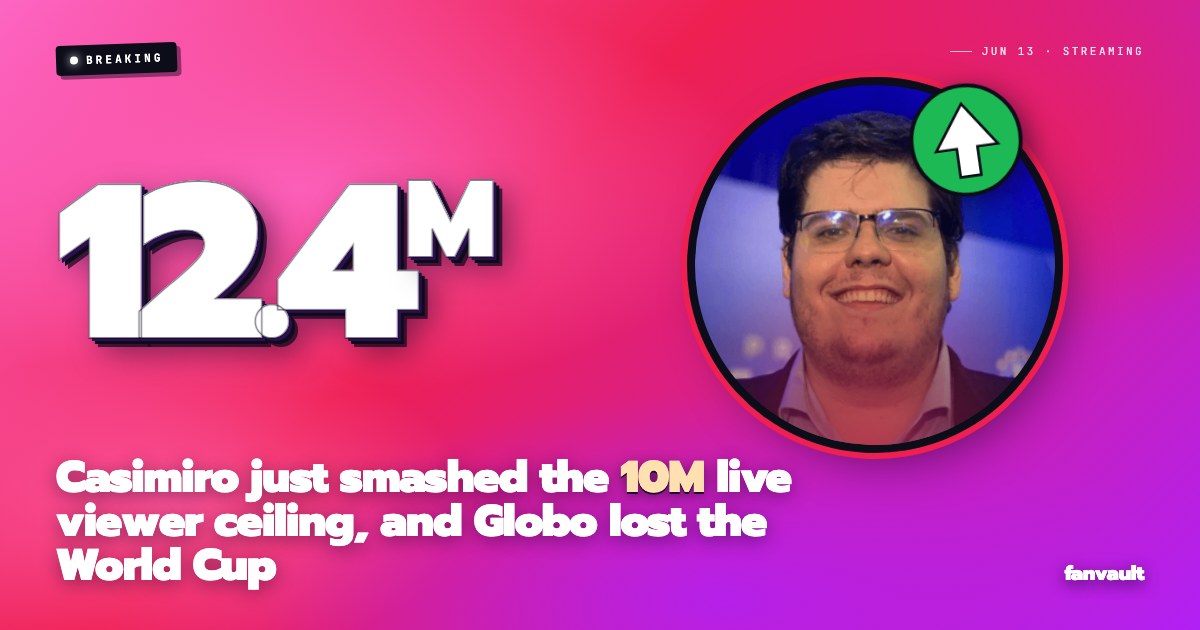
Casimiro Miguel just did what no individual streamer has ever done. On June 13, his channel CazéTV peaked at 12,399,472 concurrent viewers during Brazil's World Cup opener against Morocco, becoming the first non-Chinese streamer-led channel to crack 10 million live. He also dragged YouTube past 20 million concurrent viewers, a platform record. The home of Brazilian football is now a guy who started reacting to games on Twitch.
⚡ Key Takeaways
- CazéTV peaked at 12,399,472 concurrent viewers during Brazil vs Morocco on June 13, smashing the prior individual-streamer record of 9.33M by 33%.
- YouTube hit 20,202,476 total concurrents in the same window, the first livestream platform to ever clear the 20M barrier.
- CazéTV is streaming all 104 matches of the 2026 World Cup free, in 4K, no auth wall. Globo, the legacy incumbent, is airing 55.
- Casimiro started on Twitch reacting to football matches in 2020, scaled to 22 World Cup matches in 2022, and in 2026 he owns the entire tournament.
- Every league, label, and rights holder watching is now doing the math on creator-channel bids vs network bids.
- Legacy distribution is not the moat anymore. The audience relationship is.
What actually happened?
CazéTV's exact peak was 12,399,472 PV during Brazil vs Morocco, per Streams Charts. The previous ceiling for any individual streamer channel was 9.33M, set by Spanish streamer Ibai Llanos during La Velada del Año V. CazéTV blew past that mark by 33% on day three of his World Cup coverage.
YouTube broke too. The platform hit 20,202,476 total concurrent viewers during the match, becoming the first livestream platform ever to clear the 20M barrier, per Streams Charts. The previous platform record was 19.6M, set at the ASEAN Championship in early 2025. CazéTV alone accounted for more than 60% of YouTube's global concurrent audience in that window.
Why does this matter for creators?
Because legacy distribution just stopped being a moat. CazéTV is streaming all 104 matches of the 2026 FIFA World Cup, free, in 4K, with no subscription and no cable login, per the Associated Press. Globo, the network that has owned Brazilian football for decades, will air 55. The country's biggest soccer broadcaster, measured by both rights breadth and peak audience, is now a creator-owned channel.
This is not a "creator goes viral" story. This is a creator brand out-aggregating a national broadcaster for the most-watched sporting event on earth, in a country of 215 million people who treat soccer as oxygen. The receipts are 12.4 million concurrent viewers and a free 4K product that beat the cable bundle on user experience. Every league, label, and rights holder watching this is doing math.
"Em 2026 a Copa inteira é com a gente, de graça, no nosso canal." ("In 2026, the entire Cup is with us, for free, on our channel.")
Casimiro Miguel, Founder, CazéTV
What's the bigger picture?
Casimiro didn't sneak in. He scaled up. He blew up on Twitch during the 2020 COVID lockdowns doing football watch-alongs and reaction streams, popularizing the catchphrase "Meteu essa?" along the way. In 2022 he co-launched CazéTV with sports-marketing firm LiveMode and secured FIFA rights to 22 matches at the Qatar World Cup, peaking above 5M concurrents on Brazil games, per Fortune.
That was the proof point FIFA needed. For 2026 he parlayed it into the full tournament, all 104 matches in 4K, free, no auth wall. Brand activations like Casa CazéTV in São Paulo and Rio are expected to pull 100,000+ fans across the tournament, per SportsPro.
The implication for every rights negotiation that follows is hard to overstate. NBA media deals, La Liga, the Olympics, music tours, awards shows. They all now have to seriously weigh a creator-channel bid alongside the network bid, because the audience is already there and the platform is already free. The offer just changed shape.
What does Fanvault think?
This is the receipt creators have been waiting for. Fanvault was built on the premise that the relationship between a creator and an audience is the actual asset, and that legacy gatekeepers (TV networks, 20% platforms, agencies who treat creators as a line item) have been pricing that relationship wrong for a decade. Casimiro just proved it at the largest possible scale, a guy who started reacting to matches in his living room out-distributing Globo for the biggest event on the sports calendar because he was closer to the audience and faster on the platform. The lesson for every creator with an obsessed vertical is concrete: you don't need permission, you need a partner who can negotiate the rights, ship the product, and not skim 20% off the top while doing it.
The home of football in Brazil moved from a TV tower to a YouTube channel run by one guy and a small team. The audience went with it. Every league, label, and league office in the world just got a new comp.
Frequently Asked Questions
Who is Casimiro Miguel and how did CazéTV get the 2026 FIFA World Cup rights?
Casimiro Miguel is a 32-year-old Brazilian sports journalist who became one of the biggest creators in Latin America by streaming football watch-alongs and reaction streams on Twitch during the 2020 COVID lockdowns. His catchphrase 'Meteu essa?' became a cultural phenomenon in Brazil. In 2022, Casimiro co-launched CazéTV with the Brazilian sports-marketing firm LiveMode and secured FIFA rights to
How big is the gap between CazéTV and Globo at this World Cup?
CazéTV is broadcasting all
What does this mean for creators outside Brazil?
It means the playbook of 'specialist creator + specialist rights agency + free distribution on a creator-native platform' just got proven at the largest possible scale. Casimiro paired with LiveMode to negotiate the rights, kept the product free and in 4K, and trusted that the audience was already on YouTube. Expect every major rights holder, from leagues to record labels to awards shows, to take creator-channel bids more seriously in their next negotiation, because the audience has now demonstrably moved.
How does this connect to platforms like Fanvault?
Fanvault is a creator monetization platform that takes
Is YouTube the only platform that benefits from this shift?
Right now, on full-match live distribution, yes. FIFA's digital rights deal added a TikTok hub for highlight clips and partial-match content, but the live-stream rights for full matches are on YouTube. The