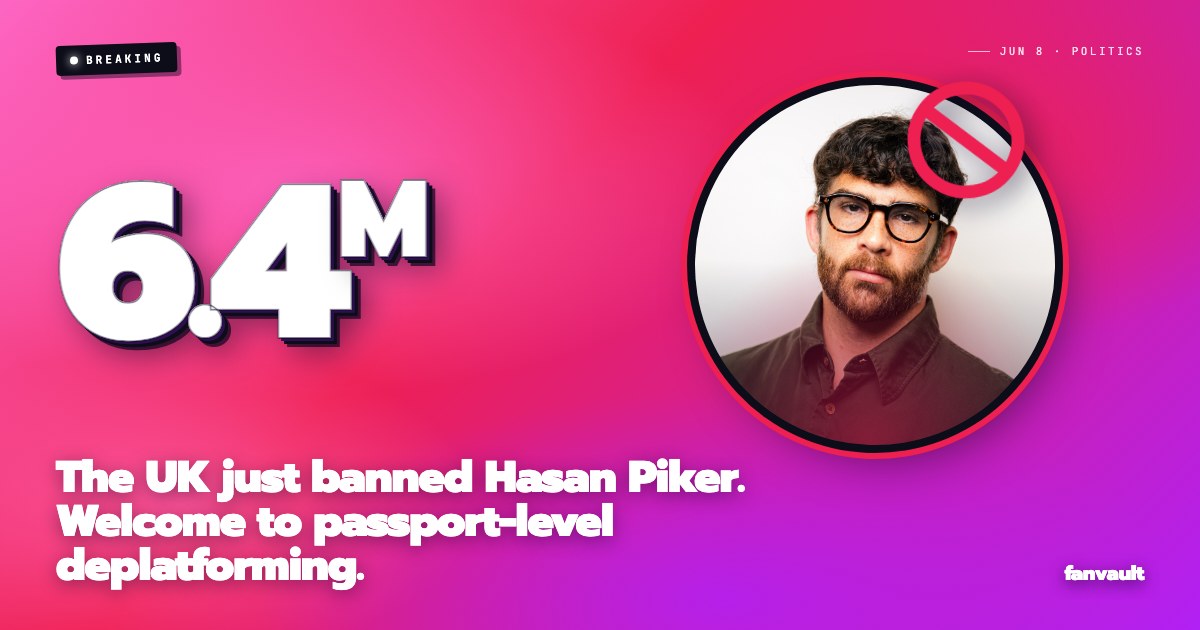
The UK Home Office revoked Hasan Piker's Electronic Travel Authorisation on June 1, hours before the Twitch megastar was set to board a flight for SXSW London and an Oxford Union debate. His uncle, Young Turks founder Cenk Uygur, got the same notice. The official reason: their presence "may not be conducive to the public good." Translation: one of the world's biggest English-language live-event markets just locked out one of the most-watched political streamers on Earth.
⚡ Key Takeaways
- The UK Home Office revoked Hasan Piker's Electronic Travel Authorisation on June 1, hours before his SXSW London and Oxford Union appearances. His uncle Cenk Uygur got the same notice.
- Official reason: their presence "may not be conducive to the public good," with specific reference to Uygur's comments on UK grooming-gang scandals.
- Piker runs the #5 Twitch channel globally with 3.06M followers and roughly 6.4M across all platforms. Daily live broadcasts pull 30K+ concurrent viewers.
- This is Piker's second border-control incident in 13 months. US Customs detained him at Chicago O'Hare for two hours in May 2025.
- The Oxford Union held the debate anyway via livestream. President Arwa Elrayess: "Free speech does not require a visa."
- For political creators, a visa-waiver tier ban is now a tier of career risk above brand-deal blowback. Cross-border touring just got riskier than the contract terms.
What actually happened?
Piker, who runs the 3.06M-follower HasanAbi Twitch channel and currently ranks #5 globally on the platform, learned the news hours before takeoff. He was bound for London for SXSW and then Oxford, where he and Uygur were the June 6 headline event at the Union. According to CNN, the ban hits a creator with roughly 6.4M followers across X, Instagram, and Twitch, and daily live broadcasts pulling more than 30,000 concurrent viewers.
The Home Office's reasoning, per The Times, leaned on Uygur's February 2026 Piers Morgan Uncensored appearance, where he called UK grooming-gang scandals "Israeli propaganda." British Jewish organisations including the Jewish Leadership Council reportedly lobbied to block the visit. Oxford Union President Arwa Elrayess, who is Palestinian, refused to cancel and announced both men would address the chamber via livestream from the United States. The debate happened anyway on June 6.
Why does this matter for creators?
An ETA is the UK's visa-waiver tier, the rubber stamp every American passport holder uses to fly in for a five-day conference or a weekend gig. Until last week, it was a near-automatic approval for anyone with a clean record. Now it's a content-moderation tool. The grounds for revocation are as elastic as four words: "not conducive" to the "public good."
For every streamer, podcaster, and commentator whose business model depends on touring, summit keynotes, university debates, or cross-border collabs, the risk model just changed. Brand-deal blowback used to be the worst government-adjacent career risk on the table. Passport-level deplatforming just joined it. And it's already retroactive.
"The Oxford Union was founded on one principle: that ideas are challenged through debate, not silenced by decree. Free speech does not require a visa."
Arwa Elrayess, President of the Oxford Union, Middle East Eye
Where does this go from here?
This is Piker's second border-control incident in 13 months. In May 2025, US Customs and Border Protection pulled him into secondary at Chicago O'Hare and questioned him for roughly two hours about Hamas, the Houthis, and Hezbollah on his return from France. He's a native-born US citizen. The escalation from secondary screening to outright entry denial, in one of the most lucrative live-event and brand-deal markets in the English-speaking world, is the part to watch.
On stream, Piker called the decision a shift into "a very different timeline" and said he "genuinely did not think this would happen." Other governments are watching.
Expect Germany, France, and Australia to study the UK's playbook and decide whether their own visa-waiver tiers function as permission slips or as leashes. Creators with strong opinions on anything geopolitical (Gaza, Ukraine, China, immigration) are now playing a passport game they didn't know was on the board.
What does Fanvault think?
Here's the uncomfortable read: the more your audience depends on you showing up in person, the more leverage every border agent in 24 countries quietly holds over your career. That's exactly why Fanvault was built around the storefront and the subscription, not the ticketed tour. A creator on Fanvault keeps 92% of revenue on an 8% platform fee, owns their fan list, and can run the entire monetization stack (auctions, paywalled posts, paid DMs, wishlists, authenticated memorabilia drops) from a Telegram chat without ever boarding a plane.
When passports become permission slips, owning your audience stops being a nice-to-have. It's the only career insurance a political creator has left.
The Oxford Union debate happened via livestream. The Twitch checks cleared. The point stands: in 2026, the creators who survive the politics will be the ones whose business model doesn't require a customs stamp.
Frequently Asked Questions
What is an Electronic Travel Authorisation, and why does the UK revocation matter?
The ETA is the UK's visa-waiver tier, the equivalent of a rubber-stamp pre-approval that lets passport holders from
The Piker and Uygur revocations show the Home Office is now treating the ETA layer as a content-moderation lever rather than an administrative formality. Once a country uses its visa-waiver tier as a discretionary speech filter, every other government with a similar tier (the EU's ETIAS, Australia's ETA, Canada's eTA) becomes a venue for the same call.
Why did the UK Home Office single out Piker and Uygur specifically?
Per The Times, the decision leaned heavily on Uygur's February 2026 appearance on Piers Morgan Uncensored, where he called UK grooming-gang scandals "Israeli propaganda." British Jewish organisations including the Jewish Leadership Council and the Community Security Trust had reportedly lobbied to block the visit.
Both men have spent years as some of the most prominent English-language critics of Israel's Gaza campaign. The Home Office's stated worry was that their Oxford Union appearance could "exacerbate antisemitism" in the UK, a framing both creators publicly rejected.
What does this mean for other political streamers and commentators?
It means the worst case for a politically vocal creator is no longer demonetization or platform suspension. It's a country flipping your visa-waiver from green to red days before a paid appearance, with no warning and no appeal that runs faster than the missed flight.
The defensive playbook gets simpler. Build revenue that doesn't require a customs stamp. Own your fan list. Diversify into formats (livestream debates, remote keynotes, paid newsletters, storefront drops) that pay you whether the airport lets you in or not.