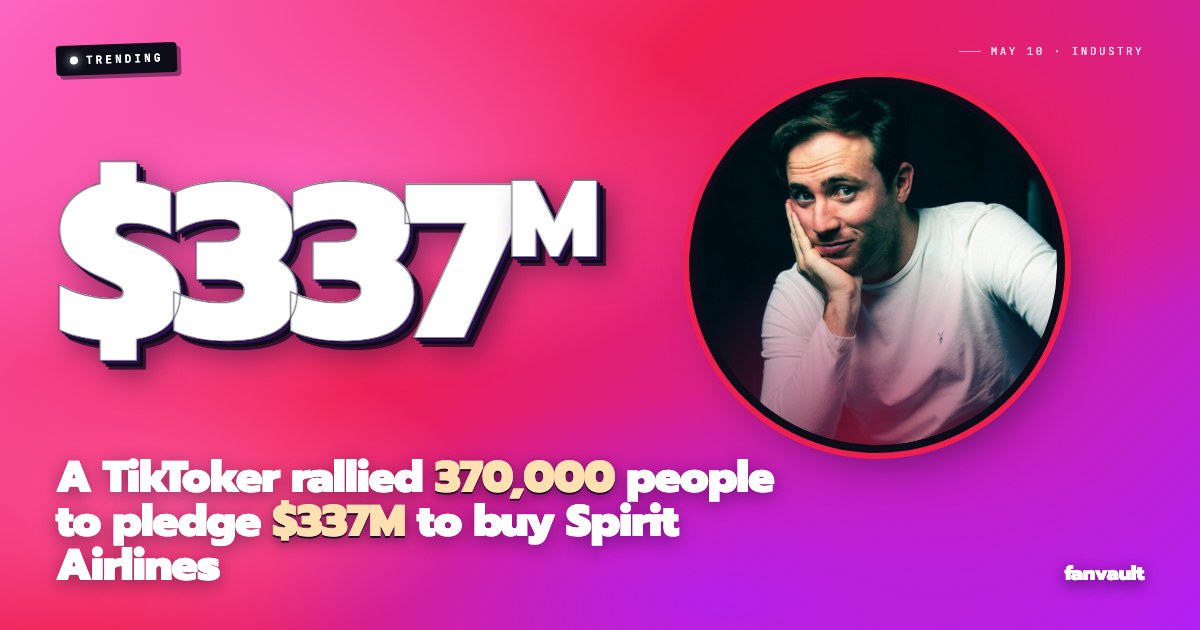
A voice actor with 11,400 TikTok followers opened his phone the morning Spirit Airlines collapsed and said, "I just had a genius idea." Eight days later, Hunter Peterson's pitch to crowdfund a community-owned airline had collected $337M in non-binding pledges from 371,552 people. The campaign crashed two websites, drew a Fortune op-ed arguing he was "fighting the wrong villain," and became the cleanest example yet of what a creator with a clear narrative can mobilize in a weekend.
⚡ Key Takeaways
- A voice actor with 11,400 TikTok followers convinced 371,552 strangers to pledge $337M to buy a dead airline in eight days.
- Spirit shut down May 2 after creditors rejected a $500M Trump-administration bailout, putting 17,000 people out of work.
- Hunter Peterson's first 'I just had a genius idea' TikTok cleared 2.8M views in 24 hours and 7M in a week.
- Both letsbuyspirit.com and the backup site crashed under load. The bottleneck was infrastructure, not interest.
- A four-figure-follower creator with a clear narrative mobilized billion-dollar-scale fundraising intent in a single weekend.
- Pledges are not equity. The 370,000 strangers who clicked the button still need a place to actually become owners.
What actually happened?
Spirit Airlines shut down on May 2, the first major U.S. carrier to fold in 25 years, after creditors rejected a $500 million Trump-administration cash infusion, per CNN Business. Roughly 17,000 employees and contractors lost their jobs over a single weekend. Hours later, Peterson, a voice actor best known for playing Lord Gnaeus in Honkai: Star Rail, opened TikTok and pitched the back-of-the-envelope math. Take 250 million U.S. adults, get 20% to pledge the price of an average Spirit fare, and the public could buy the airline outright.
The video cleared 2.8M views in 24 hours per Rolling Stone, and crossed 7M within a week. Peterson stood up letsbuyspirit.com, then a backup at letsbuyspiritair.com after the first one crashed under load. By Sunday the audited counter showed 36,605 "founding patrons" pledging $22.8M, an average of $623 each, per Business Insider.
By Monday morning the count was $88M and 125,000 patrons. By midweek, $214M, against a stated target of $1.75 billion. The structure borrowed from the Green Bay Packers: one verified member, one vote, profit shares proportional to the pledge. Peterson called it "Spirit 2.0," set the minimum pledge at $45, and kept posting through it.
Why does this matter for creators?
Peterson had 11,400 TikTok followers when this started. He is not an A-list influencer. He is a working voice actor whose previous viral moment was filming himself flying Spirit for 24 straight hours, which is exactly the kind of small, weird, durable credibility that the algorithm now rewards over raw follower count.
The asymmetry is the entire story. A creator with a four-figure audience pointed $1.75B worth of fundraising intent at the open internet in eight days, and the only thing slowing him down was his own server stack. The bottleneck in 2026 is not reach. It is infrastructure.
Think about it from Peterson's side. He went from 11,400 followers to being the face of a hypothetical billion-dollar airline in 72 hours. His DMs, his comments, his email, none of it was built to handle 370,000 strangers asking how to pledge, where to send a check, whether they could buy stock yet. That is not a content problem; it is a payments and operations problem, and most creator platforms are not designed to solve it.
"This started as a joke and this is rapidly going out of control in the best possible way."
Hunter Peterson, voice actor, follow-up TikTok after pledges crossed eight figures
Where does this go from here?
The skeptics are right about the mechanics. Pledges are not equity. TechCrunch pointed out that converting 370,000 expressions of interest into FAA-compliant ownership, route slots, labor contracts, and a working balance sheet is the actual work, and that work has not started.
Fortune's editorial board argued the campaign is aimed at the wrong target, that the real villain is the private-equity consolidation that gutted ultra-low-cost carriers, not Spirit itself. They might be right. It almost does not matter. The campaign already proved the underlying mechanic, which is that audiences will move money toward a creator they trust faster than any platform can build the rails to receive it.
What does Fanvault think?
TikTok solved the reach problem years ago. What Peterson needed in the 72 hours after his video popped was a payments stack that did not crash, a conversational fan-management layer so he was not personally answering 370,000 replies, and a storefront where he could have shipped signed Spirit memorabilia to founding patrons while the moment was hot. That stack, automation plus authenticated drops plus an integrated storefront at 8%, is exactly the bet Fanvault is making. Lightning strikes faster than ever in 2026, and the question is whether the creator it hits has anywhere to plug it in.
Peterson did not need more followers. He needed plumbing. The next creator who pulls this off will need it the same day.
Frequently Asked Questions
Did anyone actually send money to buy Spirit Airlines?
No. The
Who is Hunter Peterson?
Peterson is a working voice actor best known for playing Lord Gnaeus in Honkai: Star Rail, Cyrus Albright in Octopath Traveler 0, and AGNI in Smite 2. Before this campaign he had about
Can the public actually buy an airline this way?
The closest precedent is the Green Bay Packers, which operate as a community-owned NFL team, but they were grandfathered in under rules that no longer exist. An FAA-regulated U.S. carrier needs certificated ownership, labor agreements, route slots, fleet leases, and a working balance sheet. Converting 370,000 non-binding pledges into any of those is the actual work, and Fortune has argued the campaign would be better aimed at the private-equity consolidation that gutted Spirit in the first place.
What does this mean for the creator economy in 2026?
The asymmetry between follower count and economic mobilization is the takeaway. A four-figure creator with a clear narrative pulled in