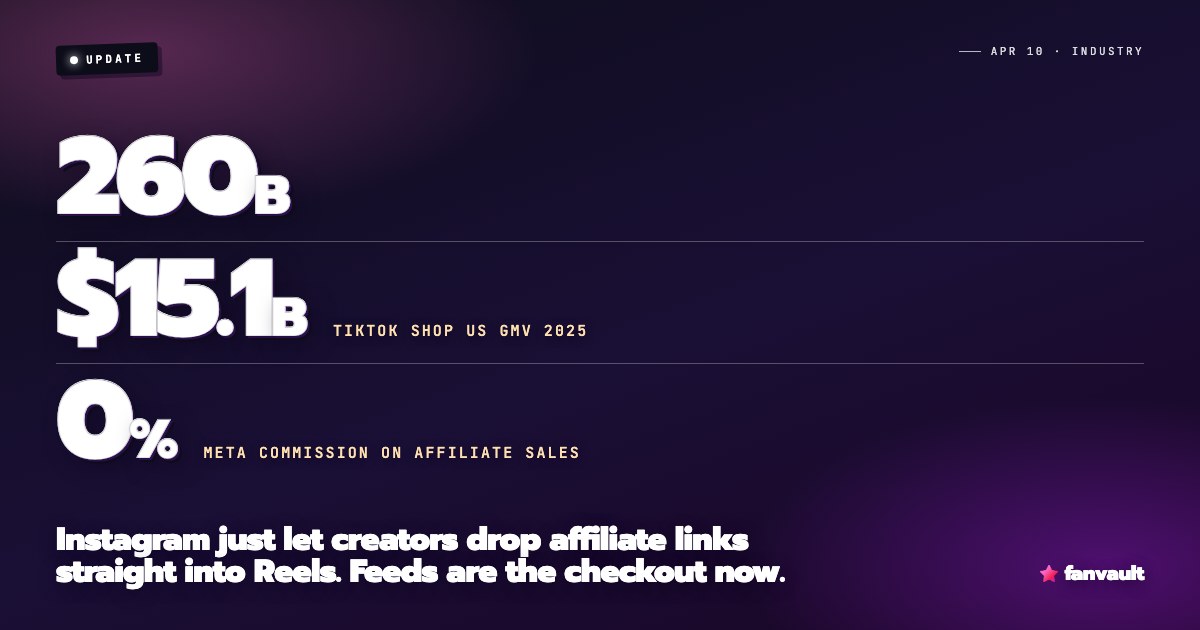
Instagram just handed creators the checkout button. As of late March, eligible creators can drop up to 30 affiliate product links directly into a single Reel, earn a commission on every sale, and skip the link-in-bio middleman entirely. Meta is taking zero platform commission at launch. The pitch is naked: Reels are not a video feed anymore, they are 260 billion daily impressions of shoppable inventory.
⚡ Key Takeaways
- Instagram now lets eligible creators (18+, 1,000+ followers) tag up to 30 affiliate product links inside a single Reel, no bio-link workaround needed.
- Meta is taking zero platform commission on affiliate sales at launch. The full negotiated brand payout flows to the creator.
- Reels bonus paid $0.01 to $0.03 per 1,000 plays. Affiliate commissions in DTC categories run 10 to 20 percent. It is a different job.
- TikTok Shop hit $15.1B US GMV in 2025, up 68 percent. This is Instagram's direct answer to that.
- Instagram Shopping converts at 1.9% versus TikTok Shop's 4.7%. Off-platform checkout is still the ceiling.
- Rollout is live in the US, Brazil, India, Indonesia, and Thailand, expanding to all 22 commerce markets by the end of spring 2026.
What actually happened?
On March 27, Head of Instagram Adam Mosseri announced that Instagram creators can now embed clickable affiliate product tags directly inside Reels, per Engadget. Eligible creators are 18+ with 1,000+ followers, and can tag up to 30 SKUs per Reel using affiliate URLs from Impact, Rakuten, Shopify Collabs, LTK, and ShopMy. The rollout began in five markets: the US, Brazil, India, Indonesia, and Thailand, with Meta committing to hit all 22 of its commerce markets by end of spring 2026.
The launch happened onstage at Shoptalk Spring in Las Vegas, where Meta's Head of Global Business Group Nicola Mendelsohn declared the shift out loud, according to Retail Dive. Meta confirmed to Tubefilter that it is taking zero platform commission on creator affiliate sales at launch. Whatever the brand pays out, the creator keeps.
Why does this matter for creators?
The unit economics change on contact. Meta's Reels bonus program has been paying creators roughly $0.01 to $0.03 per 1,000 plays, and the average sponsored Reel earns just $288, per InfluencerFee's 2026 benchmarks. Industry-standard affiliate commissions in most DTC categories run 10% to 20%. That is not a marginal delta, it is a different job.
A mid-size beauty creator pushing a $60 SKU at a 15% brand payout now earns $9 per sale, cleanly, without Meta clipping the middle. Multiply that by the 260 billion daily Reels plays Meta disclosed on its Q1 2026 earnings call, and the ceiling on product-tagged Reels is unrecognizable from the ceiling on ad-share. Reels already account for about half of all time spent on Instagram globally, per CNBC. The platforms have quietly conceded that ad-share alone cannot retain serious creators, and commerce splits are the retention play.
"For creators, when it comes to highlighting products, this means that the era of link in bio is finally over. We're basically shrinking the distance between discovering and purchase and putting creators right to the center of the journey."
Nicola Mendelsohn, Head of Global Business Group at Meta, speaking at Shoptalk Spring 2026
What's the bigger picture?
This is Instagram's answer to TikTok Shop, which spent 2025 running away with the shoppable-video category. TikTok Shop's US GMV grew 68% to $15.1B in 2025, according to Momentum Works, and global GMV cleared $64.3B, up 94% year over year. TikTok Shop converts at 4.7% while Instagram Shopping sits at 1.9%, per Social Commerce Club. The gap Meta is trying to close is not attention, it is checkout.
There is also a credibility overhang. In February, Meta ran an AI "Shop the Look" test that quietly auto-tagged products in existing creator posts without asking, and fashion creator Julia Berolzheimer publicly torched the feature, per Affiverse. Instagram walked the test back, but the trust damage bled into the affiliate launch weeks later. The new program is opt-in and creator-controlled, but the platform has to re-earn goodwill it burned freely, right as it asks creators to route their commercial identity through it.
What does Fanvault think?
Instagram just validated the thesis that every serious creator needs a storefront, not a link tree, and Fanvault has been building exactly that since day one. The Fanvault stack takes 8% and gives the creator 92%, with paywalled posts, wishlists, tips, paid DMs, and an auction-plus-buy-it-now memorabilia layer all managed through a conversational interface on Telegram or in-app. Meta's move is an affiliate window bolted onto a feed, checkout still lives off-platform, and it does nothing for creators who want to sell signed jerseys, custom drops, or paywalled experiences. Zero commission on affiliate is the floor; owning the entire commercial relationship with your fans is the ceiling.
The era of link in bio ending was always inevitable. The question was never whether creators would sell inside the feed, it was who would take the smallest cut and give them the deepest ownership. Meta just moved to zero on affiliate. The rest of the stack is still up for grabs.
Frequently Asked Questions
Who is eligible to add affiliate links to Reels?
Creators need to be 18+ with at least 1,000 followers and located in a supported market. The rollout began in the US, Brazil, India, Indonesia, and Thailand, and Meta has committed to reach all 22 of its commerce markets by the end of spring 2026, per Engadget.
How much does Meta take from each affiliate sale?
Zero, at launch. Meta confirmed to Tubefilter that it is not clipping any percentage of the affiliate commission on Reels. Whatever the brand negotiates with the creator flows through cleanly.
That could change once Meta has volume data, but today the entire payout belongs to the creator. It is the most creator-favorable commerce deal Meta has ever offered.
How is this different from Linktree or ShopMy?
Link-in-bio tools live on a creator's profile page and require a viewer to leave the Reel, tap into the profile, click the link, and then choose from a menu. Reels affiliate tags live inside the video itself, so a viewer taps once and lands on the product page.
Meta calls the difference "shrinking the distance between discovering and purchase," and that is not marketing spin. The tap count is genuinely lower, and lower tap counts convert better.
Does this beat TikTok Shop?
Not on conversion. TikTok Shop converts at
The creator economics on Instagram are better right now given the zero platform fee, but until Instagram brings checkout in-app, TikTok Shop keeps a structural advantage on GMV.
What is the "Shop the Look" mess, and why does it matter here?
In February 2026, Meta tested an AI feature that auto-tagged products in existing creator posts without asking, per Affiverse. Fashion creator Julia Berolzheimer publicly called it out for linking her feed to "cheap knockoffs and random items from brands I've never heard of, attached to my image, under my name."
Instagram walked the test back, but the affiliate launch weeks later inherited the trust deficit. The new program is opt-in, and creators are watching Meta closely to see whether that "opt-in" promise holds under commercial pressure.
How does Fanvault compare to just running Instagram Reels affiliate?
Reels affiliate is an unbundled window into brand catalogs. Fanvault is the full commercial stack for a creator's own audience: an
The two work together, not against each other. Reels affiliate sells someone else's product. Fanvault sells the creator's own product and their relationship with their fans, on their own terms and with their own checkout.