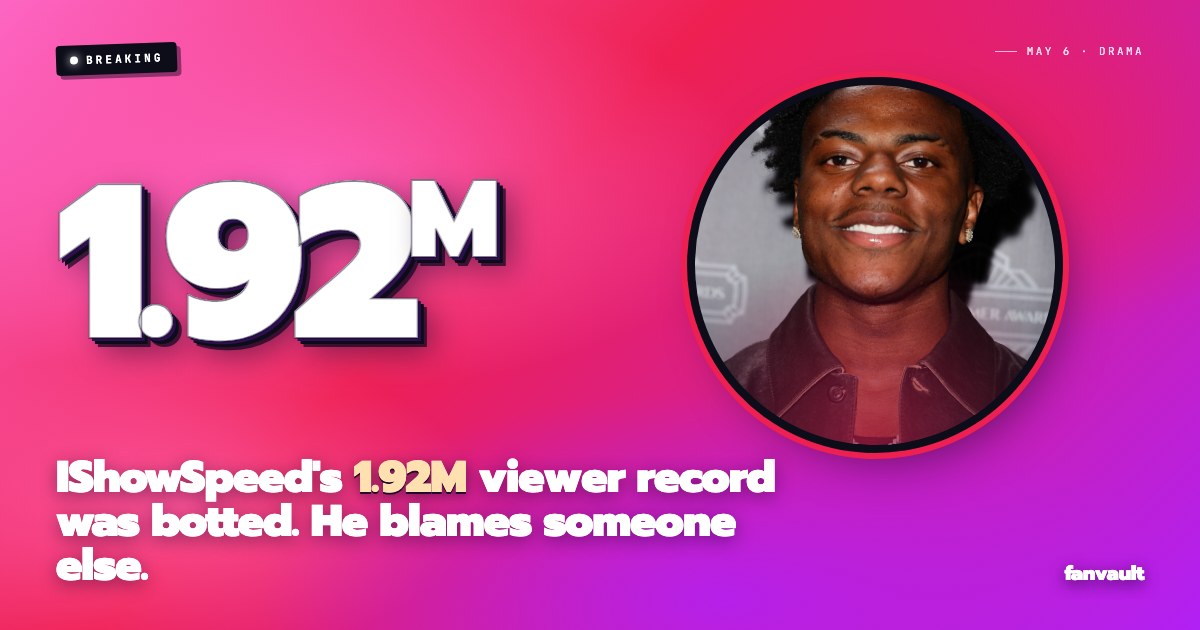
IShowSpeed didn't break his viewership record on May 6. He admits it now. His Dominican Republic stream hit 1.92M concurrent viewers on YouTube, the biggest US streaming peak ever, and the next day Speed conceded the real number was closer to 300K. The rest was bots, and he's blaming someone else.
⚡ Key Takeaways
- IShowSpeed's May 6 Dominican Republic stream hit 1.92M concurrent viewers on YouTube, then he admitted the real peak was around 300K.
- StreamsCharts flagged the giveaway: average viewership up 2,270%, active chatters up just 30.7%.
- Speed says the bots weren't his and named no one; xQc backed him publicly, theorizing a third party did it.
- Twitch CEO Dan Clancy announced a viewbot-cap policy the next day, calibrated against each channel's historical organic traffic.
- Days later, Jynxzi pulled a clean organic 920K peak for a 40-streamer LoL tournament, the largest streamer-led LoL broadcast on record.
- The viewer counter is officially compromised as a sponsorship metric; chat density, sub conversions, watch-time, and real fan dollars are what survive.
What actually happened?
Speed was broadcasting from Santo Domingo with Dominican radio host Santiago "Alofoke" Matías when his YouTube counter went vertical, peaking at 1.92 million concurrent viewers per StreamsCharts. The number would have made him the most-watched US streamer of all time in peak concurrents. Then the receipts fell apart within hours. StreamsCharts flagged the viewership curve as unusually flat, a textbook viewbot signal.
The chat math was the real giveaway. Average viewership spiked 2,270% over Speed's recent baseline. Active chatters only ticked up 30.7%. Bots inflate a counter, they don't say hi in chat.
xQc, watching live, called it "an obvious layer of bots." Speaking from a boat in the Atlantic the next day, Speed conceded everything in a Dexerto-reported address to fans. He named no one specifically. He insisted the bots weren't his.
"We never broke our record. It was a great stream, but we only peaked at around 300K. I talked to the YouTube reps. Somebody botted that stream."
IShowSpeed, addressing fans from a boat in the Atlantic the day after the broadcast
Why does this matter for creators?
Because the viewer counter is now officially compromised, and the entire sponsorship economy is priced off it. Brands cut live-stream deals against peak-viewer screenshots. Agencies pitch creators on "average concurrents." Platforms slap leaderboards on the homepage.
All of it assumes the number is real, and the IShowSpeed case proves it doesn't have to be. His Indonesia tour in 2024 is the perfect control group. That stream pulled an organic 1.04M peak and came with 3.4M new subscribers across two weeks, per Tubefilter. The Dominican Republic stream produced no comparable subscriber bump and no chat surge.
A 1.92M number that converts like a 300K number is, mathematically, a 300K number with extra steps. Sponsors who paid for the bigger figure paid for theater. That bill is going to come due fast, because the ad-buying side reads StreamsCharts too.
Where does this go from here?
Fast, because platforms are already moving. The day after Speed's stream, Twitch CEO Dan Clancy announced a new viewbot policy capping concurrent viewer counts for channels caught inflating, calibrated against historical organic traffic. The timing is not a coincidence. Twitch is publicly admitting what every analytics dashboard already knew.
Days later, Jynxzi pulled an organic 920K peak for a 40-streamer League of Legends tournament, the largest streamer-led LoL broadcast on record. Tubefilter immediately framed it inside the same trust crisis. How do you evaluate a streaming record when half the records keep turning out to be fake? The answer is, you stop looking at the counter and start looking at what fans actually did.
What does Fanvault think?
This is the cleanest case yet for ditching vanity metrics entirely. Fanvault's bet is that the only number that means anything is the number a fan actually paid. The platform takes 8% on real fan transactions (tiered memberships, paywalled posts, paid DMs, tips, wishlists, and an authenticated-memorabilia storefront), while Fanvue charges 15%, Passes 10% plus $0.30, and Fanfix around 20% on the same real revenue.
A creator with 300K real viewers who converts a meaningful slice into paying fans is worth more in actual dollars than a creator with a viral number on a leaderboard. Bots can spike a counter. They can't subscribe. They can't tip, and they can't bid on the signed jersey.
The viewbot era is ending the same way the fake-follower era ended. The metric that survives is the one fans can't fake their way into.
Frequently Asked Questions
Did IShowSpeed actually break a record on May 6, 2026?
No. The displayed
Who actually botted the stream?
Unknown publicly. Speed named no one and insisted he wasn't behind it. xQc theorized that fans or a third party added the bots on Speed's behalf, with fan suspicion pointing toward parties around the local Alofoke broadcast. As of publish, no individual or network has been publicly identified.
Why did StreamsCharts call it viewbotting in the first place?
Two signals. The viewership curve was unusually flat, where real live audiences typically fluctuate. And average viewers spiked
What did Twitch do in response?
On May 7, 2026, the day after Speed's stream, Twitch CEO Dan Clancy announced a new policy capping concurrent viewer counts for channels identified as persistently viewbotting. The cap is calibrated against the channel's own historical organic traffic and applies for a fixed penalty period across all Twitch surfaces.
Is concurrent viewership still a useful creator-economy metric?
Less and less. Sponsors, agencies, and platforms are quietly migrating toward chat density, subscriber deltas, watch-time, and direct conversion data, because those are the numbers viewbots can't replicate. The clearest evidence is that Jynxzi's organic