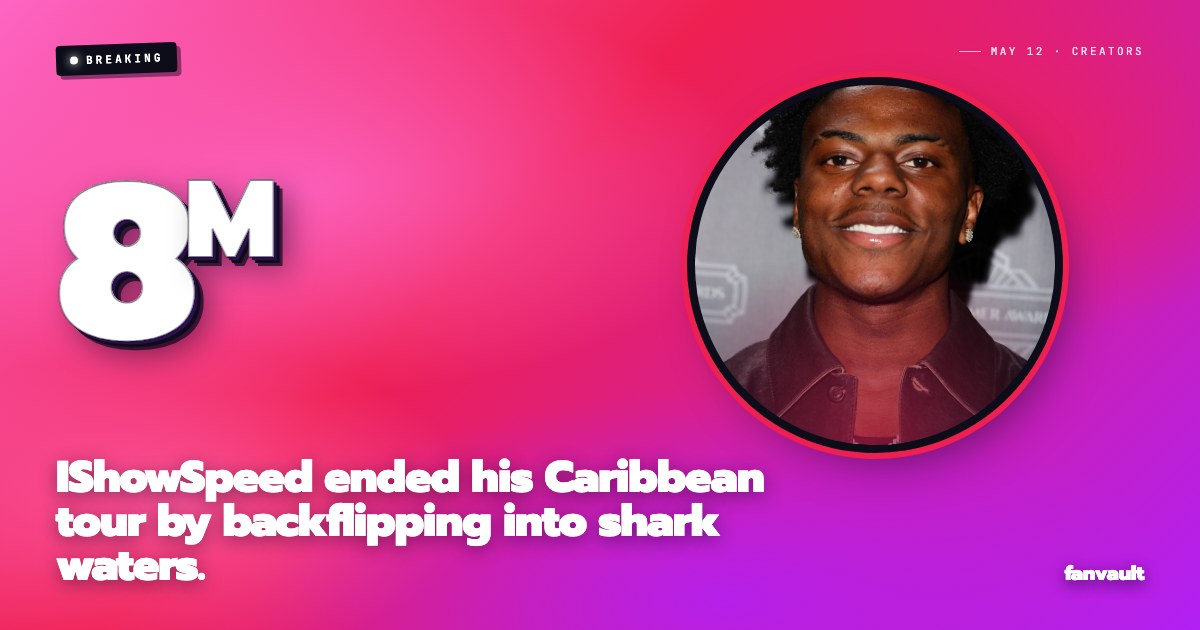
IShowSpeed closed his 15-island Caribbean livestream tour by backflipping off a platform into shark-filled water off the Bahamas, live, on May 10. The 14-day, Expedia-sponsored run pulled in 8M watch hours, added roughly 1.4M followers across platforms, and effectively turned one 21-year-old streamer into a national tourism campaign. It also exposed, in real time, how fragile streaming's headline numbers actually are.
⚡ Key Takeaways
- Speed's 14-day Caribbean tour pulled 8M watch hours, 1.4M new cross-platform followers, and a backflip into shark-filled water as the closer.
- Expedia anchored the trip as a yearlong, multi-phase travel partner. The one-shot creator sponsorship is dying at the top of the market.
- Kingston, Jamaica peaked at 194,805 concurrent viewers and 2.8M total views, with the tourism board arranging the VIP welcome.
- The Dominican Republic's 1.92M YouTube concurrent record was viewbotted, and Speed disowned it. Peak-concurrent metrics are no longer credit-worthy.
- Durable wins for Speed: 700K new YouTube subs, 314K new Twitch follows, and a combined audience past 166M.
- Fanvault's pitch for the creators below the Speed tier: 8% fee, 92% to the creator, one chat interface for storefront, DMs, scheduling, and orders.
What actually happened?
Speed (real name Darren Jason Watkins Jr.) ran the tour from April 26 to May 11, hopscotching from Dominica and Guadeloupe to Jamaica, Puerto Rico, and finally the Bahamas. Tubefilter reported that Expedia named itself his official travel partner on April 29, kicking off a yearlong, multi-phase global deal pitched directly at Gen Z viewers who skip traditional travel advertising. It was Speed's first tour with a long-term anchor sponsor instead of one-shot brand drops, and it followed his earlier 28-day, 20-country Africa run.
Caribbean tourism boards leaned in hard. Jamaica's tourist board arranged a VIP airport welcome, cultural programming, and ground logistics for his May 8 Kingston stream, which hit 2.8M views and peaked at 194,805 concurrent viewers, per the Jamaica Observer. According to Streams Charts, he gained 314,282 Twitch followers across the trip and pushed past 4 million on the platform. The finale, scuba diving with reef sharks, opening a chest of green apples underwater, then backflipping off a platform into the water above them, is the algorithm clip you can't escape this week.
- 15 island destinations in 14 days, end to end
- 8M watch hours across the IRL livestreams
- 700,000 new YouTube subscribers and 314,282 new Twitch follows
- Combined audience past 166M across all platforms
Why does this matter for creators?
This is the cleanest case study yet for livestream tourism as a category. One 21-year-old creator did the work of an entire national marketing department, with a single Kingston broadcast doing what a full year of paid destination advertising would struggle to match. Caribbean governments treated him like a head of state because, functionally, he is a media network with 305.9M in reach over two weeks, per the Jamaica Observer recap.
The bigger shift is structural. Expedia didn't buy a one-off sponsored stream. It locked in a yearlong, multi-phase relationship with measurable destination uplift, then handed the production reins to the creator. That is what top-tier creator deals look like in 2026: persistent, performance-tracked, and pitched at audiences who actively ignore TV spots and search-engine travel ads.
"Organic exposure of this kind tends to build destination awareness in ways that traditional campaigns can't easily match."
Donovan White, Director of Tourism, Jamaica Tourist Board
Where does this go from here?
There's an asterisk worth taking seriously. Speed's May 6 Dominican Republic stream initially logged a 1.92M YouTube concurrent peak, briefly billed as the biggest US YouTube livestream ever, before Dexerto reported (and Speed himself confirmed) that the record was viewbotted. Streams Charts flagged a suspiciously flat curve and a stagnant chat. The real organic peak was closer to 300,000, and Speed disowned the number on stream.
That's a warning shot to every brand still cutting checks against peak-concurrent viewership. The durable assets are the growth surfaces creators actually keep, in this case 700K new YouTube subscribers, 314K new Twitch follows, and a compounding audience that no longer trusts a leaderboard. Physical-risk virality (the shark backflip) is the closer the algorithm rewards, and platforms still have no consistent answer for it. Expect more of it, not less.
The Bahamas finale will get copied. Every aspiring IRL streamer is about to start treating the closer of their stream like a pay-per-view stunt, because that is the format the algorithm rewards. The platforms will scramble to write moderation policies around physical risk, the same way they did with the prank-streamer wave a few years back, and the policies will lag the content by months. Sponsors who want to ride the wave will need legal teams on call.
What does Fanvault think?
The Speed playbook works for maybe a half-dozen creators at the very top of the pyramid. Everyone one tier below is still gluing together storefronts, DM workflows, post scheduling, and brand-deal logistics with seven different tabs open. That is the gap Fanvault was built for.
A creator on Fanvault runs the storefront, schedules content, triages fan DMs, and processes orders through a single chat interface, in-app or on Telegram. They keep 92% of every transaction (the platform fee is 8%, versus 15% on Fanvue and around 20% on Fanfix), and they get the auction and authenticated-memorabilia infrastructure usually reserved for athletes. The tour is the marketing. The monetization is the platform.
Speed jumped into the water. The rest of the creator economy is still deciding whether to follow him in.
Frequently Asked Questions
What was IShowSpeed's Caribbean tour?
A 14-day, 15-island IRL livestream tour that ran from April 26 to May 11, 2026, anchored by a yearlong Expedia travel-partner deal announced on April 29. The route covered Antigua and Barbuda, the Bahamas, Barbados, Dominica, the Dominican Republic, Grenada, Guadeloupe, Jamaica, Puerto Rico, Sint Maarten, St. Kitts and Nevis, St. Lucia, St. Vincent and the Grenadines, Trinidad and Tobago, and the U.S. Virgin Islands.
The finale on May 10 had Speed scuba diving with reef sharks in the Bahamas, opening an underwater chest of green apples, and then backflipping off a platform into the water above the sharks.
How many people watched IShowSpeed's Caribbean tour?
Per
The single biggest stop was Kingston, Jamaica on May 8, which hit 2.8M views and peaked at 194,805 concurrent live viewers.
Was IShowSpeed's 1.92M YouTube record real?
No. The May 6 Dominican Republic stream initially logged 1.92M YouTube concurrent viewers, briefly billed as the largest US YouTube livestream ever, before Streams Charts flagged anomalous patterns and Speed himself confirmed to Dexerto that the broadcast was viewbotted. The actual organic peak was closer to 300,000 viewers, and he disowned the record publicly.
What did Expedia get out of the IShowSpeed partnership?
A yearlong, multi-phase global travel partnership pitched directly at a Gen Z audience that ignores traditional travel marketing. The first phase, the Caribbean tour, produced measurable destination uplift and roughly 305.9M in cumulative reach in two weeks. It's a template for how brand deals with top-tier creators are now structured: persistent, performance-tracked, and built around the creator's actual content rather than ad placements.
Why does this matter for smaller creators?
The Speed playbook only works for the half-dozen creators at the very top of the pyramid. For every tier below that, the bottleneck isn't audience size, it's the operational stack: storefront, fan DMs, post scheduling, fulfillment, and brand-deal logistics fragmented across seven different tools.
That's the wedge Fanvault is built for. Creators run the storefront, schedule content, triage fan DMs, and process orders through one chat interface (in-app or on Telegram), keep