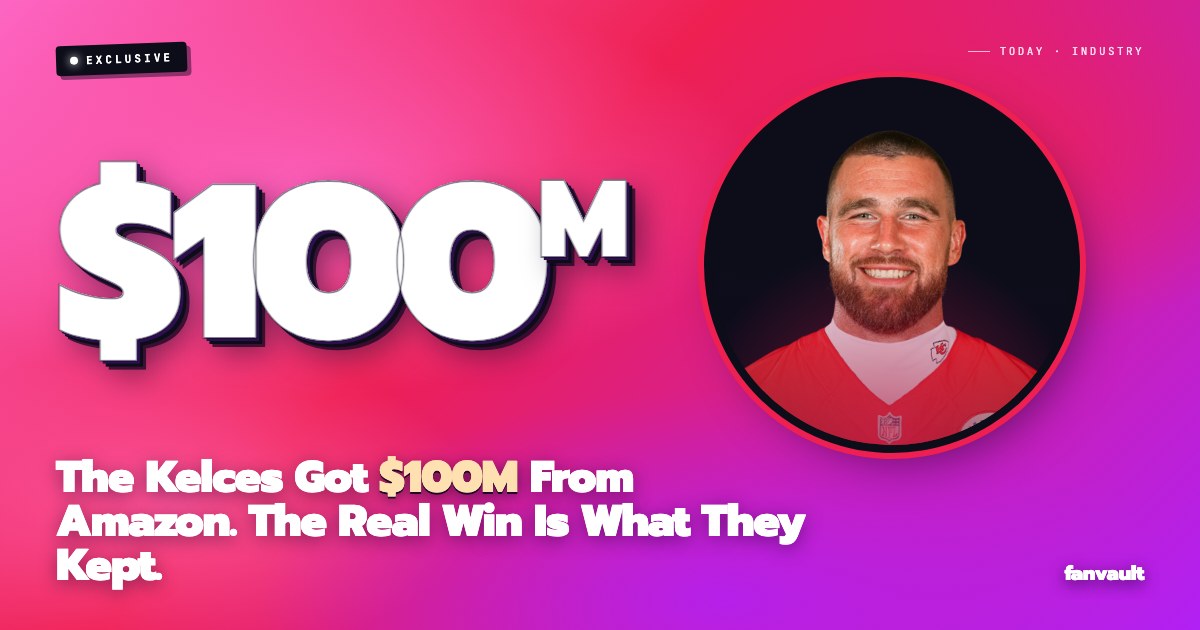
Travis and Jason Kelce locked in a three-year, $100M+ exclusive with Amazon's Wondery in August 2024, then watched Amazon dissolve the studio that signed them a year later. The brothers' show, New Heights, now anchors a new "Creator Services" division built around video, merch, and a live taping at LA's Orpheum this week. The check is the smallest part of this story.
⚡ Key Takeaways
- Three years, $100M+: the Kelces' August 2024 Wondery deal was the biggest single check ever cut for a creator-led podcast at signing.
- Wondery is gone. Amazon dissolved it in August 2025, cut 110 jobs, and folded New Heights into a new 'Creator Services' division built around video, merch, and live shows.
- Taylor Swift's October 2024 New Heights episode hit 15M+ YouTube views in 48 hours and 1.3M concurrent livestream viewers. This stopped being a podcast a long time ago.
- The Kelces licensed distribution to Amazon. They kept the audience, the brand, and the leverage. That is the entire playbook.
- Live World Cup taping at LA's Orpheum on June 15, 2026, episode lands on YouTube, Prime Video, and podcast platforms two days later.
- Fanvault keeps creators on 92% vs. Fanvue at 15%, Passes at 10% + $0.30, and Fanfix at ~20%. Own your stack or rent it forever.
What actually happened?
On August 27, 2024, Variety reported that the Kelces signed a three-year deal worth more than $100 million with Amazon's Wondery, handing the network exclusive global ad-sales and distribution rights to New Heights. The deal kicked off August 28, 2024, timed to the NFL season, and covered all audio and video episodes plus the back catalog, ad-free Wondery+ access, livestreams, and merch rights, per Amazon's own announcement. Wave Sports + Entertainment, which launched the show in 2022, stayed on as the production company.
The deal landed on a runaway cultural moment. New Heights had crossed 2.3M YouTube subscribers and hit #1 on Apple's overall podcast chart in January 2024. Then Taylor Swift dropped by in October 2024, and the episode pulled 15M+ YouTube views in under two days plus 1.3 million concurrent livestream viewers, per The Hollywood Reporter. A podcast was behaving like a Super Bowl halftime show.
Why does this matter for creators?
Because the structure of this deal is the new template. Wondery took ad-sales and distribution rights. The Kelces kept the show, the fanbase, and the leverage. That last part is what nine figures actually buys.
Compare it to the old model where a creator signed a platform-exclusive and lost their audience the second the platform stopped caring. The Kelces did the inverse. They licensed monetization rights to Amazon without handing over the IP, the YouTube channel, or the direct line to the audience.
"We really saw this opportunity where it wasn't just about a podcast. It was about how these creators could work in multiple parts of Amazon."
Steve Boom, VP of Amazon Audio, Twitch and Games
Where does this go from here?
The 2026 storyline is what happened after the check cleared. In August 2025, Amazon dissolved Wondery as an independent studio, cut roughly 110 jobs, and pushed CEO Jen Sargent out the door. The narrative slate (Dr. Death, Business Wars) moved to Audible. Personality-driven shows including New Heights, Armchair Expert, and LeBron James' Mind the Game got absorbed into a new "Creator Services" division explicitly built to bundle podcasts with merch, video, and live experiences.
In September 2025, New Heights episodes started streaming on Amazon Prime Video. On June 15, 2026, the brothers are taping a live World Cup edition at LA's Orpheum Theatre, with the episode hitting YouTube, Prime Video, and podcast platforms two days later, per Parade. The era of the pure-podcast check is over. Joe Rogan's $250M Spotify deal, Alex Cooper's $125M SiriusXM deal, and this Kelce deal are 360-degree partnerships where the IP is the product and audio is one surface, per CNBC.
What does Fanvault think?
The headline isn't the dollar figure. It's the ownership stack. The Kelces got a nine-figure offer because they walked in with an owned audience, an owned brand, and a fanbase that could be ported across audio, video, commerce, and live events.
Fanvault's thesis is that creators win when they own every layer of their distribution and keep 92% of what their audience pays them. That's why our platform fee is 8%, versus Fanvue at 15%, Passes at 10% plus $0.30, and Fanfix at roughly 20%. The Kelces will never need Fanvault. Everyone below their tier absolutely does.
If you're a creator in 2026 and you don't own your audience, you're not a partner. You're inventory.
Frequently Asked Questions
How much was the Kelce brothers' Wondery deal actually worth?
The three-year deal was reported at more than
Is Wondery still around after the deal?
Sort of. In August 2025, Amazon dissolved Wondery as an independent studio, cut about 110 jobs, and moved its narrative podcasts (Dr. Death, Business Wars) to Audible. New Heights and other personality-driven shows like Armchair Expert and LeBron James' Mind the Game got pulled into a new 'Creator Services' division under Matt Sandler, explicitly designed to bundle podcasts with merch, video, and live experiences. Then-CEO Jen Sargent, who championed the New Heights acquisition, departed Amazon in the restructuring.
When did New Heights launch and who actually produces it?
The Kelces launched New Heights in September 2022 with Wave Sports + Entertainment as a JUKES Original production, distributed on YouTube and podcast platforms. Wave stayed on as production company even after the Wondery deal took distribution rights in August 2024. The show hit #1 overall on Apple Podcasts in January 2024 and now reaches more than
What should smaller creators actually take from this deal?
That the check followed the audience, not the other way around. The Kelces sold distribution rights and kept the IP, the channel, and the fan relationship, which is the only reason the deal cleared nine figures in the first place. Creators below that tier still benefit from the same principle on a smaller scale: own the audience, keep as much of the revenue as possible, and avoid platforms that take a meaningful cut. Fanvault is built around exactly that thesis (we take