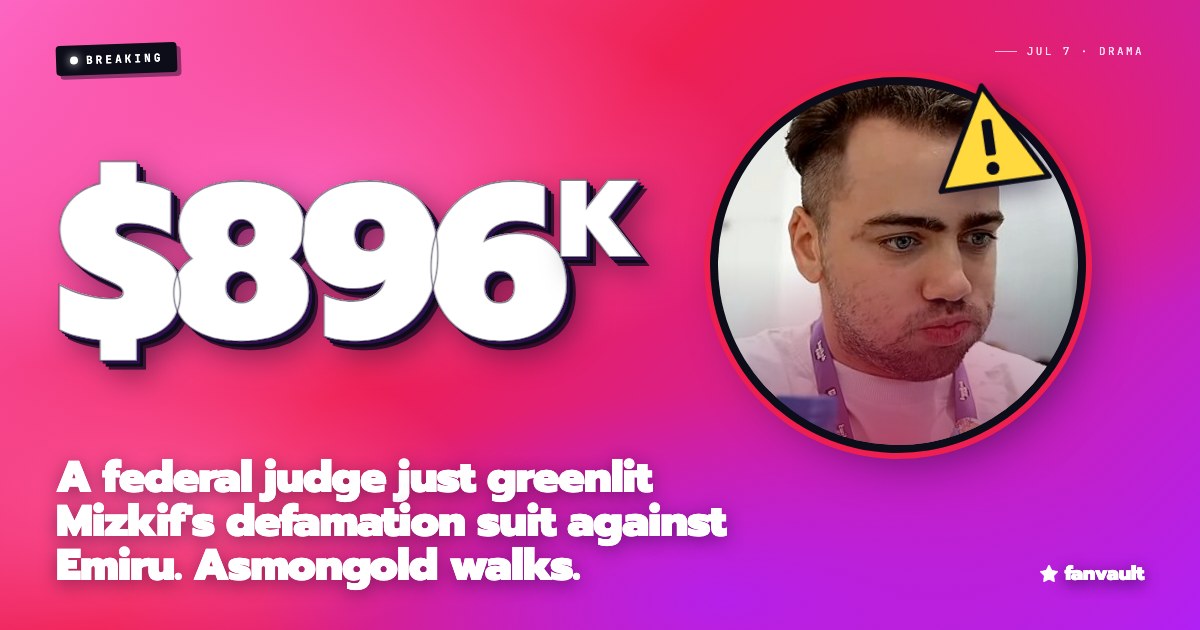
A federal magistrate judge just handed Mizkif his first courtroom win since Emiru's October 2025 livestream detonated his career. On July 7, Judge Susan Hightower recommended DENYING Emiru's motion to dismiss his defamation suit, ruling her allegations were "reasonably capable of a defamatory meaning." Asmongold got out clean. Emiru now faces discovery, depositions, and a jury.
⚡ Key Takeaways
- Federal magistrate recommended DENYING Emiru's motion to dismiss on July 7, letting Mizkif's defamation claim proceed toward discovery.
- Asmongold got his motion to dismiss GRANTED and walked away without prejudice.
- The magistrate rejected Emiru's 'emotional truth, not some statement of decisive fact' framing at the pleading stage.
- Emiru has 2.12M Twitch followers, ~10.3K active subs, and a co-ownership stake in OTK, all now on the line.
- Mizkif is separately being counter-sued for $896K by Mythic Talent Management and King Gaming Labs.
- First federal defamation case involving top-tier livestreamers to survive a motion to dismiss, setting the precedent every creator lawyer will cite.
What actually happened?
In a report and recommendation filed in the Western District of Texas, Magistrate Judge Hightower found that Mizkif had "plausibly pleaded" defamation and that the gist of Emiru's stream, which accused him of sexual assault, stalking, blackmail, and abuse, was "reasonably capable of a defamatory meaning," per Dexerto. She simultaneously recommended GRANTING Asmongold's motion to dismiss, ending the defamation claim against Zack "Asmongold" Hoyt without prejudice. It is not a final ruling until the district judge signs off, but it is the first ground Mizkif has retaken in nine months.
The underlying suit, filed in November 2025, names Emiru, Asmongold, OTK Media, Mythic Talent Management, and King Gaming Labs as defendants, per KXAN. OTK publicly confirmed Mizkif's termination on October 27, 2025, two days after Emiru went live, and threw its weight behind her. Mythic and King Gaming Labs have counter-claimed that Mizkif still owes them $896K in unpaid fees.
Within hours of the recommendation, Mizkif turned it into content. He dropped a 45-minute YouTube video titled "Emiru Lied, Part 1," walking through DMs, timeline contradictions, and message logs he says show peers knew her story was inconsistent. Two days later, on July 9, he posted a screenshot on X of alleged May 2024 Discord messages between Asmongold and Emiru in which Asmongold appeared to admit using a racial slur as a password. Asmongold, live on stream the same day, declined to litigate it in real time.
Why does this matter for creators?
Because it just ended the era where a viral livestream accusation was treated as untouchable "expressive content." Emiru's lawyers built her defense around the argument that her stream was "expressing her heartfelt emotional journey over several years with an admittedly toxic man" and therefore "emotional truth, not some statement of decisive fact," per Dot Esports. The magistrate rejected the framing at the pleading stage. Subjective language wrapped around specific factual claims about sexual assault does not automatically get the "opinion" shield.
Translation for every top-100 streamer: if you go live and name a specific person as a sexual abuser, your DMs, your contracts, and your private Discord logs are now potential court exhibits. The "this is my truth" framing is not a legal force field. Media-liability insurance, the kind broadcast journalists carry, is about to become a line item on top-tier creator P&Ls.
"Texas law has long held that even a verifiably false statement is not defamation if the context of that statement reveals that the statement was merely a reflection of an opinion, not a statement of fact."
Emiru's motion to dismiss, March 3, 2026 (via Sportskeeda)
Where does this go from here?
Assuming the district judge adopts the recommendation, Emiru is looking at full discovery. That means depositions, subpoenaed DMs, and every private conversation about the relationship being paged through by lawyers. It also means the case becomes a citation. This is the first federal defamation suit involving top-tier livestreamers to survive a motion to dismiss, and it is happening in the venue where half the biggest streaming orgs are incorporated.
The stakes are wildly asymmetric. Emiru has 2.12M Twitch followers, roughly 10,300 active subs, and a co-owner stake in OTK, per TwitchTracker. Mizkif has zero active Twitch followers after his October 2025 OTK termination and streams to about 6,200 average viewers on Kick.
A defamation win doesn't cancel a contract loss. He could take the ruling and still walk out worse off financially.
What does Fanvault think?
The parasocial authenticity model built modern streaming, but it also built a decade of legal exposure that nobody priced in. Fanvault is a creator monetization platform, which means we watch this ruling as a structural warning: talent agreements, co-ownership stakes, and private DMs across creator orgs are one lawsuit away from being court exhibits, and the mid-cap creator orgs of 2026 are structurally unprepared for that. The winners of the next cycle will be the platforms that treat creators like real businesses (with real contracts, real compliance, real payouts) instead of parasocial chaos engines that generate ad impressions right up until someone goes live with a receipt.
The Mizkif ruling isn't just about Mizkif. It's the first time a court told top streamers that their audience isn't a defamation shield, and the whole industry should be reading the docket.
Frequently Asked Questions
What did the judge actually recommend?
On
What was Emiru's defense?
Her legal team argued that her stream was 'expressing her heartfelt emotional journey over several years with an admittedly toxic man' whose statements were 'emotional truth, not some statement of decisive fact.' The March 3, 2026 motion also called Mizkif's lawsuit a 'temper tantrum disguised as a legal filing.' The magistrate rejected the framing at the pleading stage because subjective language wrapped around specific factual accusations does not automatically get the 'opinion' shield.
What happens next in the case?
Assuming the district judge adopts the recommendation, Emiru enters full discovery: depositions, subpoenaed DMs, and every private conversation about the relationship becoming potential court exhibits. Mizkif is also being counter-sued by co-defendants Mythic Talent Management and King Gaming Labs for
Why does this ruling matter beyond Mizkif and Emiru?
This is the first federal defamation case involving top-tier livestreamers to survive a motion to dismiss. The venue is the Western District of Texas, home to OTK and half the largest streaming orgs. Whatever the district judge decides becomes the citation every creator lawyer points at when the next viral livestream accusation goes off, and it forces every top streamer to reconsider whether their audience actually shields them from defamation law.