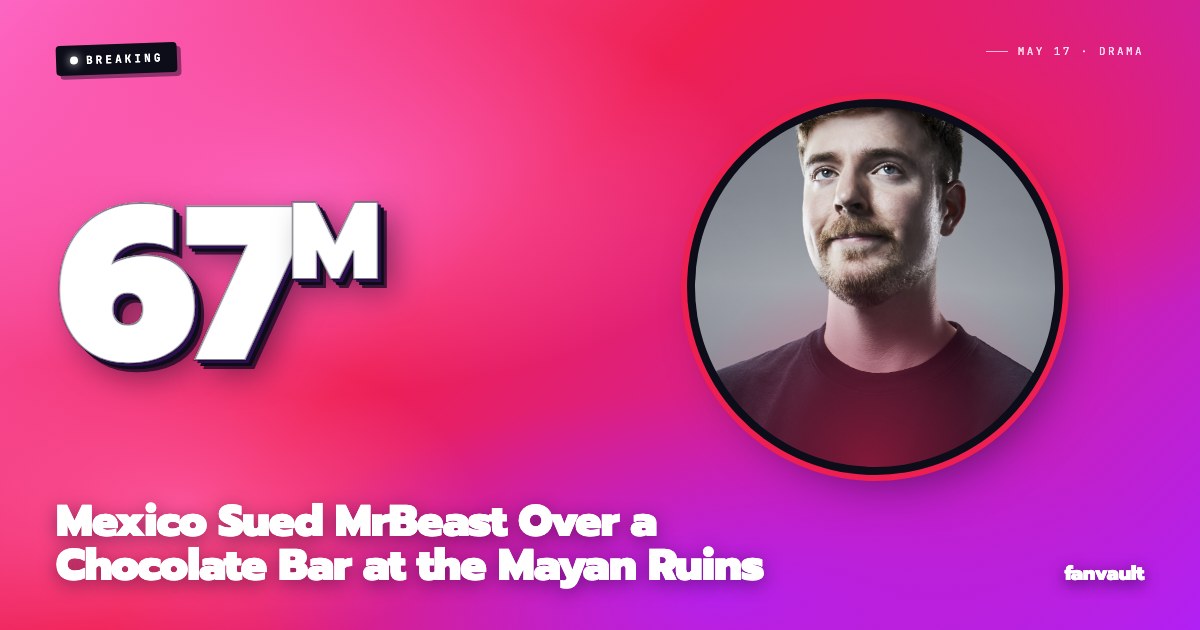
Mexico's government is suing MrBeast's production company over a chocolate bar. Specifically, the box of Feastables he pulled out at Chichén Itzá and called "the only Mayan-approved snack on the planet" in a video that's now crossed 67M views. The lawsuit, filed by the National Institute of Anthropology and History, accuses the production of turning a heritage permit into an ad shoot. The president of Mexico personally weighed in.
⚡ Key Takeaways
- MrBeast plugged Feastables inside Chichén Itzá in a video that hit 67M views in a week.
- Mexico's INAH filed an administrative lawsuit against Full Circle Media, the production company that coordinated the shoot, for exceeding documentary-permit terms.
- Culture Secretary Claudia Curiel de Icaza promised sanctions; President Claudia Sheinbaum personally ordered an investigation from her morning press conference.
- INAH publicly disputed scenes in the video as staged dramatizations, including the drone-in-pyramid and helicopter-descent shots.
- Heritage agencies worldwide now have a template for treating creator brand integrations as commercial filming with commercial liability.
What actually happened?
On May 10, MrBeast (Jimmy Donaldson, 27) uploaded "I Explored 2000 Year Old Ancient Temples," a 16-minute walkthrough of Calakmul, a UNESCO World Heritage biosphere reserve, and Chichén Itzá, one of the New Seven Wonders of the World per Jerusalem Post. The video crossed 67M views in seven days according to IBTimes UK. Midway through, MrBeast produced a box of Feastables and called them "the only Mayan-approved snack on the planet."
Mexico's National Institute of Anthropology and History filed an administrative complaint against Full Circle Media, the production company that coordinated the shoot, Newsweek reported. The permit issued was documentary, not commercial. Culture Secretary Claudia Curiel de Icaza promised sanctions. President Claudia Sheinbaum personally ordered INAH to clarify how filming access was granted, per CNN.
The story moved fast. On May 13, INAH publicly stated the production had exceeded permit terms. On May 14, Sheinbaum addressed it from her morning press conference. By May 15, INAH was rebutting specific scenes and MrBeast was firing back on X.
INAH also publicly disputed scenes as dramatized. No drone flew inside El Castillo's chamber, no one descended into a temple from a helicopter, no one spent the night inside an archaeological park, and no pre-Hispanic mask was handled, per Artnet News. The agency said those moments were staged or added in post but presented as real.
Why does this matter for creators?
This is the moment the creator brand-integration playbook collided with a sovereign government, and the government won the news cycle. Every top creator now runs a media-plus-CPG hybrid: MrBeast has Feastables, Logan Paul has Prime, Emma Chamberlain has Chamberlain Coffee, Ryan Reynolds built Mint Mobile inside his content for years. The math used to be straightforward. Shoot anywhere, plug the product, drive sales.
That math just broke. Filming permits at heritage sites, parks, and museums are typically issued as documentary or editorial, not commercial. The moment a creator's owned brand enters the frame, the permit category shifts. 395M subscribers does not shield you from the difference.
"We disapprove of any commercial pursuit that distorts the value of archaeological sites, which are a legacy of our indigenous cultures and the pride of our nation."
Claudia Curiel de Icaza, Mexican Secretary of Culture
Where does this go from here?
Two precedents got set this week. Governments are treating creator content as commercial filmmaking, with the permit fees and liability that come with that. Audiences are also getting sharper at spotting where the editorial ends and the ad begins, especially at sites they treat as sacred.
MrBeast pushed back on X, calling the lawsuit reports "lies" and claiming the Feastables scene was filmed off-site, not at any monument. His own team separately called the controversy "unfortunate." Neither defense engages with the actual INAH complaint, which is about the permit terms, not the camera angle on the chocolate bar.
Expect heritage agencies, parks departments, museum trusts, and stadium operators worldwide to write tighter creator clauses into their permitting workflows. Expect commercial-permit fees to follow. The shoot-anywhere-monetize-anywhere model just got expensive to export.
What does Fanvault think?
The line between editorial and advertising is collapsing for creators, and that collapse is now a brand-safety risk for the creator, not just the advertiser around them. At Fanvault, where creators keep 92% through an 8% platform fee, monetization lives on the storefront: a drop, an auction, a paywalled post, a tip jar, a paid DM. Those formats are commerce by design, labeled as such, on the creator's own turf. Pretending a chocolate bar at a Mayan temple is content rather than commerce is exactly the trick that ends with the president of Mexico opening her morning press conference about you.
The creator-economy giants spent a decade convincing audiences that the ad was the content. Mexico just reminded them the audience still knows the difference.
Frequently Asked Questions
What is MrBeast actually being sued for?
The administrative complaint, filed by Mexico's National Institute of Anthropology and History (INAH), names Full Circle Media, the local production company that coordinated the shoot, rather than MrBeast personally. INAH says the production was granted a documentary-only filming permit but used the sites to promote a commercial product (Feastables chocolate peanut butter cups). The agency wants compensation and sanctions for what Culture Secretary Claudia Curiel de Icaza called damage to the importance and sanctity of Mexican archaeological heritage.
Did MrBeast actually fly a drone inside the pyramid?
No, according to INAH. The agency publicly stated that several dramatic moments in the May 10 video were staged or added in post, including the drone shot inside El Castillo's chamber, the helicopter descent into a temple, the overnight stay inside the archaeological park, and the handling of a pre-Hispanic mask. INAH said none of those things actually happened on site, even though the video presents them as real footage from the trip.
How big is the video?
The video crossed
What does this mean for creators with their own product brands?
It means the seam between editorial content and commercial advertising is now legally and politically risky in a way it wasn't before. Governments, heritage agencies, parks, and museums issue filming permits with category restrictions, and the moment a creator's owned brand appears on screen the activity flips from documentary to commercial. Creators running a media-plus-CPG hybrid (MrBeast with Feastables, Logan Paul with Prime, Emma Chamberlain with Chamberlain Coffee) should expect tighter permitting clauses, higher fees, and faster political escalation everywhere they shoot from now on.