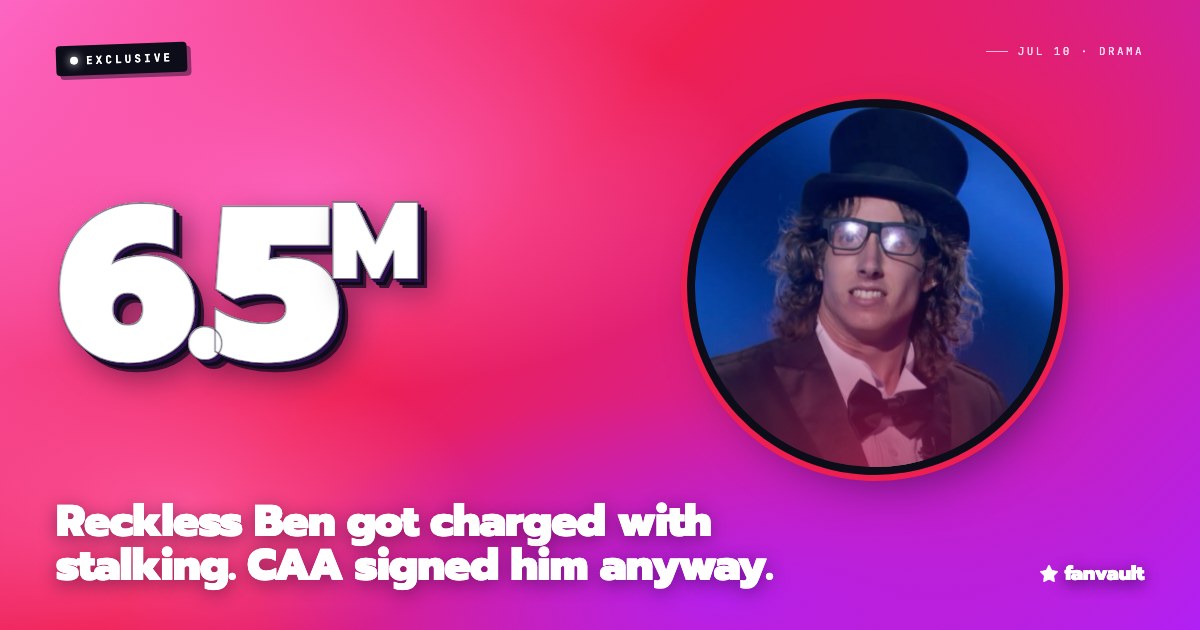
The Hollywood Reporter dropped the news July 10: CAA has signed Reckless Ben Schneider, the 27-year-old YouTuber whose viral Lego-theft investigation racked up 6.5M views, four criminal charges including stalking, and a federal defamation lawsuit stacked with 16 defendants. The agency called him "a pioneer in independent investigative filmmaking." His next criminal hearing was ten days ago. Hollywood just decided that math still works.
⚡ Key Takeaways
- CAA signed Reckless Ben Schneider on July 10, three days after his Utah gag order lifted and four months after his stalking arrest.
- His May 21 video "I Tracked Down the Thief Who Stole $200,000 of LEGO" pulled roughly 6.5M views and added about 397K subscribers in 30 days per Social Blade.
- Schneider is facing four criminal charges (including class A misdemeanor stalking) plus a federal civil suit seeking at least $1.3M, with exposure warned to hit $10M per defendant across 16 defendants.
- Coffeezilla's June 10 rebuttal drew about 4M views in 24 hours and valued the disputed Lego collection at roughly $107K (not $200K), with only $10K to $20K genuinely unaccounted for.
- The deal is Hollywood pricing reputational risk at zero: top agencies are now underwriting view counts before criminal and civil cases resolve.
What actually happened?
Schneider's story broke into the mainstream on May 21, when he published "I Tracked Down the Thief Who Stole $200,000 of LEGO" on YouTube. The video has since pulled roughly 6.5M views and helped his channel add about 397K subscribers in the next 30 days, per Social Blade. His Lego series now sits near 28 million cumulative views, and he cleared 1.5 million total subscribers with several trackers showing him closing in on 2 million.
The problem is that Schneider was already in criminal court by the time the viral video went up. He was arrested March 10 in American Fork, Utah after three days of showing up at the home of a Bricks & Minifigs-linked figure, sending a rubber-duck package to force a signature, and refusing officers' orders to leave. Prosecutors formally charged him March 27 with stalking (class A misdemeanor), targeted residential picketing, disorderly conduct, and criminal trespass, per KSL.
Bricks & Minifigs Franchising then sued Schneider and 15 other defendants in federal court for defamation, disparagement, civil conspiracy, and intentional infliction of emotional distress. The company is seeking at least $1.3M, and Schneider's own lawyers have warned exposure could top $10M per defendant across 16 defendants, per NewsNation.
Why does this matter for creators?
Because CAA didn't wait. They didn't wait for the misdemeanor case to resolve, they didn't wait for the federal civil suit to clear mediation, and they didn't wait for a fellow investigator to publicly gut the underlying claim. Coffeezilla's June 10 rebuttal, "I Found The $200,000 Missing Lego," pulled 4M views in its first 24 hours, valued the disputed collection at roughly $107K (not $200,000), and argued only $10K to $20K was actually unaccounted for, per Techdirt.
Signing him anyway is the industry telling every other agent that the reputational discount they used to charge is now zero. Attention wins.
"A pioneer in independent investigative filmmaking. A documentary creator and digital media personality whose fearless approach to storytelling has made him one of the most talked about creators on the internet."
CAA, statement to The Hollywood Reporter
Where does this go from here?
Watch for two things. First, other top agencies will accelerate their bidding on investigative and "gonzo" creators through the rest of 2026, and signings will happen earlier in the reputational lifecycle rather than later. Second, the traditional playbook (finish your legal cycle, then get repped) is dead. If you added a third of a million subscribers in a month, the phone rings while the court date is still on the calendar.
The Utah gag order was lifted July 7. CAA announced the deal July 10. That is 72 hours between "the creator can legally speak again" and "the biggest agency in Hollywood attached its name to him." The next Bricks & Minifigs mediation is on the calendar for later this summer, per ABC4, and everyone in the industry will be watching the docket, not the subscriber count.
What does Fanvault think?
The Reckless Ben story is the cleanest 2026 data point on a much older problem: the creators generating the most attention are still monetizing through the platforms taking the biggest cut. Schneider added 397K subscribers in 30 days and is still routing most of his upside through ad revenue and merch middlemen while burning legal fees. Fanvault's read is that a creator whose audience will DVR his court appearances is exactly the creator who should own the direct relationship: memberships, paid DMs, wishlists, and authenticated storefront drops on a platform where the take is 8%, not 15% like Fanvue or 20% like Fanfix.
The story here isn't who signed Schneider. It's who is going to underwrite him after the mediation.
Hollywood used to buy talent. It just bought a lawsuit with a subscriber count.
Frequently Asked Questions
Who is Reckless Ben and what did he actually do?
Ben Schneider, 27, is a YouTuber who goes by Reckless Ben and specializes in on-the-ground investigative videos. On May 21, 2026, he published "I Tracked Down the Thief Who Stole $200,000 of LEGO," which alleged a Bricks & Minifigs franchise in Keizer, Oregon had refused to return Ed Mansell's consigned Lego Star Wars collection (more than 780 sealed sets and roughly 1,200 rare minifigures) after a change in franchise ownership.
The video hit roughly
What are the criminal charges against Ben Schneider?
He was arrested March 10, 2026 in American Fork, Utah after three days of showing up at the home of Joshua Johnson (a Bricks & Minifigs-linked figure), sending a package of rubber ducks to try to force a signature, and refusing police orders to leave. On March 27, prosecutors filed four charges: stalking (class A misdemeanor), targeted residential picketing (class B), disorderly conduct (class C), and criminal trespass (class B).
A Utah court gag order restricting his public statements was in place from June 10 to July 7, per Dallas Express. CAA announced the signing three days later.
What is Bricks & Minifigs suing over?
Bricks & Minifigs Franchising filed a federal civil lawsuit against Schneider, his LLC, Bryan Mansell, and 13 additional defendants for defamation, disparagement, civil conspiracy, stalking, trespass, and intentional infliction of emotional distress. The company is seeking at least
Coffeezilla's June 10 forensic rebuttal complicates the underlying facts by valuing the disputed collection at roughly $107K rather than $200K, and estimating only $10K to $20K was genuinely unaccounted for, per Techdirt.
Why does the CAA signing matter for other creators?
Because it signals that top-tier Hollywood representation is now available to investigative creators with active criminal cases and pending federal civil suits, so long as the view counts justify the risk. Expect other major agencies to accelerate bidding on gonzo and investigative talent through the rest of 2026, and expect signings to happen earlier in the reputational lifecycle rather than after cases resolve.
What the deal doesn't solve is monetization. A creator adding hundreds of thousands of subscribers per month is still routing most of that upside through platform-controlled ad revenue instead of a direct storefront where he keeps the majority of every dollar his audience wants to send in.