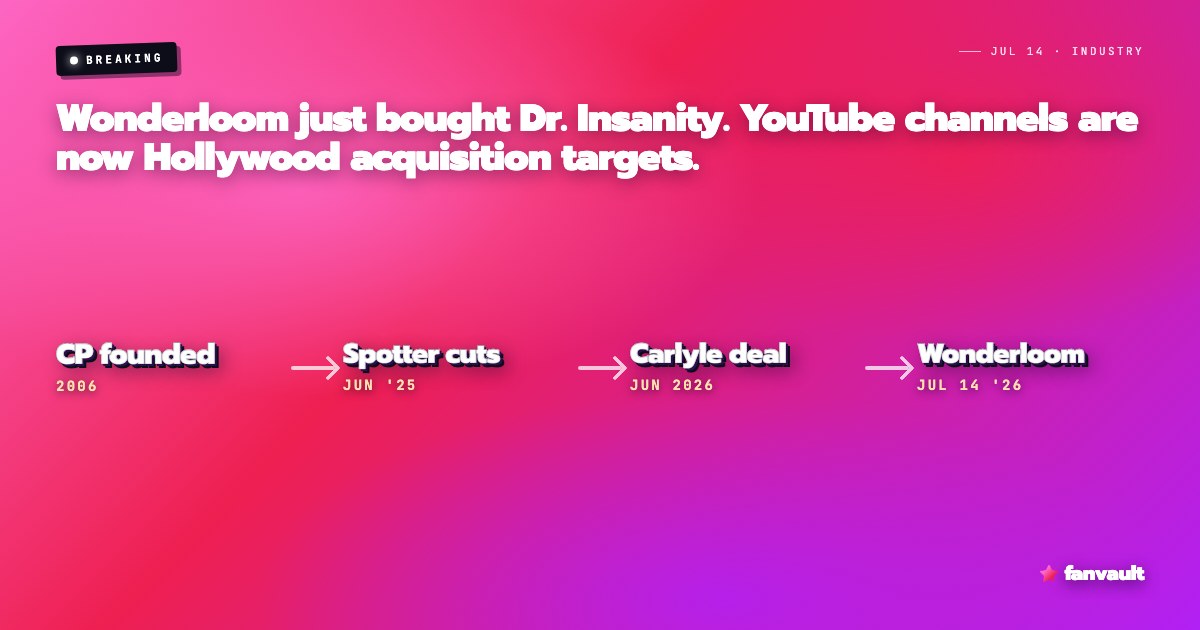
Content Partners just launched Wonderloom Media and dropped its opening bet: buying Dr. Insanity, a 5.3M-subscriber YouTube true-crime channel with 1.3 billion lifetime views. The message is unmistakable. YouTube channels are now Hollywood acquisition targets, and the private-capital rollup machine that spent two decades gobbling film libraries is coming for the creator economy next.
⚡ Key Takeaways
- Content Partners launched Wonderloom Media on July 14, 2026 and immediately acquired YouTube true-crime channel Dr. Insanity as its opening bet.
- Dr. Insanity has 5.3M subscribers and 1.3B lifetime views; hit videos routinely clear 30M views apiece.
- This is the mid-market rollup moment: a single-operator YouTube channel is now big enough for a Carlyle-backed private-capital vehicle.
- Creator-economy M&A hit 52 deals in H1 2025 (up 73% YoY), and $4B+ has been spent on YouTube channel acquisitions over five years.
- Spotter, the original YouTube rollup, spent $940M on 735+ channels and cut staff in June 2025 after missing its numbers.
- Fanvault's take: at an 8% platform fee with the ops team baked in, the smarter play is to build a creator business worth acquiring, and never sell it.
What actually happened?
On July 14, 2026, Content Partners (a Los Angeles investment firm best known for buying up film and TV libraries) officially launched Wonderloom Media with former Wheelhouse Chief Strategy Officer Ed Simpson as CEO. The venture's first acquisition, per Variety, is Dr. Insanity, the documentary-style true-crime channel founded by Jared West. Financial terms were not disclosed.
The receipts back the noise. Dr. Insanity has racked up more than 1.3B total views, per Deadline, with individual videos like "How Police Captured Colorado's Smartest Killer" pulling roughly 30 million views apiece. The capital story is just as loud. One month before the deal, Carlyle Global Credit and Content Partners closed a fresh single-asset continuation vehicle, per Carlyle, adding new firepower on top of a portfolio that already spans 800 motion pictures and 3,000 hours of TV.
Why does this matter for creators?
Wonderloom is not licensing Dr. Insanity's back catalog. It is buying the company, taking equity, and promising "professionalized operations, expanded distribution, and 360° monetization strategies." That is a studio-library playbook ported directly onto a single YouTube operator. Wonderloom has telegraphed publicly that food, travel, and general entertainment channels are next on the shopping list.
The size threshold is what should have every mid-sized creator paying attention. Dr. Insanity is not MrBeast. It is a five-million-sub, single-format channel with one operator behind it, exactly the profile that a year ago had no realistic buyer other than another creator. Per RockWater, creator-economy M&A hit 52 deals in the first half of 2025 alone, up 73% year over year.
"YouTube is no longer the disruptor. It has become the incumbent. The Creator Economy has matured into one of the most important sectors in media."
Ed Simpson, CEO, Wonderloom Media
Where does this go from here?
The rollup playbook is not new, and the receipts on how it plays out are getting harder to hide. Spotter, the original YouTube library rollup, invested $940M across 735+ channels before slashing staff in June 2025 after missing its financial targets, per Bloomberg. Jellysmack, Mythical, and a small army of imitators have all had to reset expectations since. Wonderloom is entering a market where more than $4B has already been spent on YouTube channel acquisitions over the last five years, per FinancialContent.
What's different about Wonderloom is the vintage of the money behind it. Content Partners has been in the film-and-TV-library business since 2006, per PR Newswire, and it's the largest independent owner of major studio-distributed content. That's a very different operator than Spotter or Jellysmack, both of which were creator-economy natives. Whether Scorsese-back-catalog instincts actually translate to five-minute true-crime uploads is the whole bet.
The pitch to creators is always the same. Cash now, an ops team, and "scale," in exchange for equity and long-term control. What the last five years suggest is that the pitch has a mixed track record for the buyer and an even more mixed one for the creator being bought. The next 18 months will test whether "professionalized operations" is genuine leverage or just a nicer phrase for "your channel now has a boss."
What does Fanvault think?
The Wonderloom-Dr. Insanity deal is the moment the rollup thesis officially industrializes at the mid-market, and that's exactly the wrong reason for a healthy creator to sell equity. A creator on Fanvault keeps 92% of every dollar under our 8% platform fee, owns their own storefront, runs auctions on authenticated memorabilia, sells paid DMs and wishlists, and has an automation layer plus Content Capital agents handling the operational work through a chat interface. That creator does not need to dilute for a "professionalized ops" team, because the ops team is baked in. Selling to a rollup trades sovereignty for a partner who has to make money on top of the fee you already give up.
Hollywood is coming for YouTube. The smarter play is to build a creator business worth acquiring, and then never sell it.
Frequently Asked Questions
Who is Dr. Insanity and how big is the channel?
Dr. Insanity is a documentary-style YouTube true-crime channel founded by Jared West. It has more than
It's a single-format, single-operator channel, exactly the profile Wonderloom is targeting as it industrializes the creator-M&A playbook at the mid-market.
What is Wonderloom Media and where does its money come from?
Wonderloom Media is a new venture launched by Content Partners and former Wheelhouse Chief Strategy Officer Ed Simpson, who serves as CEO. Content Partners is a Los Angeles investment firm founded in
The capital behind Wonderloom got a fresh boost on June 16, 2026, when Carlyle Global Credit closed a single-asset continuation vehicle with Content Partners specifically to fuel its ongoing acquisition strategy.
Which creators are next on Wonderloom's shopping list?
Wonderloom has publicly signaled that food, travel, and general entertainment channels are next. It's targeting YouTube-native and creator-led businesses with strong communities, promising "professionalized operations, expanded distribution, and 360° monetization strategies."
Translation: mid-market YouTube channels in the low-eight-figure revenue range should expect inbound acquisition inquiries over the next 18 months. The
Should creators actually sell to a rollup firm like Wonderloom?
The pitch (cash now, an ops team, in exchange for equity and control) has a mixed track record. Spotter, the original YouTube library rollup, invested
The math is uncomfortable. A creator who can already run their own storefront, memberships, tips, and monetization stack keeps the equity and the control. A creator who can't is essentially buying an ops team at a permanent, dilutive price.