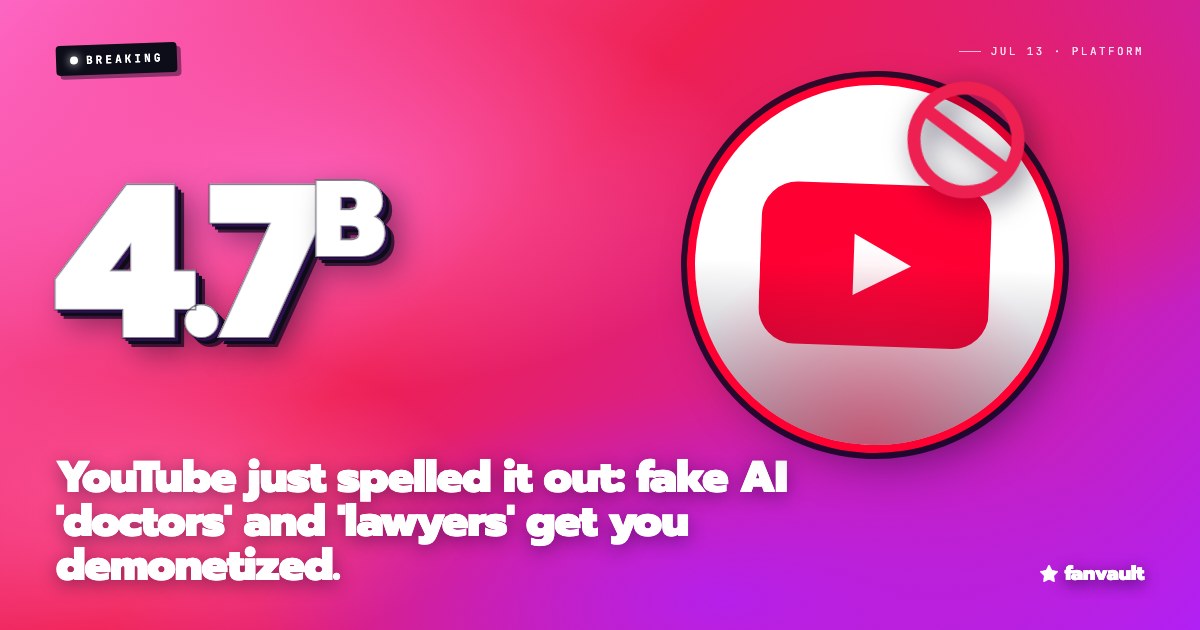
YouTube just published its clearest kill list yet for AI slop. On July 13, 2026, the platform named three demonetization buckets under its Inauthentic Content policy, calling out AI "doctors" pushing wellness remedies, AI "podcast hosts" handing out financial tips, and AI "lawyers" dispensing legal advice by name. The receipts already exist: 4.7B views wiped from 16 top-100 channels in a single January sweep.
⚡ Key Takeaways
- YouTube named three demonetization buckets on July 13, 2026: templated content, reused content, and 'unsatisfying' content, including fake AI 'doctors,' 'lawyers,' and 'podcast hosts.'
- Not a new rule. YouTube renamed 'Repetitious Content' to 'Inauthentic Content' on July 15, 2025 and started enforcing hard in January 2026.
- The January sweep killed 16 top-100 AI channels, 4.7B lifetime views, 35M subscribers, and roughly $10M in annual ad revenue.
- One Bible-story channel earning $30K/month and an exam-prep channel at $7.5K/month are among the confirmed demonetization casualties.
- YouTube is not banning AI, it is banning AI as a replacement for the creator: template-in, voiceover-out, zero human editorial decisions.
- The lesson: AdSense is one policy PDF away from zero. Own your audience off-platform and diversify revenue beyond the algorithm.
What actually happened?
YouTube's Head of Editorial and Creator Liaison, Rene Ritchie, framed the July 13 update as "a minor update to YouTube's long-standing YPP policies." The Inauthentic Content policy now names three specific tripwires: generic or repetitive content that looks templated, reused content that adds no meaningful original value, and content that is "unsatisfying or off-putting" to viewers. That third bucket is where the fake AI experts sit, per Tubefilter.
This is not a fresh rule. YouTube quietly renamed "Repetitious Content" to "Inauthentic Content" back on July 15, 2025, expanding its scope from duplicate-upload spam to any mass-produced, template-driven video, as TechCrunch flagged at the time. Six months later, the enforcement wave landed.
YouTube terminated 16 top-100 AI-slop channels holding 35M subscribers and roughly $10M in annual ad revenue, per OutlierKit. The single largest kill, CuentosFacianantes, had 5.95 million subscribers alone, XDA Developers reported.
Why does this matter for creators?
YouTube isn't banning AI. CEO Neal Mohan noted over one million channels used YouTube's own AI creation tools daily in December 2025. The line the platform is drawing is between AI as augmentation and AI as replacement. A ChatGPT script piped into ElevenLabs voice, glued to stock footage, and uploaded with zero human editorial decisions is now inauthentic by definition.
The demonetization risk is not distributed evenly. A Bible-story channel with 588,000 subscribers earning around $30,000 a month lost its monetization, and a separate exam-prep channel pulling $7,500 a month got the same treatment, per OutlierKit. If you built a business on an AI persona pretending to hold a license (medical, financial, legal), YouTube has now put your model on the taxonomy in plain English. The channel that used to earn is now the case study.
"Generic or repetitive content is content that looks like it's made with a template, or that may feel repetitive to viewers after watching several videos in a row from the same channel."
YouTube Help Center, updated July 13, 2026
Where does this go from here?
Enforcement scale is now industrial. Some AI-slop operators were spinning up as many as 150 new YouTube channels a day, each pushing 6-7 automated uploads, per MilX. Mohan used the phrase "AI slop" himself in his January 2026 annual letter, per IBTimes UK. When the CEO adopts the meme, the enforcement infrastructure follows.
Expect faster demonetization loops, more aggressive Shorts sweeps, and less patience for channels whose entire personality is a synthetic voiceover. The winners will look human, not necessarily hand-crafted (AI editing tools are still fine), but human in the editorial decisions viewers can feel. Faceless channels aren't dead. Faceless channels pretending to be licensed professionals are.
What does Fanvault think?
AdSense is not a business, it is a slot at a table that Google resets whenever the policy language needs an update. The July 13 clarification is a reminder that a single announcement can zero out $10M in annual revenue overnight. Fanvault (8% platform fee, 92% to creators, with a storefront for authenticated memorabilia, wishlists, and paid DMs) is built for creators whose fans value them as a person, not as an anonymous script-to-voiceover pipeline. The sister platform, Content Capital, treats AI as an operating layer for real creators, human or AI-native personas with editorial direction from day one, not as a replacement for the creator itself.
YouTube did creators a favor by publishing the tripwires. Own your audience off-platform, or the next policy PDF owns you.
Frequently Asked Questions
Is YouTube banning all AI-generated content?
No. The July 13 clarification is not a ban on AI, it is a ban on AI as a replacement for the creator. YouTube's own CEO, Neal Mohan, noted that over
What triggers demonetization is content that is templated, mass-produced, or built around an AI persona pretending to be a real expert (a fake AI 'doctor' recommending remedies, an AI 'lawyer' handing out legal advice, an AI 'podcast host' giving financial tips). Using AI to edit, translate, or generate B-roll is still fine.
What kinds of AI content will actually get you demonetized?
Per Tubefilter, the three buckets YouTube named are: (1) generic or repetitive content that 'looks like it's made with a template,' (2) reused content that adds no meaningful original value, and (3) content that is 'unsatisfying or off-putting' to viewers, including fake AI 'experts' cosplaying as licensed professionals.
If your channel is a script-to-voiceover pipeline with stock footage and zero human editorial decisions, all three buckets apply to you.
How many channels have actually been terminated?
The single largest enforcement action to date happened in January 2026, when YouTube terminated 16 top-100 AI-slop channels representing
Individual demonetization cases include a Bible-story channel earning $30,000/month and an exam-prep channel earning $7,500/month, both stripped under the Inauthentic Content policy.
Is this actually a new policy or just repackaging?
Repackaging. YouTube renamed 'Repetitious Content' to 'Inauthentic Content' on July 15, 2025, expanding its scope from duplicate-upload spam to any mass-produced, template-driven video, as TechCrunch reported at the time.
The July 13, 2026 update is a public-facing clarification with concrete examples, not a new rule. YouTube's Rene Ritchie called it 'a minor update to YouTube's long-standing YPP policies.'
What should creators do differently now?
Own your audience off-platform and diversify beyond a single AdSense line item. A platform that can zero out
Build direct relationships, sell paywalled content, run drops and auctions, and treat every platform's monetization line as rentable, not owned. Fanvault's 8% platform fee (versus Fanvue's 15%, Passes' 10% + $0.30, Fanfix's ~20%) and creator storefront exist for exactly this shift.