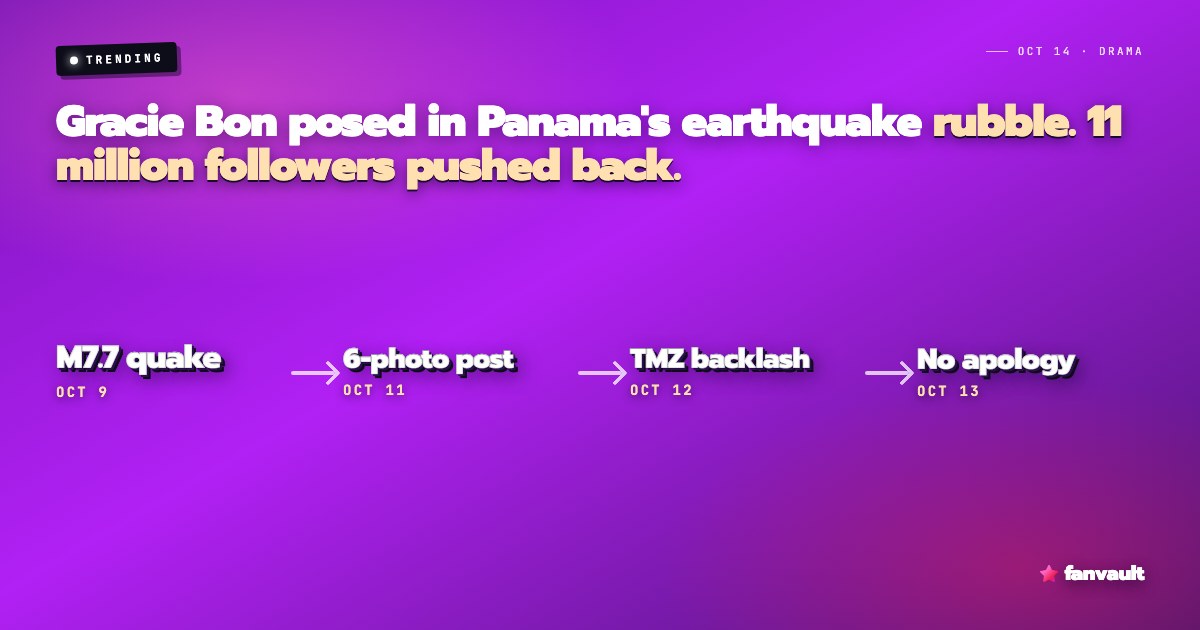
Gracie Bon, the Panamanian influencer with more than 11 million Instagram followers, posted a six-photo carousel of herself standing in the rubble of Panama's magnitude 7.7 earthquake. The internet called it a disaster photo op. Bon called it awareness, refused to apologize, and turned the question back on her critics. It's the clearest lesson of 2026 on how crisis content goes wrong when the creator is the focal point of the frame.
⚡ Key Takeaways
- Gracie Bon posted a six-photo carousel of herself in the rubble of Panama's magnitude 7.7 earthquake on October 11, 2026.
- The post pulled roughly 150,000 likes in 24 hours and thousands of comments calling it a disaster photo op.
- TMZ, Complex, Yahoo, Dexerto, and Bored Panda all picked it up, and Bon's defiant TikTok reply sparked a second wave.
- Bon says she wasn't posing, was donating supplies, and will keep pushing donations.
- The lesson for creators: when you're the focal point of the frame, the caption can't save the post.
- Crisis playbook: lead with the cause, link verified relief, and keep yourself out of the shot.
What actually happened?
The quake hit southern Panama on October 9. Al Jazeera reported a magnitude 7.7 event that set off tsunami warnings across Latin America, and Euronews counted at least 27 injured as buildings came apart. CNN logged 147 aftershocks in its initial coverage.
Two days later, on Sunday, October 11, Bon posted a six-photo series in white, standing among scattered bricks, destroyed beds, and the remains of collapsed buildings, according to Yahoo Entertainment. Her caption, as translated by TMZ, read: "the reality of my country 💔 after the earthquake, we have to remember that the material is recovered, but life is priceless." Yahoo reported the post pulled roughly 150,000 likes in 24 hours, along with thousands of comments calling her out.
By October 12, TMZ had the headline "Gracie Bon Ripped for Posing Amid Panama Earthquake Damage," and Complex followed. Bon answered on TikTok. Per Dexerto, she said she was in the photo but not posing, and The Nightly reported she said some people get more outraged by a photo than by families losing everything.
"I'm not posing, I'm simply appearing in the photo on MY post."
Gracie Bon, Panamanian influencer, Complex
Why does this matter for creators?
Because the caption never wins against the frame. When the creator is standing dead center in a field of wreckage, the audience reads the post as being about the creator. It doesn't matter how heartfelt the words underneath are.
Bon's defense is honest about how the attention economy works: her face reaches more people than a photo of a collapsed wall, and more reach can mean more donations. That logic is real. It just doesn't survive a feed full of injured people and broken homes, where every self-shot image looks like the disaster is the backdrop and she is the subject.
There's also the brand problem. Bon broke out in January 2024 with a Reel and petition demanding bigger airline seats, as Know Your Meme documents, and she has built her reach on provocation ever since. The same instinct that grew her following collided with a moment where her audience wanted restraint. Provocation is a great growth engine until the news cycle needs you to read the room.
Where does this go from here?
Bon isn't backing down. Her defiant reply kicked off a second wave of coverage on October 13 from Yahoo, Dexerto, Bored Panda, and The Nightly, and she says she'll keep using her platform to push donations. That second wave is the real story: the backlash to the backlash is now its own content cycle.
Here's the thing creators should actually take from it. Both sides can be right at once. The post may have driven relief attention, and it may have also made the relief look like it was about her. If you ever post into a crisis, the playbook is simple:
- Lead with the cause, not your face.
- Link directly to verified relief organizations.
- Keep yourself out of the shot, or at least out of the center of it.
- Show the work (supplies, rebuilds, receipts) instead of the backdrop.
Brand partners watch moments like this closely. Your audience is also an advertiser base, and a crisis post that reads as self-promotion is the kind of thing that quietly shows up in the next contract conversation.
What does Fanvault think?
Reach built on outrage is a loan, not an asset, and disasters are when it gets called in. Fanvault is built for creators who earn from fans who already care, through tiered memberships, tips, wishlists, and a full storefront, at an 8% platform fee so creators keep 92%, which means no single post has to go viral to pay the bills. That's also why Fanvault runs brand-safe content standards with a two-strike policy and verified, manually approved onboarding: brand safety isn't a PR afterthought, it's part of the business model. Own your monetization and you get to point the camera at the cause instead of yourself.
In a crisis, the most powerful thing a creator with 11 million followers can do is step out of the frame.
Frequently Asked Questions
Why was Gracie Bon criticized for her Panama earthquake photos?
On October 11, 2026, Bon posted a six-photo Instagram series of herself standing among the wreckage left by Panama's magnitude 7.7 earthquake. Critics said she was using a national disaster as a backdrop for self-promotion, a reaction TMZ and Complex both covered.
How did Gracie Bon respond to the backlash?
She didn't apologize. In a TikTok reply reported by Dexerto, she said she wasn't posing, that she was helping with supplies and rebuilding, and she asked critics what they had done to help Panama. She said she'll keep using her platform to promote donations.
How serious was the October 2026 Panama earthquake?
Al Jazeera reported a
How should creators post about a disaster without getting backlash?
Lead with the cause, not yourself. Link directly to verified relief organizations, keep yourself out of the center of the frame, and show concrete help (supplies, rebuilds) rather than using the damage as a backdrop. Brand partners watch these moments, so treat crisis posts as part of your business reputation.