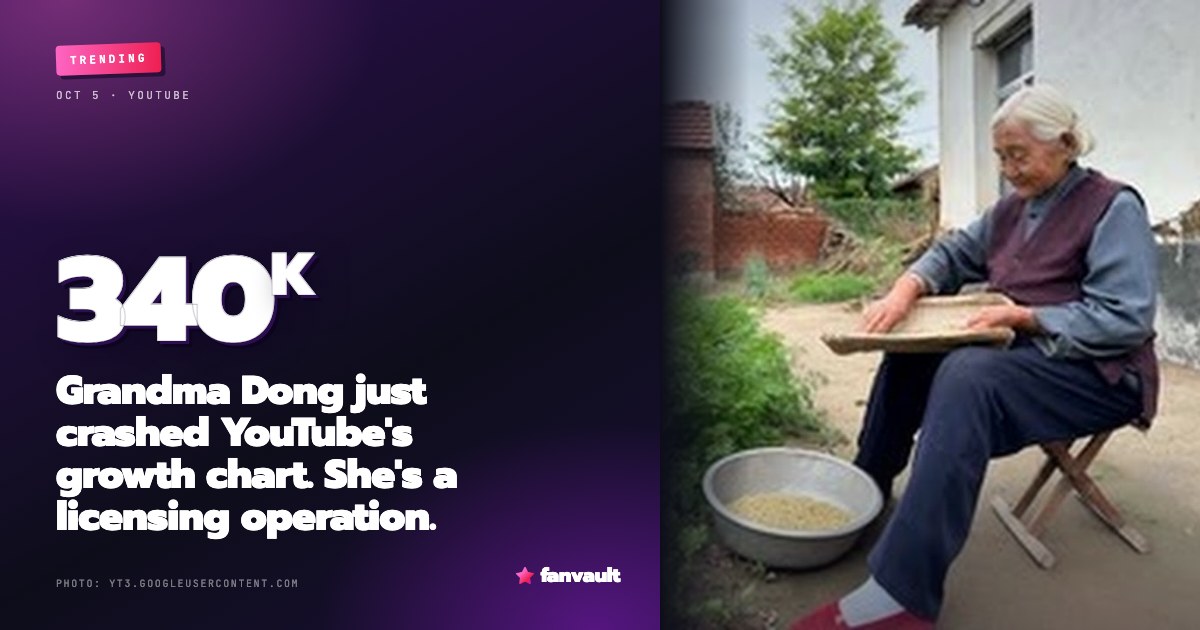
Grandma Dong, a YouTube channel of 14-second rural-life clips, added 340,000 subscribers in one week and landed at #20 on Tubefilter's Global Sub Top 50. The catch: there's no single grandma behind the camera. The channel says its videos are licensed from creators in mainland China, repackaged for English-speaking viewers, and posted about five times a day.
⚡ Key Takeaways
- Grandma Dong added 340,000 YouTube subscribers in one week, ranking #20 on Tubefilter's Global Sub Top 50.
- The channel sits at 3.42 million subscribers and 572.7 million views, up from 2.57 million about a month earlier.
- It's a syndication business: clips licensed from mainland China creators, packaged in English, posted about five times a day.
- CreatorDB found 101 of 417 fast-growing big channels post 2+ times a day, with 197 million subscribers combined.
- Volume isn't how individuals win: low-frequency channels pulled about 98,800 subs per upload vs. about 1,900 for 60+ a month posters.
- The creator play is owning a real fan relationship, the one thing a repost feed can't sell.
What actually happened?
The chart for the week of October 4 puts Grandma Dong at 3.42 million all-time subscribers and 572.7 million all-time views, per Tubefilter. The format is tiny stories: a fish, a puppy, a scissor-sharpening trick, apples so sweet the bugs eat them. As Tubefilter put it, her videos "often feature food, but she doesn't necessarily cook it herself."
A month earlier, CreatorDB clocked the channel at 2.57 million subscribers and 159 uploads in 30 days. That's roughly 850,000 new subscribers in about a month, at five uploads a day. And the channel isn't hiding the model: its YouTube description reads, "All videos are authorized by creators in mainland China and strictly adhere to platform regulations."
Why does this matter for creators?
Because the growth chart is no longer a clean scoreboard of creators. CreatorDB analyzed 417 of 2026's fastest-growing YouTube channels above 500,000 subscribers and found 101 posting at least twice a day, with 197 million subscribers between them. It called that cohort "an industrial layer hiding inside YouTube's growth charts."
Those charts shape brand rates, agency pitches and everyone's gut sense of what winning looks like. When a distributor licensing a whole region's output takes a top-20 slot, a solo creator posting twice a week is being benchmarked against a supply chain. That race is unwinnable, and it's the wrong race anyway.
"That is not a grandmother's schedule; that is a shift pattern."
Thomas Doyne, CreatorDB
CreatorDB's own data proves the point. Channels posting fewer than 8 times a month gained about 98,800 subscribers per upload, versus about 1,900 for channels posting 60 or more times. Farms win on total volume, while real people win on what each video actually pulls.
There's a fan-side gap too. Millions of viewers subscribed to a grandmother they will never meet, run by an operator nobody has named. That works for a 14-second smile, but it's a thin foundation for anything that needs trust, like paying someone directly.
Where does this go from here?
YouTube already drew its line. On July 15, 2025, it renamed its "repetitive content" monetization rule to "inauthentic content," aimed at mass-produced, templated videos, per YouTube Help and Gulf News. The reused-content policy didn't change, so licensed clips can still earn when they add meaningful editing, narration or commentary.
A licensed, English-packaged repost feed sits squarely in that gray zone. Expect more of these operations, not fewer, as long as wholesome short-form crosses borders this cheaply. Also watch the invisible people here: the mainland creators whose footage powers the channel are anonymous to its American audience, and what they earn depends entirely on their licensing deal.
What does Fanvault think?
Fans who show up for a real person should be able to pay that person directly, which is why Fanvault charges an 8% platform fee and creators keep 92% (Fanvue takes 15%, Passes 10% + $0.30, Fanfix about 20%). One Fanvault account carries tiered memberships, paid DMs, tips, wishlists and a storefront with auctions and authenticated memorabilia, the kind of real-person relationship a repost feed can never sell. Add an automation layer that runs listings, scheduling, DMs and orders through chat (in-app or on Telegram), plus sister platform Content Capital publishing across Instagram, TikTok and X, and a solo creator gets production capacity without turning into a content farm.
Grandma Dong is charming, and she's also a supply chain. Creators don't have to beat the factory. They just have to be the person fans can't get anywhere else.
Frequently Asked Questions
Who actually makes Grandma Dong's videos?
The channel's own YouTube description says all videos are authorized by creators in mainland China. CreatorDB describes it as a licensing operation that repackages that content in English for an American audience. No operator or company behind the channel has been publicly named.
How fast is Grandma Dong growing?
Tubefilter recorded about
Is a licensed repost channel allowed to make money on YouTube?
Generally yes, if it adds value. In July 2025 YouTube renamed its repetitive content rule to inauthentic content, targeting mass-produced, templated videos, but left its reused-content policy unchanged, per YouTube Help. Clips and compilations can still be monetized with meaningful editing, narration or commentary.
Should creators post more to compete with content farms?
The data says no. CreatorDB found channels posting fewer than 8 times a month gained about