A buy-it-now drop is a limited-quantity, fixed-price product release with a countdown and a teaser arc that concentrates fan demand into a single window instead of drip-selling from an always-on catalog. On Fanvault, the storefront inside every creator profile handles listings, checkout, and Shippo-powered fulfillment in one flow, so a first-time drop can go from planning to shipping in about two weeks. The math that matters: a 5,000-person audience list should generate 400 to 800 waitlist signups.
⚡ Key Takeaways
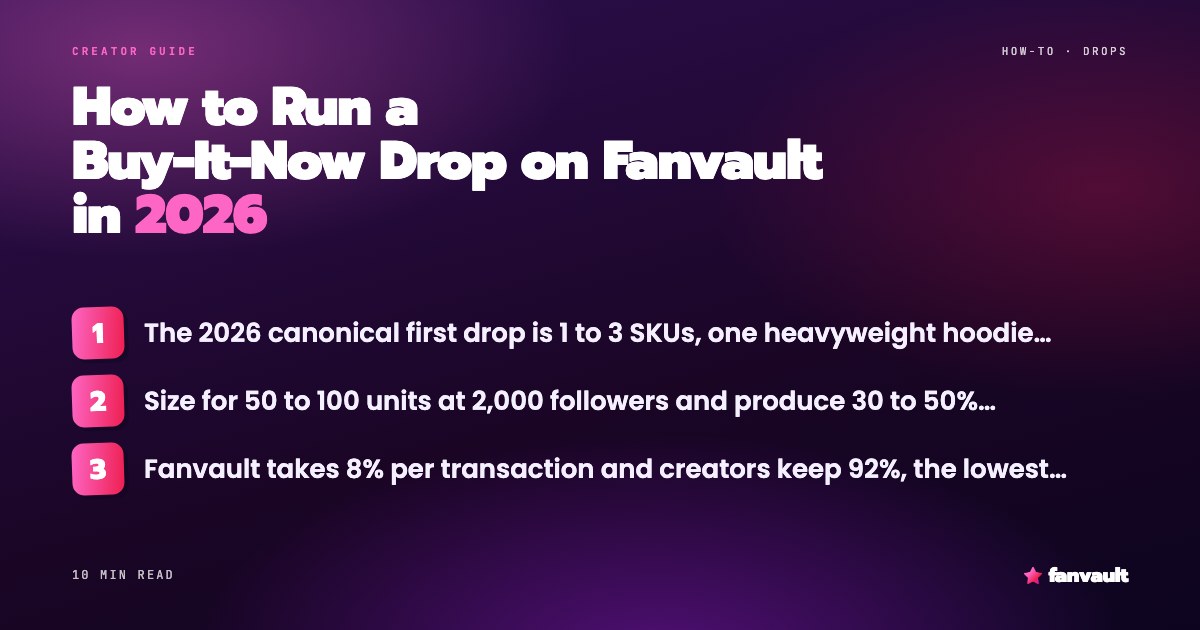
- The 2026 canonical first drop is 1 to 3 SKUs, one heavyweight hoodie plus one premium tee.
- Size for 50 to 100 units at 2,000 followers and produce 30 to 50% fewer units than your forecast demand.
- Fanvault takes 8% per transaction and creators keep 92%, the lowest fee of any named creator platform.
- Run a two-week teaser arc where engagement climbs day-by-day, not a spike-and-fade.
- Add an Instagram Story countdown sticker so followers get auto-notified at go-live.
- A hoodie nets $10 to $30 per unit vs $3 to $8 on a print-on-demand tee, weight the drop toward the hoodie.
What do you need before your first drop?
Three prerequisites, in order. First, a verified Fanvault storefront. Every creator is manually approved and 18+ age-verified at onboarding, so start that early. Second, a paid-out payment setup through Stripe Connect, which Fanvault uses for every transaction. Third, a small run of physical stock or a print-on-demand supplier ready to ship inside a two-week window.
Fanvault takes 8% per transaction and you keep 92%, the lowest fee of any named creator monetization platform. That compounds fast because product and merchandise sales are already 21.2% of creator income per Yahoo Finance, inside a creator economy that SQ Magazine values at $234.65 billion in 2026.
How long does it take to plan a drop that actually sells?
Budget two weeks for the teaser arc and one week for post-drop fulfillment. The two weeks are non-negotiable: engagement on a drop teaser sequence should climb day-by-day, and campaigns that spike on day one and decline by day three signal a failed escalation per Influencers Time.
Which SKU should you pick for your first drop?
The 2026 canonical pair is one hoodie plus one premium tee. That single combination carries most of the margin for a first-time creator collab per Vain New York, which recommends launching just 1 to 3 core products. Keep the design specific to your audience, not a blank tee with a small logo. That is the single most common first-drop failure mode.
The economics favor the hoodie as the profit-carrying SKU:
| SKU type | Retail price | Net per unit |
|---|---|---|
| Print-on-demand tee | $30 | $3 to $8 |
| Premium hoodie | $50 to $60 | $10 to $30 |
Numbers from Merch Titans. A hoodie-weighted drop also clears the "why does this cost that much" objection because the physical item carries the price.
How many units should you make?
For a brand around 2,000 Instagram followers, EasyApps recommends 50 to 100 units total, sized to hit roughly 80% sell-through while preserving scarcity. The safer 2026 posture is deliberate undersupply: produce 30 to 50% fewer units than your forecast waitlist demand. A fast sellout generates demand signal and social proof; visible unsold inventory kills the scarcity you just spent two weeks building.
A quick sizing example: a 4,000-person early-access waitlist with a 12% launch conversion rate implies about 480 units of demand. Producing 240 to 340 units puts you inside the undersupply band.
How do you build a teaser arc that primes buyers?
Three to five teaser posts across two weeks, escalating in specificity. A default sequence:
- Day 1 to 3: silhouette or blurred reveal, no product details.
- Day 4 to 7: behind-the-scenes, why this item exists, who it is for.
- Day 8 to 11: the price, the quantity, the exact drop time.
- Day 12 to 14: final call and a Story countdown sticker, which lets followers tap once and be auto-notified the moment the drop goes live per Sked Social.
In a 2024 international survey, 31% of consumers said a "limited edition" label made them more likely to buy apparel per Shopify. That is a real demand lift, and it compounds when you layer scarcity types (quantity + time + access). Nike's SNKRS app has industrialized the pattern to 50M+ downloads and routine minute-long sellouts.
How do you list a buy-it-now drop on Fanvault?
Buy-it-now drops are a native listing type in the Fanvault storefront alongside auctions, so a drop is a fixed-price product with a scheduled go-live, not a bespoke integration. Attach the SKU, the price, the total unit count, and the countdown window. Provenance metadata (signed, worn, condition) is a first-class field on every listing, so if you are dropping a signed variant or a stream-worn item, put that in the listing itself, not in the caption.
Fanvault's automation layer, in-app chat or Telegram, lets you spin up the listing, schedule the drop, and triage fan DMs through a chat interface instead of clicking through screens. That matters at the go-live minute, when you would rather be replying to buyers than editing product pages. Payments run through Stripe Connect and fulfillment through Shippo (labels, tracking, guest checkout), all in the same order flow.
How do you turn one drop into a recurring revenue line?
The mechanic is the exciting part, the retention loop is the revenue. Two 2026 cadences work:
- Weekly ultra-limited items for existing fans or a paid tier (access scarcity).
- Monthly full drops with a rotating hero SKU.
After the drop clears, send a thank-you DM with tracking, and offer buyers early access on the next drop. This mirrors how Twitch streamer Sykkuno's official merch drop pulled public reactions from Pokimane, Bella Poarch, and QTCinderella. A drop is a community event and a cross-creator marketing moment, not a transaction.
What are the biggest mistakes on a first drop?
The dominant failure mode is a low-effort design on a blank tee with no teaser, no countdown, and no waitlist, thrown live at a random time. The fix is a scripted arc and a pre-launch checklist:
- 1 to 3 SKUs picked, hoodie carrying the margin.
- Units sized 30 to 50% under forecast waitlist demand.
- Story countdown sticker scheduled, waitlist email queued.
- Provenance metadata (signed / worn / condition) filled on each listing.
- Post-drop thank-you DM template written before the drop, not after.
Even the biggest drops make the undersupply call deliberately. Taylor Swift's 2025 holiday drop had the plush cat item gone in 5 minutes and fans publicly "devastated", which set up the restock moment and gave the team a clean demand signal for the next round. Plan for the sellout, not against it.
Frequently Asked Questions
How much does it cost to sell a drop on Fanvault?
Fanvault takes
On a 50-unit run of $60 hoodies ($3,000 gross), Fanvault fees come to $240 vs Fanvue's $450, a $210 delta on a single drop. Payments run through Stripe Connect, so payouts follow standard Stripe timing.
How many units should my first buy-it-now drop have?
For an audience around 2,000 Instagram followers,
Then intentionally produce 30 to 50% fewer units than your forecast waitlist demand. A fast sellout generates demand signal for the next drop, while visible unsold inventory kills the scarcity you just spent two weeks building.
What should I sell in my first drop, a tee or a hoodie?
Both, with the hoodie carrying the margin. The 2026 canonical pair per Vain New York is one heavyweight hoodie plus one premium tee.
A $30 print-on-demand tee usually nets
How long before the drop should I start teasing?
Two weeks is the standard window. Ship 3 to 5 teaser posts across the run, escalating from silhouette to behind-the-scenes to price/quantity to final call. Add an Instagram Story countdown sticker in the final 48 hours so followers tap once and get auto-notified at go-live.
Engagement should climb day-by-day. If it spikes on day one and declines by day three, the escalation is failing and the drop will underperform per Influencers Time.
What happens if my drop sells out in five minutes?
That is the win condition, not the failure. A
Taylor Swift's 2025 holiday merch drop had multiple items gone in five minutes and fans publicly "devastated," and the team turned that into a follow-up moment. The riskier outcome is a drop that does not clear, which kills the scarcity signal for every drop after it.