An AI influencer is a social media persona whose face, voice, and content are generated with AI tools, run by a person or team who publishes and monetizes it like any creator account. Starting one from zero in 2026 means labeling it on day one, posting Reels consistently for months, and monetizing only after a format works. Expect slow growth: average Reels engagement sits at 0.48%, per Socialinsider.
⚡ Key Takeaways
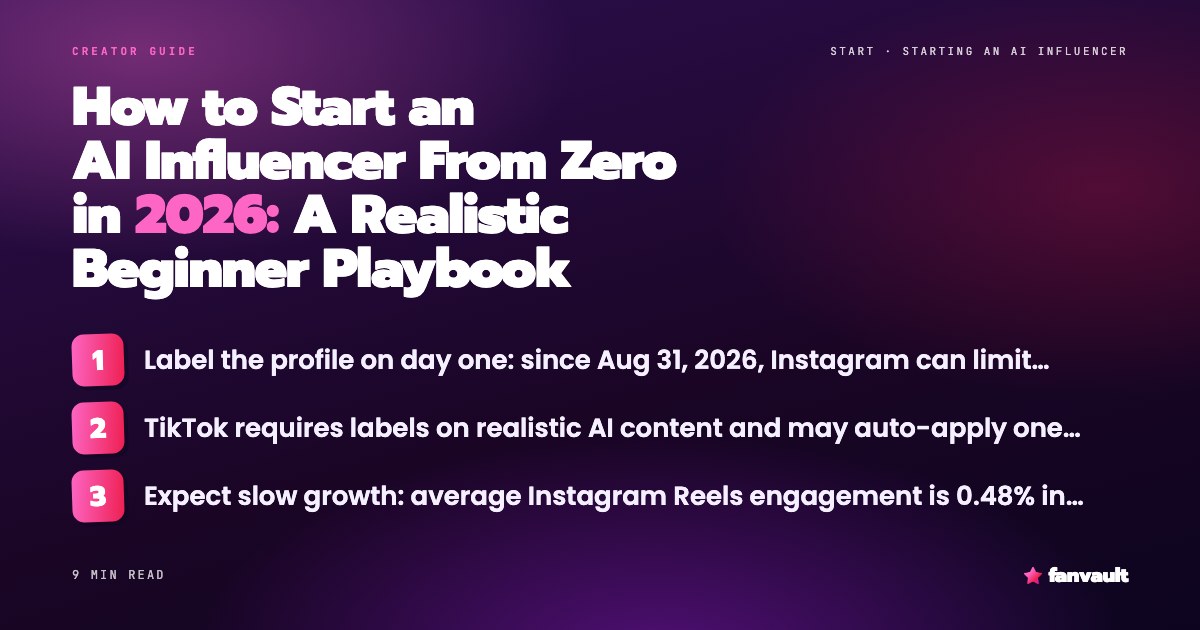
- Label the profile on day one: since Aug 31, 2026, Instagram can limit reach for unlabeled AI-person accounts, and labeled accounts keep theirs.
- TikTok requires labels on realistic AI content and may auto-apply one you can't remove.
- Expect slow growth: average Instagram Reels engagement is 0.48% in 2026, down from 0.52% in 2025.
- Months 1 to 3 find a format, months 4 to 6 double down, months 7 to 12 monetize.
- FTC Endorsement Guides cover AI personas, so paid deals need clear disclosure.
- Famous earnings (Lil Miquela ~$9,000 per post, Aitana López up to €10,000 a month) are outliers and partly self-reported.
What should you decide before you generate a single image?
Most new AI influencer accounts fail on consistency, not image quality. Making a striking picture is the easy part. Making the same person look like the same person across 90 posts, in different outfits, rooms, and lighting, is the actual work.
Write a character bible before you open any generator. It is the reference you check every post against:
- Name, age range, location, and a one-line backstory the audience can repeat
- Face and body reference images you reuse for every generation
- Two or three content pillars, not ten
- Voice rules for captions and DMs: words the persona uses, topics it avoids
- A visual style guide: color palette, camera feel, recurring locations
Lock the face and style first. Followers forgive a slow posting week. They do not forgive a face that changes.
Why should you label your AI influencer on day one?
In 2026, disclosure is a reach requirement. On August 31, 2026, Instagram renamed its "AI creator" label to "AI-generated profile" and said accounts featuring an AI-generated person that skip it can have their reach limited, while labeled accounts keep their reach, per TechCrunch.
The other platforms point the same way. The TikTok Help Center requires a label on all AI-generated content with realistic images, audio, or video, says TikTok may auto-apply an "AI-generated" label you can't remove, and may remove unlabeled content. The Meta Help Center says Meta may require an AI label on photorealistic video or realistic audio, with possible penalties when a required label is missing.
Audiences see these labels constantly. In October 2024 alone, Instagram content carrying the "AI info" label drew over 1 trillion label views, per the Meta Transparency Center. Label the profile and the content from the first post.
What does a realistic month-by-month plan look like?
Think in three phases. Each one has a single job, and skipping ahead is the most common way beginners burn out.
| Phase | Main goal | What you actually do | Milestone to hit |
|---|---|---|---|
| Months 1 to 3 | Find a format | Finish the character bible, lock face consistency, label the profile, post Reels daily | One or two formats that beat your own average |
| Months 4 to 6 | Double down | Post more of what works, cut what doesn't, answer DMs, build an email list or owned storefront | A small audience that comments and replies |
| Months 7 to 12 | Monetize | Pitch small brand deals with FTC-compliant disclosure, launch subscriptions, paywalled posts, or drops | First recurring revenue |
Notice what is missing: a viral moment. Plan for steady compounding and treat any breakout as a bonus.
How fast should you expect an AI influencer account to grow?
Slowly. Socialinsider puts average Instagram Reels engagement at 0.48% in both Q2 and Q3 2026, below the 0.52% average for 2025. Organic reach is getting harder for every account, human or synthetic.
Small accounts do have one edge. At the 1K to 5K follower tier, Reels average about 3 comments versus 1 for image posts, per the same Socialinsider data. That is why the first three months should lean on Reels: comments are the signal that tells you a format is working.
When do you actually start monetizing?
Usually somewhere in months 7 to 12, once a format reliably gets comments. Monetize earlier and you are selling to an audience that does not exist yet.
Brand deals follow the same rules as human creators. The FTC's 2023 updated Endorsement Guides apply to virtual influencers and AI personas, so payment or brand control must be disclosed clearly and conspicuously, per BakerHostetler.
Keep expectations grounded. Lil Miquela reportedly charges around $9,000 per sponsored post versus upwards of $250,000 for a human influencer with 1M+ followers, per Built In. Aitana López's agency co-founder told Fortune she earns up to €10,000 (about $11,000) a month and around €3,000 in an average month. Those figures are self-reported and unaudited, and both personas are outliers.
Because algorithms keep shifting, build direct revenue alongside brand deals:
- Subscriptions and tiered memberships
- Paywalled photos and videos
- Limited drops sold through a storefront you control
Content Capital, Fanvault's sister platform, can stand up a new AI influencer from scratch, generate on-brand photos and videos, and publish across Instagram, TikTok, and X. It plugs into a Fanvault storefront, where the platform fee is 8%, so creators keep 92%.
Do audiences actually trust AI influencers?
It depends on the survey, so treat the numbers as a range. In a 2024 survey by The Influencer Marketing Factory, only 15% of respondents rated their trust in virtual-influencer product promotions 7 out of 10, and 36% said AI influencers should disclose their AI nature in their bios.
A 2025 Censuswide study for Billion Dollar Boy, reported by Agility PR, found 76% of consumers trust virtual influencers for product recommendations, yet 57% believe digital twins erode trust in creator content. The common thread: audiences want to know what they are looking at. Disclosure protects trust as well as reach.
What should your first 90 days look like?
Save this checklist and work through it in order.
- Week 1: write the character bible and pick two or three content pillars
- Week 1: build a reusable face and style reference set
- Week 2: create the profiles and apply the AI-generated profile label on Instagram and AI labels on TikTok
- Weeks 2 to 4: post one Reel a day and log comments per post
- Weeks 5 to 8: identify your top two formats and cut the rest
- Weeks 5 to 8: reply to every comment and DM in the persona's voice
- Weeks 9 to 12: set up an email list or owned storefront so followers have somewhere to go
- Weeks 9 to 12: draft an FTC-compliant disclosure template for future brand deals
- Day 90: review which format earned the most comments and plan months 4 to 6 around it
Frequently Asked Questions
How long does it take to make money with an AI influencer?
Plan on roughly 7 to 12 months. The first three months go to finding a format, the next three to growing it, and monetization (brand deals, subscriptions, paywalled posts, drops) comes once an engaged audience exists. With average Reels engagement at 0.48% per Socialinsider, quick wins are rare.
Do I have to disclose that my influencer is AI?
In practice, yes. Instagram can limit reach for unlabeled AI-person accounts, per TechCrunch, and TikTok requires labels on realistic AI content. For paid posts, the FTC's Endorsement Guides apply to virtual influencers, per BakerHostetler.
How much do AI influencers earn?
Most earn little in year one. The headline cases are outliers: Lil Miquela reportedly charges around $9,000 per sponsored post (Built In), and Aitana López's agency says she earns up to €10,000 a month, a self-reported figure (Fortune).
Should I post Reels or images when starting an AI influencer?
Lean on Reels. At the 1K to 5K follower tier, Reels average about 3 comments versus 1 for image posts, per Socialinsider, and comments are the clearest early signal that a format works.
Where can an AI influencer sell content directly?
An owned storefront keeps income independent of algorithms. Content Capital can build and publish an AI persona and plug it into a Fanvault storefront, which supports subscriptions, paywalled posts, and drops at an 8% platform fee, so creators keep 92%.