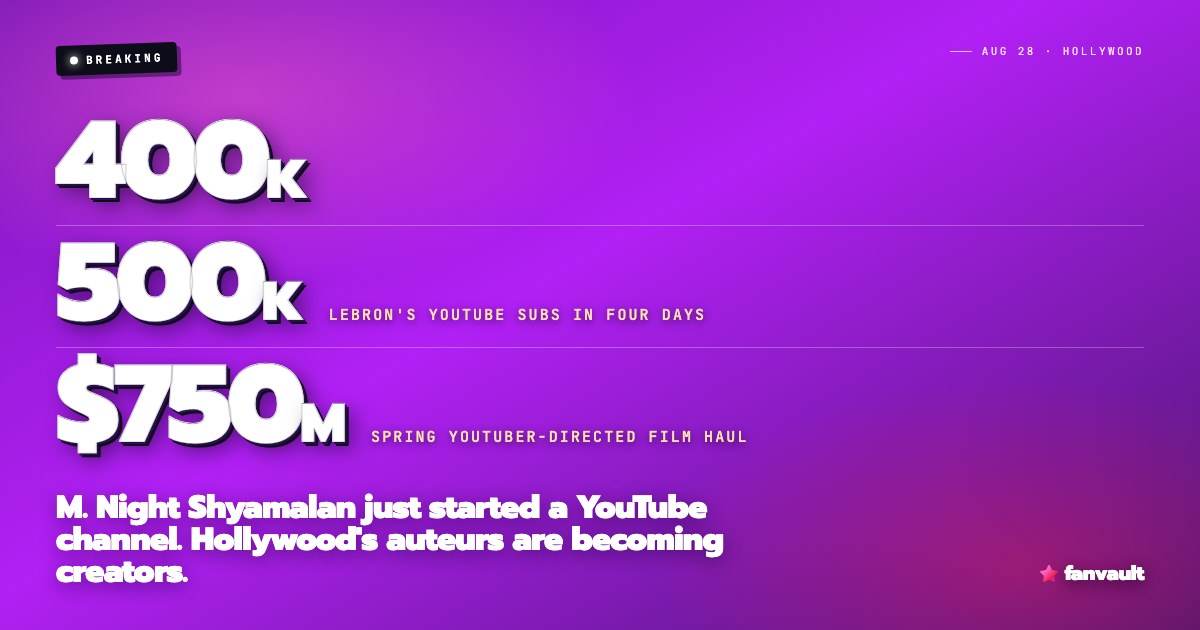
M. Night Shyamalan, the writer-director of The Sixth Sense and Split, quietly uploaded his first YouTube video on August 27, sat on a bench outside his office, and asked viewers to help him build a "relationship." The video cleared 400,000 views in under 24 hours and pulled 45,700 subscribers to a channel that did not exist two days earlier. Hollywood's auteur class just went creator-first, and the direction of travel is now impossible to miss.
⚡ Key Takeaways
- Shyamalan's debut YouTube video cleared 400,000 views and 45,700 subscribers in under 24 hours.
- He filmed himself on a bench outside his office, admitted he was "scared," and asked viewers to help him "undo" 30 years of Hollywood stigma.
- LeBron James launched a YouTube golf channel 12 days earlier and hit 500,000 subs in four days, per the YouTube blog.
- Three YouTuber-directed films (Backrooms, Iron Lung, Obsession) cleared roughly $750M worldwide this spring.
- 2026 is the crossover year where U.S. kids watch YouTube more than broadcast TV, 58.6% vs 57%.
- When a two-time Oscar nominee is asking strangers to subscribe, the leverage moved to whoever owns the audience.
What actually happened?
Shyamalan opened the channel with a self-cameo, a filmmaker who admitted on camera that he was extremely nervous to be on YouTube, per The A.V. Club. He described it as a chance to "reflect, get to know each other, deepen the relationship," and said he wanted to "undo whatever stigmas are in my head, or in anybody's head" after 30 years of making movies. The first upload passed 24,000+ likes almost immediately, according to Social News XYZ, and comments filled with "What a twist!" jokes within the first hour.
He promised a second video for August 30 and gave no other roadmap. No release schedule, no format, no partnership. Just a filmmaker on a bench, a tree he planted in memory of his father, and an ask. For a director whose entire career has been built on tightly-controlled theatrical reveals, the vulnerability is the point.
Why does this matter for creators?
A director with two Academy Award nominations and more than $3B in career box office does not need distribution. He does not need marketing. He does not need a green-light from a studio to reach the multiplex. What he says he wants, on camera, is a direct line to the audience he has spent three decades reaching through third parties.
That is a very loud admission that the direct-to-fan channel now sits above the theatrical channel in the value stack. If a filmmaker who can green-light a Universal release feels the pull to open a YouTube account and ask strangers to subscribe, the leverage in this industry has moved. It has moved toward the person who owns the audience, not the person who owns the distribution deal.
And this is not a one-off. This is a pattern accelerating in real time.
"What I hope it is is an opportunity to reflect, get to know each other, deepen the relationship."
M. Night Shyamalan, in his launch video, via JoBlo
Where does this go from here?
Shyamalan is not the first Hollywood name to make this move in August 2026. LeBron James launched a 90-minute-per-episode YouTube golf channel on August 15 and crossed 500,000 subscribers in four days, per the YouTube Official Blog. Both launches followed a spring theatrical run where three YouTuber-directed films (Kane Parsons's Backrooms, Curry Barker's Obsession, Markiplier's Iron Lung) collectively cleared roughly $750M worldwide.
Parsons became the youngest filmmaker ever to land a No. 1 opening at 20 years old, and Deadline reported Backrooms became A24's first $100M domestic release, closing at $361M+ worldwide. Meanwhile, Advanced Television noted 2026 is the crossover year where U.S. kids watch YouTube more than broadcast TV, 58.6% vs 57%, and 88% of parents of 2 to 5 year olds say their child prefers YouTube. Studio talent is going creator-first for exactly the reason unknown YouTubers are getting studio deals. The audience lives on the platform, and the economics reward the person, not the IP.
What does Fanvault think?
When the director of The Sixth Sense sits on a bench and tells the internet he wants a "relationship," that is a plain-text confirmation of what every serious creator business is already built around. The audience relationship IS the asset. Not the platform, not the algorithm, not the IP.
Fanvault takes 8% (creators keep 92%) because the direct line to an audience is worth more than the middleman that used to gate it. Fanvue takes 15%, Passes takes 10% plus $0.30, and Fanfix takes roughly 20%. None of them turn that audience into an authenticated storefront with auctions and buy-it-now drops the way Fanvault does.
A YouTube channel gets you attention. A Fanvault storefront turns that attention into recurring revenue you own, on your terms, with the automation layer running the storefront while you make the work. That is the difference between a follower count and a business.
Every creator watching this should be asking the same question. Not "should I start a channel?" but "when the audience shows up, where does the money land?"
When a two-time Oscar nominee is on a bench asking strangers to subscribe, the creator economy officially stopped being Hollywood's minor leagues.
Frequently Asked Questions
Why did M. Night Shyamalan start a YouTube channel?
Shyamalan framed the channel, in his own launch video, as an attempt to "reflect, get to know each other, deepen the relationship" with his audience after 30 years in Hollywood. He said he wanted to "undo whatever stigmas are in my head, or in anybody's head," and admitted he was scared of the format, which he took as a sign he was doing something right.
The move is less about YouTube monetization for a filmmaker of his scale and more about ownership of the audience relationship itself. It is the same reason LeBron James launched his own golf channel two weeks earlier, and the same reason unknown YouTubers are now getting theatrical release deals.
How well did the Shyamalan channel launch actually perform?
The first upload passed
Who else in Hollywood is doing this?
LeBron James launched a 90-minute-per-episode YouTube golf channel on August 15, 2026, and cleared 500,000 subscribers in four days according to the YouTube Official Blog. On the reverse side of the same trend, YouTuber-directed features like Kane Parsons's Backrooms, Markiplier's Iron Lung, and Curry Barker's Obsession collectively cleared roughly $750M worldwide this spring.
Parsons became the youngest filmmaker ever to open a No. 1 domestic release at 20 years old, and Backrooms became A24's first $100M domestic release. The traffic between YouTube and Hollywood is now bidirectional.
What does this mean for creators today?
The audience relationship is the asset. Not the platform, not the algorithm, not the IP. A director with $3B in career box office is opening a YouTube channel to build a direct line to fans, which means every creator below that ceiling should be doing the same and then some.
The practical read is to own the audience wherever you build it, and then route that audience to a storefront you actually own the economics of. Fanvault takes 8% (creators keep 92%) versus Fanvue's 15%, Passes's 10% plus $0.30, and Fanfix's roughly 20%. When Shyamalan-scale attention lands, the only question is where the money lands with it.