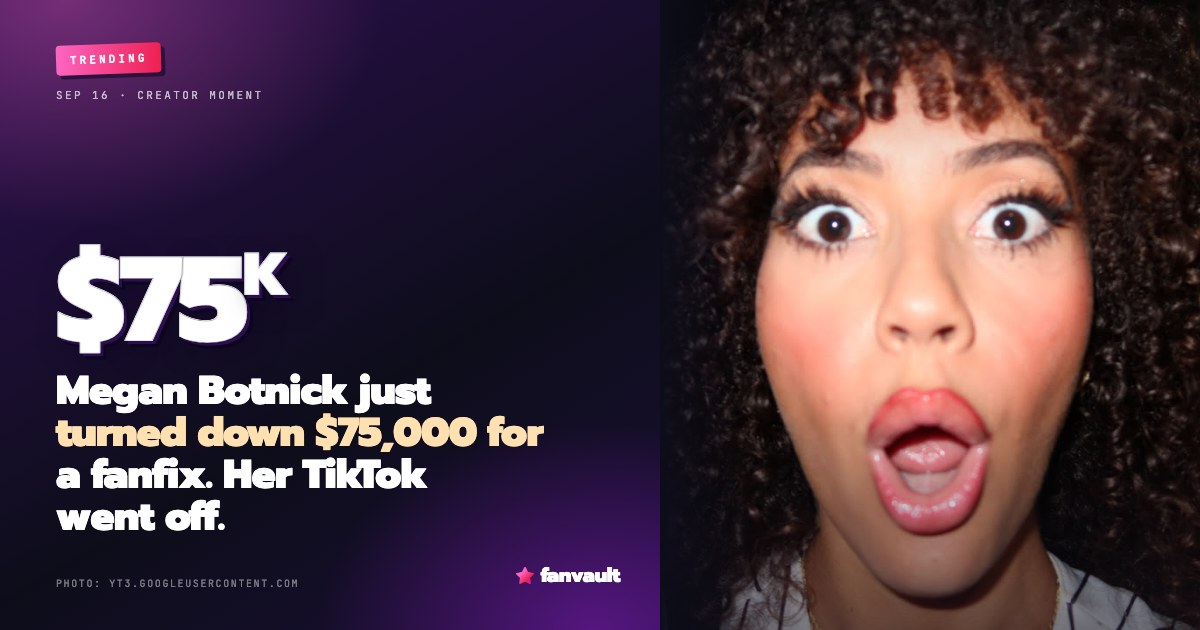
Megan Botnick just turned down $75,000 to sign with Fanfix, the safe-for-work OnlyFans alternative, and posted a car-cam TikTok explaining why while she's still paying off two credit cards. The clip broke on September 16, 2026, exploded across X and TikTok within hours, and forced the creator economy to look at a question it usually avoids: what does 2.2 million followers actually buy you?
⚡ Key Takeaways
- Megan Botnick (@mbeeco) turned down a $75,000 signing offer from Fanfix on September 16, 2026, while paying off two credit cards.
- She has roughly 1.2M Instagram followers and 500K on TikTok, and negative net worth. Follower count and bank balance aren't the same thing.
- Fanfix takes a ~20% platform commission and had paid out more than $300M to creators by mid-2026, up from roughly $170M a year earlier.
- Aggregators including Daily Loud and YabaLeftOnline pushed the clip across X the same day; Yahoo, NewsBreak, HypeFresh, and Diaspora Digital Media all ran coverage within 24 hours.
- Recruiting cash is how non-adult subscription platforms buy mid-tier talent: Fanvue takes 15%, Passes takes 10% + $0.30, Fanfix ~20%. Sign once, pay forever.
- Fanvault's position: 8% fee, 92% to the creator, no signing bonuses needed to make the math work.
What actually happened?
Botnick, a 24-year-old Brazilian-American comedian and actress with roughly 1.2M followers on Instagram and close to 500K on TikTok, filmed the video from her car. Fanfix offered her $75,000 just to sign, per Yahoo Entertainment. She was, in her own words, watching her credit score tank and losing sleep over two maxed credit cards. She said no anyway.
The story bounced across the aggregator ecosystem within hours. YabaLeftOnline and Daily Loud pushed it on X, and Yahoo Entertainment, NewsBreak, HypeFresh, and Diaspora Digital Media all had coverage up the same day. Botnick's framing did the work. She wasn't posting about Fanfix specifically, she was posting about a broader creator-economy culture she called exploitative.
Why does this matter for creators?
A creator with 2.2 million followers, negative net worth, and a five-figure signing offer on the table is not an anomaly in 2026. It's the median mid-tier influencer's Tuesday. What Botnick actually surfaced is the trade platforms hope creators don't examine too closely: cash now, in exchange for locking earnings into a fee that eats a fifth of every dollar going forward.
The follower-count-equals-wealth myth is one of the creator economy's most durable lies. Sponsorship money is inconsistent, ad revenue is discounted for short-form and comedy verticals, and the reliable payers are the platforms that keep the highest cuts. Fanfix takes a 20% commission and enforces a strict safe-for-work policy, per an independent breakdown by Luvi. By mid-2026 it had paid out more than $300M to creators, up from roughly $170M a year earlier, according to Outseeker.
The other platforms in the same frame don't fare better. Fanvue takes 15%. Passes takes 10% plus $0.30 per transaction. Signing bonuses are the sweetener that hides the fee, and they work because followers see the check but rarely see the schedule.
"A common misconception people have is that I have money because I have followers."
Megan Botnick, Comedian and creator, @mbeeco
What's the bigger picture?
The signing-bonus trend didn't start with Fanfix. YouTube's original creator-fund era, Snapchat's Spotlight payouts, TikTok's Creativity Program, all of them used upfront cash to move creators onto surfaces where the platform kept most of the recurring value. Fanfix's play is the subscription-platform version of that same move.
The pitch is easy for a creator to hear when they're 24, in debt, and watching their credit score drop. Sign here, get a check now, worry about the fee later. Fanfix reportedly paid out over $300M by mid-2026, which means it can afford to run the play at scale. That's not a knock on Fanfix's business model, it's a description of how the model works.
What's new is that creators are being loud about the numbers. A year ago these offers stayed inside DMs. Now they're the TikTok. That transparency is the actual story here, more than the specific dollar figure.
On X, Botnick posted a follow-up thanking supporters and asking them to "be the light you wish to see on the internet." Coverage in Diaspora Digital Media noted her stated plan for the money she does eventually earn: homeless shelters, animal rescue centers, and mental institutions. The line landed because it named the actual asymmetry.
Fans see the follower count. Creators see the credit-card statement. The gap between those two views is the story.
What does Fanvault think?
Fanvault's read is unsentimental. Creators shouldn't have to choose between dignity and rent, and no signing bonus fixes a fee schedule that's already extracting a fifth of everything before it hits a creator's account. The recruiting-bonus playbook only works because the fee behind it is punitive enough to recoup the check over time.
Fanvault charges 8%, so creators keep 92%. There are no recruiting checks, because the math already works without one. Every monetization surface a creator would actually want, tiered memberships, paywalled posts, paid DMs, tips, wishlists, an authenticated-memorabilia storefront, lives inside a single account. A comedian with 2.2 million followers and negative thousands in the bank doesn't need a bribe to sign, she needs a fee that actually funds the life she's already carrying.
The Botnick moment isn't going to end recruiting bonuses. It just made clear what they're actually buying.
Frequently Asked Questions
Who is Megan Botnick and how big is her following?
Megan Fernandes Botnick, 24, is a Brazilian-American comedian, actress, model, and singer based in Los Angeles who posts across every major platform under the handle @mbeeco. She has roughly
Wait, was the offer from Fanfix or from OnlyFans?
Fanfix. Several mainstream outlets, including NewsBreak, framed it as an "OnlyFans" offer, which is inaccurate. Fanfix is the safe-for-work subscription platform positioned as the OnlyFans alternative, no explicit content allowed, roughly a 20% platform commission, and more than $300M paid out to creators by mid-2026 per Outseeker. The conflation matters because it's the reason a lot of casual readers assumed this was an adult-content offer. It wasn't.
Why would she turn down $75,000 if she's in debt?
Botnick's own answer, per Yahoo Entertainment: "I would rather struggle financially as a person I'm proud of than get rich and become someone I'm ashamed of." Coverage in Diaspora Digital Media noted she plans to eventually route the money she does earn into homeless shelters, animal-rescue centers, and mental institutions. So the refusal wasn't a rejection of monetization, it was a rejection of the terms and the culture behind them.
What does this say about signing bonuses in the creator economy?
Signing bonuses have quietly become the default recruiting move for non-adult subscription platforms whose reach depends on mid-tier talent that hasn't been signed yet. The math works because the fee behind the check keeps extracting for the life of the account: Fanvue takes 15%, Passes takes 10% plus $0.30, Fanfix takes roughly 20%. A five-figure upfront number gets amortized very quickly against a fee that never stops. Botnick's post is unusual only because she made the offer public.