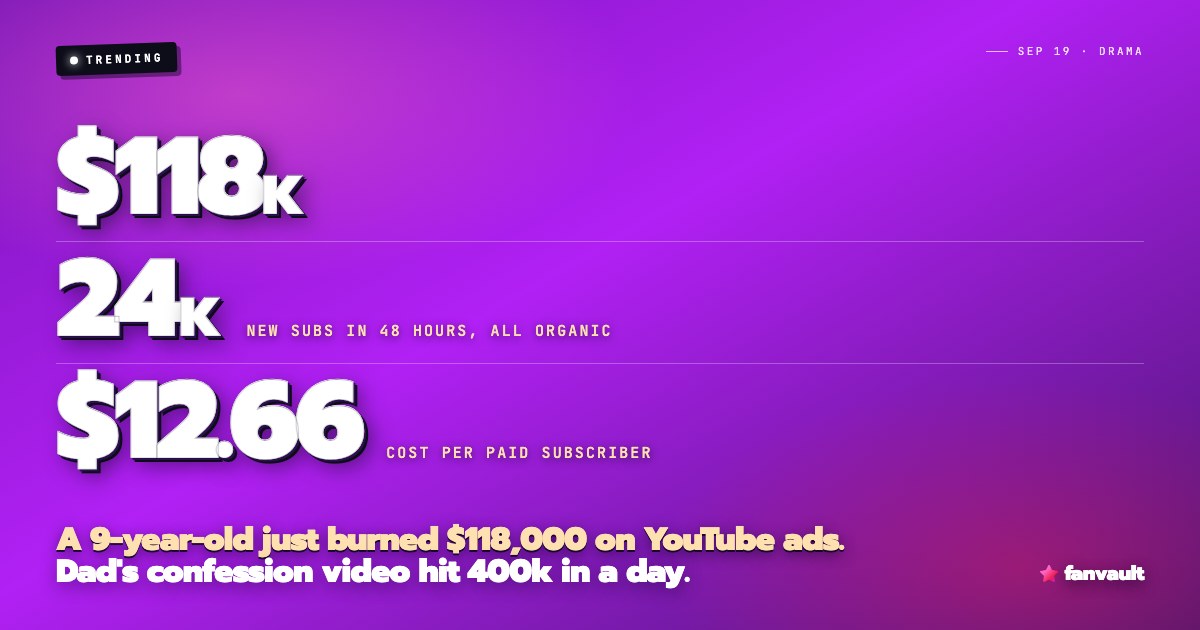
A nine-year-old Minecraft creator ran up $118,000 in YouTube ad charges on his father's company credit card over three weeks. Marketing employee David Sarkisyan hijacked his son Mike's own channel on September 15 to post the confession. That video is now ranked #7 on YouTube's gaming trending chart. It added about 24,000 new subscribers to Mighty Mike Plays in 48 hours, more than every paid campaign that preceded it combined.
⚡ Key Takeaways
- Nine-year-old Minecraft creator Mighty Mike Plays ran up $118,000 in YouTube ads over three weeks on Dad's company card.
- It started with a single $20 promotion Dad ran to cheer his son up, and then the card stayed saved in a shared Google account.
- The $118K bought 689,828 views and 9,320 subs, roughly 17 cents per view and $12.66 per subscriber.
- The free confession video 'Message from Dad' added about 24,000 new subs in 48 hours, more than every paid campaign combined.
- David Sarkisyan was terminated, is personally liable, has 30 days to repay, and may have to sell the family home.
- The story is what happens when platform defaults treat a nine-year-old and a marketing director as the same user.
What actually happened?
Per CreatorDB, the $118,000 bought 689,828 views and 9,320 subscribers across three of Mike's Minecraft videos. That works out to roughly 17 cents per view and $12.66 per subscriber, about what a growth-stage DTC brand pays for top-of-funnel traffic. The spree started with a single $20 ad Dad placed to cheer his son up after a discouraging view count. A Robux purchase had already saved the corporate card to the family's shared Google account, and Mike simply ran the same tool back over the following three weeks.
According to Video Games Chronicle, Dave was pulled into a room with his manager, corporate, and finance and shown the six-figure line item on his company card. The next day Mike posted a community update reading "I'm in big trouble," and Dad hijacked the channel that evening to release "Message from Dad... Mighty Mike Plays is Over." On September 19, per a follow-up video, Dave confirmed he had been terminated, is personally liable for the full balance, has 30 days to repay, and may have to sell the family home.
Why does this matter for creators?
Ad-driven audience buying used to sit behind an agency, a media plan, and a legal review. Today it sits behind a saved card and a slider a nine-year-old can move. YouTube's paid-promotion flow does not distinguish between a director of marketing and a child chasing view counts. Every time Mike pushed the budget bar higher, the estimated-views number went up, so he pushed it higher.
The receipt on organic versus paid is where the story gets ugly for growth hackers. Of the roughly 33,200 subscribers Mighty Mike Plays has today per Wikitubia, about 24,000 arrived in the 48 hours after the free confession went live. The panicked 12-minute video outperformed every $118,000 in ads that preceded it. Native honesty is still the growth hack, and the pumped version keeps failing on schedule.
"I was called into a room with my manager, people from corporate and people from finance, and asked to account for $118,000 of ad spend on the company credit card assigned to me."
David Sarkisyan, Mike's father, in the confession video via Vice
What's the bigger picture?
Kids are inheriting the entire 2026 growth stack whether their parents realize it or not. Per Tom's Hardware, the spree started when Dad showed Mike how the budget slider worked as a one-time promotion. A nine-year-old with no context for CPM, attribution, or audit trail looked at the exact same interface an agency uses and behaved rationally on his own terms. He turned the number up because the platform rewarded him for turning the number up.
The other lesson is where liability lands when platform defaults do the work. There is no age gate on ad spend, no anomaly detection on a personal card burning through $118,000 in three weeks, and no refund posture that softens the fall. Dave is on the hook, not YouTube, and every creator running ads through consumer tools inherits the same exposure.
What does Fanvault think?
Fanvault reads this as a monetization-stack story, not a bad-parenting story. A creator's tools should be built to keep more of what fans give them on the way in, not to claw back losses on the way out. Fanvault takes 8% per transaction and returns 92% to the creator, versus 15% at Fanvue, 10% plus 30 cents at Passes, and roughly 20% at Fanfix. Paid-promotion loops like the one that flattened the Sarkisyan family are exactly the kind of leak that eats a small channel's runway before it ever finds its audience.
The most-watched piece of content the Sarkisyan family ever made was the one where they admitted they were cooked. The market noticed, and it paid in the currency that actually matters.
Frequently Asked Questions
How did a 9-year-old spend $118,000 on YouTube ads?
Mike's father David Sarkisyan, a marketing employee, had earlier used his company credit card to buy Roblox currency (Robux) for his son, and the card stayed saved to the family's shared Google account. When Mike got discouraged that his Minecraft videos were getting single-digit views, Dad ran a one-time
Over the next three weeks, Mike ran the same YouTube ad tool back on three of his own videos, dragging the budget higher each time because the estimated-views counter went up when he did. There was no age gate, no anomaly detection on the corporate card, and no confirmation step that would have stopped him. Per Tom's Hardware, what was meant to be a single $20 promotion ended at $118,000.
What did the $118,000 actually buy in views and subscribers?
Per CreatorDB, the spend delivered
Those are not bad unit economics for a mature DTC brand chasing top-of-funnel traffic. They are catastrophic unit economics for a small kids' Minecraft channel with no product to sell against those subscribers.
What happened to David Sarkisyan after the ad charges came to light?
On September 14 Dave was pulled into a room with his manager, corporate, and finance to account for the $118,000 line item on the company card assigned to him. The next day he hijacked his son's channel to release the confession video 'Message from Dad... Mighty Mike Plays is Over.'
Per a follow-up video posted September 19 and covered by Video Games Chronicle, Dave confirmed he had been terminated, is personally on the hook for the full balance, has 30 days to repay it, and may have to sell the family home.
Why did the free confession video outperform every paid campaign?
The 12-minute confession was uploaded with zero ad spend behind it and drove roughly
Audiences reward the honest, native moment and punish the pumped one, especially on a platform whose recommender is trained to surface stories that stop the scroll. The panicked, unpolished, first-person admission was exactly the format the algorithm was built for. The ad flow was built for something else.