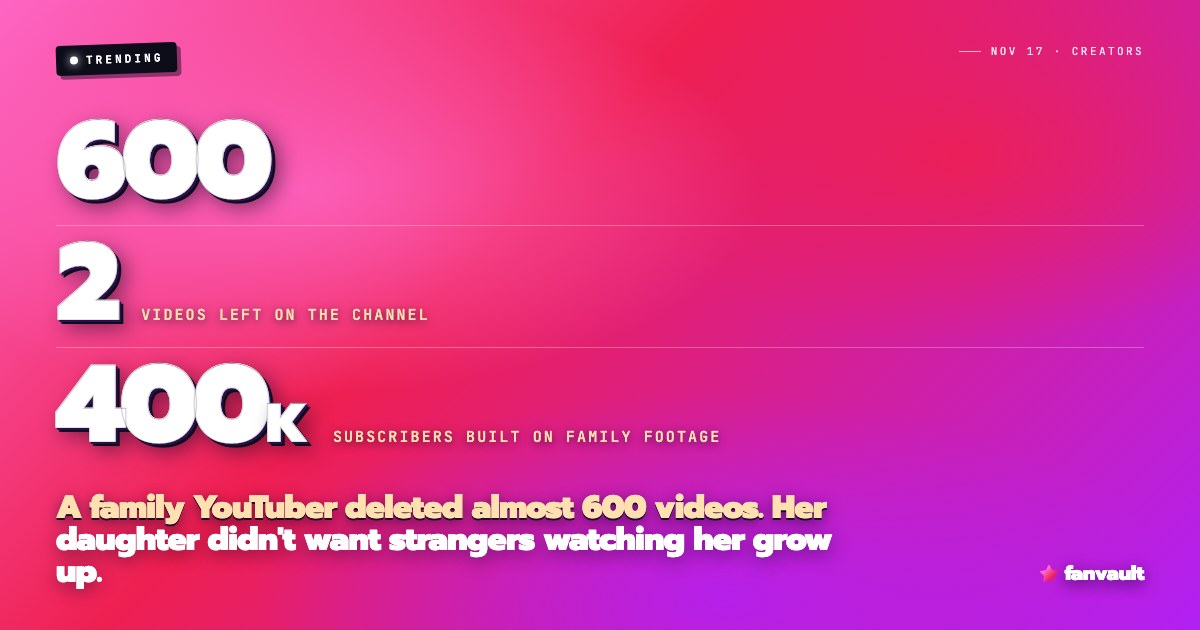
Okan, the mom behind Japanese family channel Okan to Musume, has deleted nearly 600 videos, leaving just two on a channel built to about 400,000 subscribers. The reason: her eldest daughter was embarrassed that people she had just met could pull up her childhood online. That's family vlogging's consent problem, finally cashed out by the kid it was always about.
⚡ Key Takeaways
- Okan of Japan's Okan to Musume deleted nearly 600 videos; just 2 remain on a channel of about 400K subscribers.
- The reason: her eldest daughter was embarrassed that new acquaintances could watch her childhood online.
- Public videos fell from about 590 to 175 by August 2026, then to two by November.
- Okan also plans to stop showing her younger daughter's face at a later, private date.
- US law is moving the same way: Illinois trust accounts (15% of gross) and Minnesota's under-14 ban on monetized content.
- The takeaway: a business built on someone who can't consent is a deferred bill, and Okan paid it on her daughter's timeline.
What actually happened?
The channel launched in 2018 and grew to more than 400,000 subscribers documenting the daily lives of Okan, her husband Yota, and their two daughters, according to Dexerto. In December 2025 the family paused all YouTube and social activity after Okan confirmed an underage-smoking incident involving her then-13-year-old eldest daughter, calling it "the result of a lack of education" on her part, per Yutura. When the channel returned on May 27, 2026, Okan said the eldest daughter would "basically" no longer appear, though her voice might still be heard in everyday footage, Yutura reported.
Then came the purge. By early August the public video count had fallen from about 590 to 175, and by early November only the May update remained, per Yutura tracking cited by Dexerto. In a November 17 update, Okan said her daughter had grown embarrassed by the idea of new acquaintances seeing videos from when she was little, and she also cited stricter YouTube policies. Two videos now remain, and Okan says she will stop showing her younger daughter's face at a date she is keeping private.
"We deleted the videos out of respect for my daughter's feelings."
Okan, Creator of Okan to Musume, via Dexerto
Why does this matter for creators?
Family vlogging has always run on a quiet liability: the main talent never signed anything. The back catalog keeps earning views and ad revenue long after the kid in it is old enough to say no. Okan let that bill come due voluntarily, and she paid it in years of content and the income attached to it.
The math is uncomfortable. A 400K-subscriber channel built largely on a child's daily life is an asset only as long as that child stays quiet about it. Once she is a teenager with classmates, a search bar, and opinions, the archive flips from income into exposure.
Give Okan credit. Most channels in this genre wait for a lawsuit, a law, or a viral callout before anything comes down. She chose the kid over the catalog, on the kid's timeline. That's the right call, and every parent-run channel should be doing the same math on what its archive actually costs.
What's the bigger picture?
Okan isn't alone. In September, PewDiePie ended his family vlogs, saying he wanted his son to have more privacy and make his own choices about appearing online, Dexerto noted.
Lawmakers are moving the same way. Illinois requires that kids under 16 get 15% of gross earnings, held in trust, when they appear in at least 30% of paid video content in a 30-day window, per Fisher Phillips. Minnesota went further on July 1, 2025, barring children under 14 from monetized content creation and letting people depicted as minors sue for damages, the Star Tribune reported.
Illinois, California, Minnesota, and Utah have all passed kidfluencer protections, according to the New Jersey State Bar Foundation. The direction is obvious. A child's footage is increasingly treated as the child's own, and Okan just showed what it looks like when a parent acts on that before anyone forces her to.
What does Fanvault think?
Fanvault's position is simple: the person on camera should be the person who chose to be there and who owns the upside. That's why Fanvault is an 18+ platform where every user and creator is age-verified and every creator is manually approved at onboarding. Creators keep 92% of every transaction across memberships, paywalled posts, paid DMs, tips, wishlists, and a storefront for authenticated memorabilia. Okan's lesson isn't to stop sharing your life, it's that a creator business should be built by the person whose life it is.
Okan to Musume spent years turning a childhood into content. It took one teenager's embarrassment to switch most of it off, and that might be the most honest edit family vlogging has made all year.
Frequently Asked Questions
Why did Okan delete almost 600 videos?
In her November 17, 2026 update, Okan said her eldest daughter was embarrassed that people she had just met could watch videos from her childhood. She also cited stricter YouTube policies, according to Dexerto.
How many videos are left on the Okan to Musume channel?
Just two: the May 2026 return update and the November explainer. The public count fell from about 590 to 175 by early August, per Yutura tracking cited by Dexerto.
Will Okan keep making family vlogs?
Yes, but differently. Okan expects her eldest daughter to stop appearing on social media altogether, and she plans to stop showing her younger daughter's face at a date she is keeping private, while continuing everyday vlogs.
Which US states have kidfluencer laws?
Illinois, California, Minnesota, and Utah have passed protections, per the New Jersey State Bar Foundation. Illinois requires a trust set-aside of 15% of gross earnings for qualifying kids under 16, and Minnesota bars children under 14 from monetized content creation, per the Star Tribune.
What does this mean for family vloggers?
A back catalog built on a child's life can become a liability once that child is old enough to object, and the law increasingly backs the child. The durable creator business is one where the person on camera is an adult who chose to be there and owns the upside.