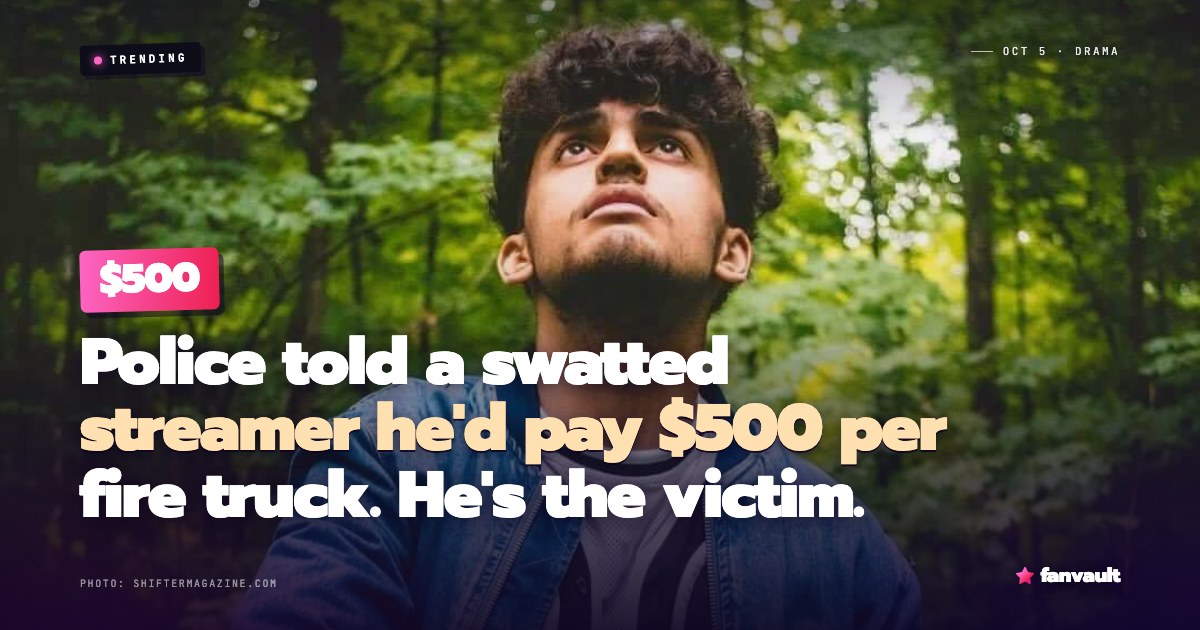
Toronto police told Kick streamer Tiagz he'd be billed $500 for every fire truck that answers the next swatting call at his Airbnb. In the same conversation, they admitted he didn't make the calls. Eight trucks rolled to the last fake fire, so one repeat costs $4,000. The victim gets the invoice, and the swatter gets nothing.
⚡ Key Takeaways
- Toronto police told Kick streamer Tiagz he'd be billed $500 per fire truck for future swatting calls at his Airbnb.
- Eight trucks answered the last fake fire report, so one repeat means a $4,000 bill for the victim.
- The same officer admitted police had no reason to believe anyone at the property made the calls.
- Toronto's 2026 rate is actually $583.05 per vehicle for malicious false alarms, about $4,664 for eight trucks.
- In September, police threatened Tiagz with a mischief arrest over the same swattings.
- The fee bills the address, not the caller, so the only findable person in the chain pays.
What actually happened?
According to Dexerto, officers came to Tiagz's door after a false report of a residential fire sent emergency crews to his Toronto Airbnb. One officer said eight fire trucks had responded and that police had no reason to believe anyone at the property made the call, a point Yardbarker also flagged. Then came the warning: the fire department would treat the next incident as a false alarm, and somebody was paying.
"There is a bill for $500 for each truck that responds."
Unnamed Toronto police officer, on Tiagz's Kick livestream, via Dexerto
Tiagz asked whether police could trace the calls. The officer said that would come later, adding, "But upfront they will be placing a bill on you guys." When Tiagz asked why he should pay for calls he never made, the officer pointed at the address getting the response and tied the incidents to his livestreaming. Tiagz refused the charge and was told he could fight it in court.
This isn't round one. In September, police came to the same Airbnb and threatened to arrest him over the repeated swattings, Dexerto reported. A clip that spread around September 22 shows an officer warning that a third visit that night would mean a mischief charge, per Werkin on X. Tiagz refused to end the stream, arguing the camera was what protected him.
Why does this matter for creators?
Because it flips the logic of harassment. The swatter is anonymous. The streamer is the one person in the chain with a fixed, findable address, so the bill, the arrest warnings, and the court date all land on him.
The officer's framing tells you everything. Telling a victim that "right now these actions are inciting false alarms" treats the livestream itself as the offense, as quoted by Dexerto. Live IRL streaming pays creators for being present and reachable in real time, and swatters weaponize exactly that.
And the money isn't a bluff. Toronto's fee schedule, published by the City of Toronto, charges $583.05 per fire vehicle dispatched to an address for a malicious false alarm under its 2026 rates. Eight trucks at that rate comes to about $4,664, more than the officer's own math.
The fee is written to bill the address that gets the trucks, not the person who dialed. For a homeowner with a faulty alarm, that logic holds. For a streamer being targeted by strangers, it's a tax on being harassed.
There's a chilling effect baked in, too. If staying live means more calls and more bills, the rational move is to stop streaming from anywhere findable, which is exactly what a swatter wants.
Where does this go from here?
Dexerto's post on X said police were still trying to find the swatter, and it pulled more than 2,300 likes as the story spread to Yardbarker and Digg. Until someone is identified, every new prank call arrives with a price tag attached to Tiagz's door.
Watch three things: whether the city actually issues an invoice, whether Tiagz contests it in court, and whether police ever trace the calls. The city's fee page also links a false-alarm reimbursement request form, the obvious first stop if a bill shows up.
The bigger question belongs to the platforms. It's not just the Airbnb, either: clips from his community show Tiagz and his team swatted while driving in Montreal. Kick and every other live platform earn from IRL content that broadcasts where a creator is, minute by minute. When that turns into a target, the creator absorbs the legal and financial risk alone.
Swatting already puts a creator's safety on the line. Toronto just found a way to make the target pay for it, too.
Frequently Asked Questions
Why would a swatting victim get billed for fire trucks?
Toronto charges a fee for each fire vehicle dispatched to a specific address in response to a malicious false alarm, currently
How much could Tiagz owe?
The officer quoted
Has Tiagz been threatened by police over swatting before?
Yes. In September, officers warned that if they had to return a third time that night he would be arrested and charged with mischief, according to a clip shared by Werkin on X. Tiagz refused to end his stream, arguing the camera protected him.
Can Tiagz fight the bill?
He refused the charge on stream and was told he would have to take it to court. The City of Toronto's fee page also links a false-alarm reimbursement request form.