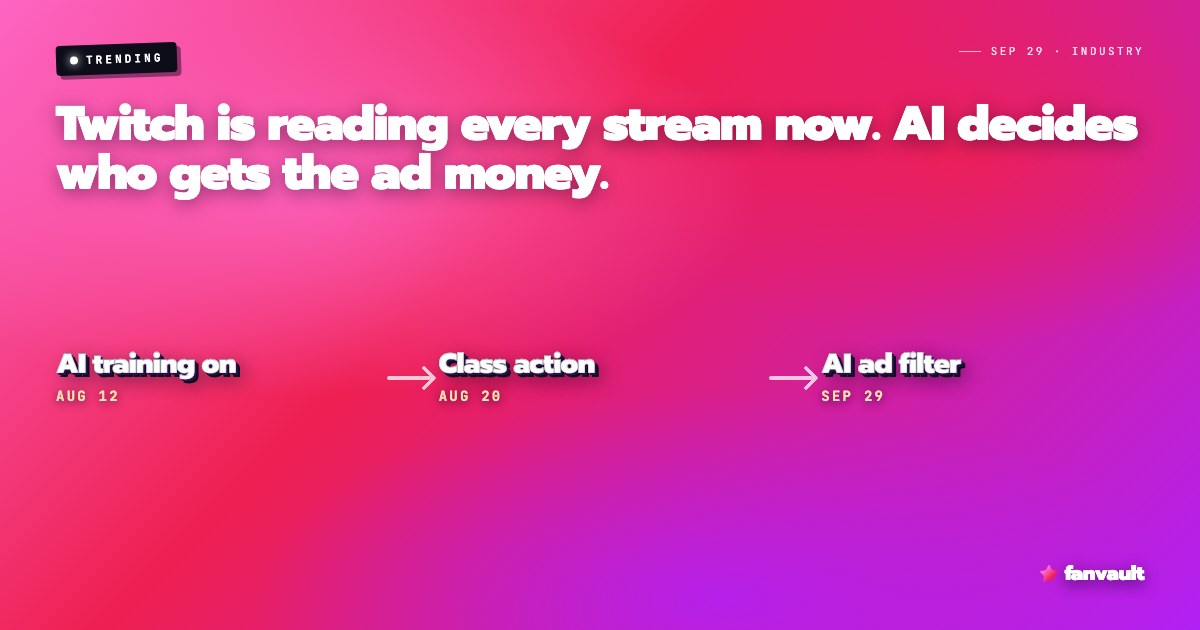
Twitch CEO Dan Clancy says the platform now transcribes everything streamers say live, and AI decides whether each channel is safe for a given advertiser. Fail the check and that brand's ads simply don't run on your stream. Creators can't see the verdict, appeal it, or audit it, and it lands six weeks after Twitch switched on Amazon AI training by default.
⚡ Key Takeaways
- Twitch CEO Dan Clancy says the platform transcribes every live stream and uses AI to decide which advertisers' ads run on each channel.
- Creator-applied content labels hit "over 99 percent" consistency, per Clancy, and AI transcription now sits on top of them.
- Streamers can't see what triggers a flag, and LGBTQIA+ creators and VTubers are leading the backlash.
- It follows Twitch's August 12 default opt-in to Amazon AI training and an August 20 class action over scraping.
- Twitch drew 4.3B hours in Q2 2026 against YouTube's 15.6B, and its lead over Kick shrank to about 3x.
- The takeaway for creators: income that comes straight from fans can't be muted by an advertiser's AI.
What actually happened?
Clancy made the comments on episode 75 of The Snarketing Podcast, recorded September 22 according to Dexerto. The clip blew up on September 29 when streaming reporter Zach Bussey posted it, per Techloy, and Tubefilter confirmed the core claim: Twitch transcribes all live streams and uses AI to withhold ads from content it judges a poor brand match.
The system stacks two layers. Creators tag their own streams with Content Classification Labels, which Clancy says are applied with over 99 percent consistency. AI transcription of live speech sits on top, and the combined signal gets checked against each advertiser's brand settings.
"We have content classification guidelines; they have over 99 percent consistency in labeling it. So then, when you, as an advertiser, tell us what your brand considerations are, you can make sure that it doesn't appear near stuff that doesn't match your brand."
Dan Clancy, CEO, Twitch, The Snarketing Podcast via Dexerto
Why does this matter for creators?
Because the rules are invisible. Twitch hasn't told streamers which words, topics, or jokes trip a flag, so swearing, politics, or a sexual bit can quietly drop a channel out of a campaign. That's a pay cut with no notice and no paper trail.
The creators most worried are the ones blunt filters already punish. LGBTQIA+ streamers and VTubers are leading the backlash, and LuminusRed, a streamer with about 16,000 followers, told Cineplay their ad revenue fell when they used queer-related tags like "lesbian" in past experiments. Now they fear an AI will flag them every time they mention their own identity. Others point out that a transcript doesn't hear sarcasm, tone, or context.
Brand safety sounds neutral. In practice it means an advertiser's comfort zone gets enforced by a model reading your words in real time, and the creator eats the cost.
What's the bigger picture?
The timing is doing a lot of damage here. On August 12, Twitch confirmed Amazon trains generative AI on streams, VODs, clips, chat, images and text, with the setting on by default, as Decrypt reported. Chief product officer Mike Minton's defense: "If it was opt-in, nobody would opt in."
On August 20, streamer Warren Pandiscia filed a proposed class action against Twitch and Amazon in federal court in Northern California, alleging the scraping may have started as early as 2024, per Tubefilter. Six weeks later, streamers learned that what they say on air is also being transcribed to decide who gets paid.
Then there's the business pressure. Streams Charts counted a record 31.4B hours of livestreams watched in Q2 2026, and Twitch's slice looks thin next to YouTube and TikTok LIVE. Its lead over Kick shrank from about 5x to about 3x in a year.
| Platform | Hours watched, Q2 2026 |
|---|---|
| YouTube | 15.6B |
| TikTok LIVE | 8.9B |
| Twitch | 4.3B |
| Kick | 1.6B |
A platform losing share has every reason to make its ad inventory look safer to brands. The question is who pays for that safety, and the answer is creators, through a system they can't see or challenge.
What does Fanvault think?
Fanvault thinks this is the clearest argument yet for income that never passes through an advertiser's filter. Streamers and gaming talent are one of the creator groups Fanvault is built for, and the model is direct fan revenue (subscriptions, paywalled posts, tips, paid DMs, and a storefront for auctions and buy-it-now drops of authenticated memorabilia like stream-worn apparel and tournament gear), with creators keeping 92% on an 8% platform fee. To be straight about it, Fanvault uses AI too, for content moderation via Sightengine under brand-safe standards with a two-strike policy. The difference is that a creator's paycheck comes from fans who chose them, not from whether an ad model approved of their last sentence.
Twitch built a machine that listens to every word and tied the ad money to what it hears. Smart streamers will start building the income it can't mute.
Frequently Asked Questions
Does Twitch really transcribe every stream?
Yes, according to CEO Dan Clancy on episode 75 of The Snarketing Podcast. Tubefilter reports Twitch transcribes all live streams and uses AI to withhold ads from content it judges a poor match for an advertiser's brand.
How does Twitch decide which ads run on a stream?
Two layers. Streamers apply Content Classification Labels, which Clancy says are used with
Which creators are most worried about Twitch's brand-safety AI?
LGBTQIA+ streamers and VTubers. Streamer LuminusRed told Cineplay their ad revenue fell when they used queer-related tags like "lesbian," and they fear the AI will flag mentions of their own identity.
How is this connected to Twitch's Amazon AI training controversy?
On
How can streamers protect their income from ad filters?
Lean on revenue that comes directly from fans: subscriptions, paywalled posts, tips, paid DMs and drops. On Fanvault, creators keep