YouTube will not terminate Russell Brand's channel, even after his conviction for rape and sexual assault and a sentence of 10 years and six months. Meta already wiped his Instagram, Facebook and WhatsApp. A prison-message video his wife posted to the channel had about 950K views when Tubefilter reported the decision, despite the UK government asking Google to pull it. One convicted creator, two opposite answers, and that split is the real story.
⚡ Key Takeaways
- Russell Brand was convicted of one rape and three sexual assaults on Nov 5 and sentenced to 10 years and six months on Nov 9.
- Meta disabled his Instagram, Facebook and WhatsApp within days. YouTube is keeping his 6.6M-subscriber channel live.
- A prison message read by his wife hit about 950K views after Google refused a UK government request to remove it.
- YouTube only terminates when the channel's content is tied to the crime; Brand's offences predate 2009, his channel started in 2012.
- The takeaway for creators: distribution and income are separate switches, and every platform draws its own line.
What actually happened?
On November 5, a Southwark Crown Court jury convicted Brand of one count of rape and three counts of sexual assault against four women, offences committed between 2004 and 2009, per the Metropolitan Police. He was acquitted of two other rape counts and one count of attempted indecent assault, according to The Hollywood Reporter. On November 9, Mr Justice Bennathan sentenced him to 10 years and six months, and he must serve two thirds before release on licence, Variety reported. Brand denied every charge.
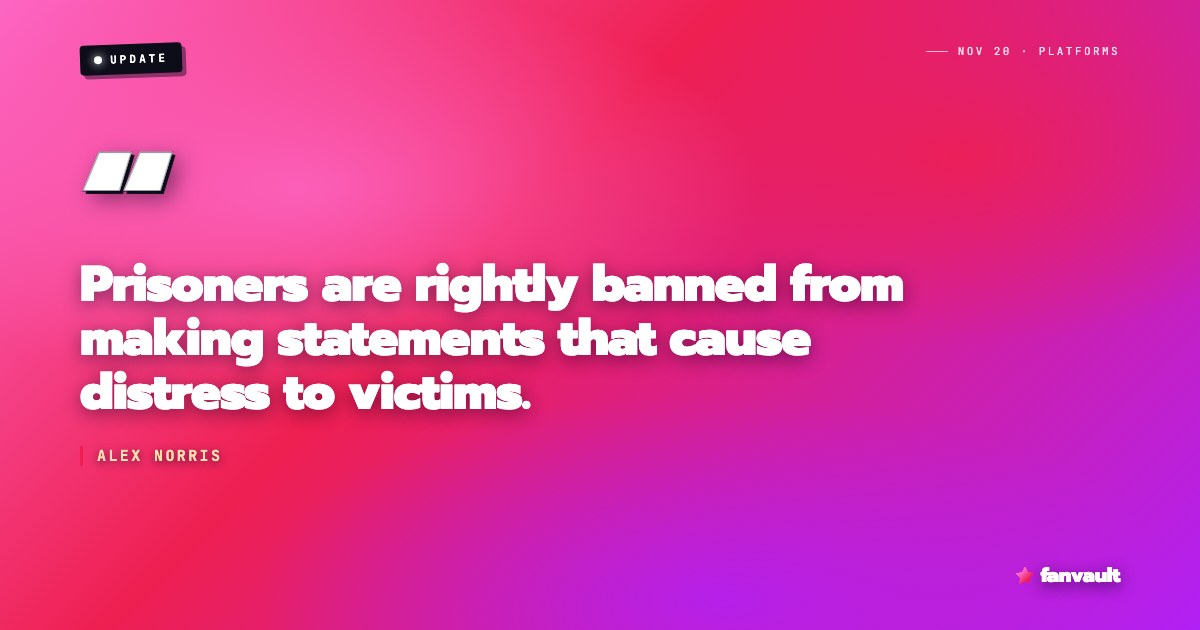
Within days, Meta disabled his Instagram, Facebook and WhatsApp accounts, and a spokesperson confirmed the Instagram removal was for policy violations, per LBC. Then on November 15, Laura Brand posted an episode of 'Sunday Service with the Brands' to his YouTube channel, reading a handwritten message from him in prison insisting he is not guilty. Justice Secretary Alex Norris called it 'completely unacceptable,' and Downing Street confirmed an investigation into a possible prison-rules breach, according to ITV. The Ministry of Justice asked Google to remove the video, and Google declined, saying it did not break its rules while adding that its teams were investigating (Variety).
| Platform | Account status | Money |
|---|---|---|
| Meta (Instagram, Facebook, WhatsApp) | Disabled | Gone with the accounts |
| YouTube | Live, prison video still up | Demonetized since September 2023 |
| X | Active | No action reported |
Why does this matter for creators?
YouTube's rule is narrow on purpose. It terminates a channel only when the owner is convicted and the channel's content is directly tied to the crime, per Tubefilter. Brand's offences all predate 2009, and his channel started uploading in 2012, so by YouTube's own logic the channel is not the crime.
Here's our stance: that logic is defensible on paper and incoherent in practice. A rule built to separate the person from the content stops working when the content is the person, broadcasting a denial from a prison cell to a channel with 6.6 million subscribers. YouTube already decided Brand shouldn't earn a cent from that channel. Deciding he can still use it as a megaphone, over the explicit objection of the government that jailed him, is a choice, not a neutral default.
For every other creator, the lesson is colder. Demonetized-but-not-banned is a real, lasting status, and distribution and income are two separate switches that each platform flips on its own terms.
"It is only right that the Government asks for content that is distressing for victims to be taken down, and we strongly believe YouTube should remove this content."
Ministry of Justice spokesperson, UK Ministry of Justice, Yahoo News
What's the bigger picture?
Brand saw the first switch flip in September 2023, when YouTube cut him from the Partner Program after sexual-assault allegations, per Al Jazeera. At the time he had about 6.6M YouTube subscribers, 11.2M X followers and 1.4M on Rumble, according to Rolling Stone. He moved his money to Rumble and asked fans to pay $60 a year, NME reported. Even on the way down, his income came from a direct line to his audience, not from ad revenue.
That is the uncomfortable part of this story. The ownership tools that let a convicted man keep talking to millions are the same tools every legitimate creator needs. The difference should be rules, published in advance and applied the same way to everyone, not three companies improvising three answers to one case. Meta removed the person, YouTube kept the channel and cut the money, and X did nothing.
What to watch next: any sanction for the broadcast falls to the governor of HMP Littlehey, where Brand says he is held, and could include a longer sentence or lost privileges. And YouTube still has to answer whether reaction and conspiracy videos from a convicted man count as related content.
What does Fanvault think?
Fanvault thinks platforms owe creators and fans rules they can read before a crisis, not policy invented in the middle of one. That's why Fanvault is an 18+, invite-gated platform where every creator is verified and manually approved at onboarding, content runs through AI moderation, and brand-safe standards are backed by a two-strike policy. Creators who play by those rules keep 92% of what they earn (an 8% fee, versus 15% at Fanvue, 10% + $0.30 at Passes and about 20% at Fanfix) across memberships, paywalled posts, paid DMs, tips, wishlists and a storefront. Own the relationship with your fans, and make sure the platform underneath you writes its lines down.
YouTube says the channel isn't the crime. A 950K-view broadcast from a prison cell says the line was never that clean.
Frequently Asked Questions
Why won't YouTube remove Russell Brand's channel?
YouTube's policy is to terminate a channel only when its owner is convicted and the channel's content is directly tied to the crime, per Tubefilter. Brand's offences were committed between 2004 and 2009, and his channel began uploading in 2012.
Is Russell Brand still making money from YouTube?
No. YouTube suspended his channel from the Partner Program in September 2023, and Google says it has not been able to monetize since, per Al Jazeera and Yahoo. After that he asked fans to pay $60 a year on Rumble, NME reported.
What did Meta do with Russell Brand's accounts?
Meta disabled his Instagram, Facebook and WhatsApp accounts after his sentencing, and a spokesperson confirmed the Instagram removal was for policy violations, per LBC. His X account remains active.
What does this mean for creators?
Demonetization and removal are separate decisions, and each platform makes them on its own terms. Creators who own a direct relationship with their audience, on a platform with clear published standards, are less exposed to rules that change case by case.