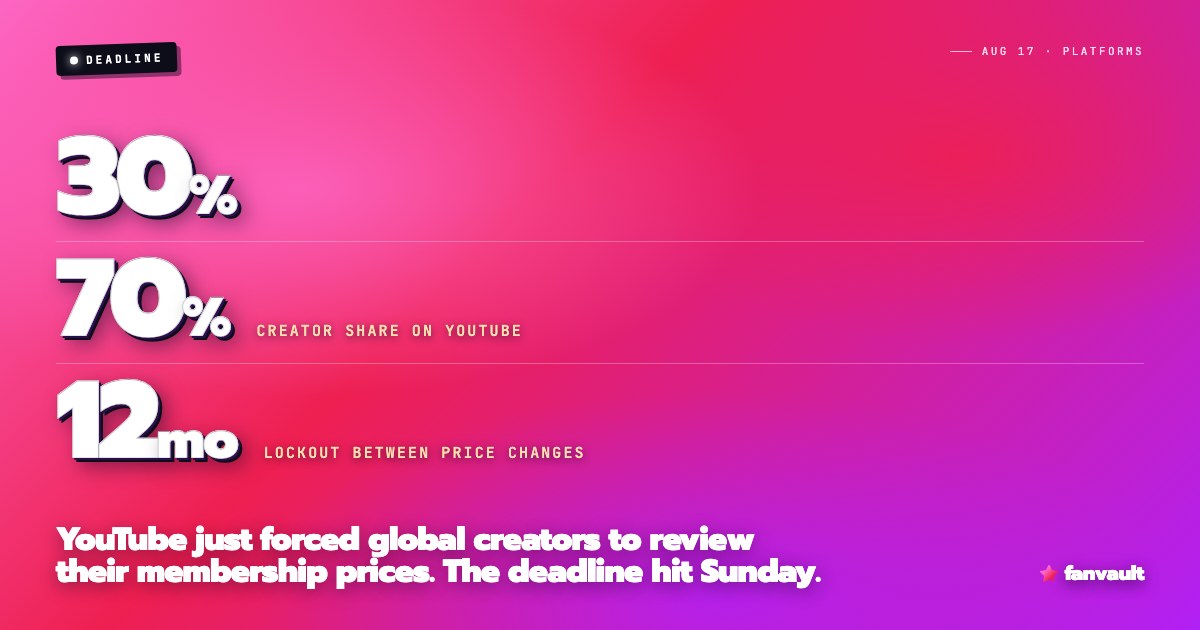
YouTube's deadline hit Sunday. As of August 17, 2026, if a creator with international channel members did not manually review or override YouTube's new smart-pricing recommendations, the platform now auto-applies FX-adjusted default prices to every new membership signup outside the US. YouTube keeps 30% of whatever number lands on the rail. Silence was consent.
⚡ Key Takeaways
- YouTube's August 17 deadline forced creators to review international channel membership prices or accept the platform's smart-pricing algorithm as the default.
- If a creator did nothing, YouTube's FX-adjusted recommendations now set the price for every new international member.
- YouTube keeps 30% of every membership payment, creators keep 70%, and that split applies to whatever number the algorithm lands on.
- Existing paying members are unaffected, and members paying in US dollars are untouched.
- Prices can only be changed once every 12 months per tier, so Sunday's decision is effectively locked through August 2027.
- Fanvault charges 8% and lets the creator set the price, not the platform.
What actually happened?
YouTube quietly rolled out a country-specific pricing engine inside YouTube Studio's Earn > Memberships surface. The recommendations are computed from audience location, engagement per country, and what comparable audiences pay, per TubeBuddy. Creators had three options: accept YouTube's number, edit it, or set their own. If they did nothing, YouTube's number became the default for new international members.
Existing paying members keep the price they already pay, and members paying in US dollars are untouched, per Social Day. That narrows the impact to new international signups, which is precisely where most growth still comes from. Memberships can only be repriced once every 12 months per tier, per YouTube Help. Whatever a creator locked in Sunday is now locked through August 2027.
Why does this matter for creators?
Price is not a knob a platform gets to twist. It is positioning. When YouTube's algorithm decides what a Tier 1 in Brazil, Nigeria, or the Philippines should cost, the creator has outsourced the most strategic lever in their entire membership stack. YouTube takes 30% of whatever number the algorithm lands on.
The default-action-forcing part is the tell. YouTube did not ask creators to opt in to smart pricing, it shipped the recommendations, set a deadline, and let inertia carry the rest. Creator-industry outlets escalated coverage in the weeks before Sunday, but most creators still learned about it after the fact. That is what platform gravity looks like in 2026.
"Some creators have noted that the channel membership rates can fluctuate significantly based on foreign exchange rates, which makes it more expensive for international fans to sign up. In order to address this, YouTube has added new balancing measures to keep fees relative by location."
Andrew Hutchinson, Content and Social Media Manager, Social Media Today
What's the bigger picture?
Channel Memberships launched in 2018 at a flat $4.99 tier for creators with 100,000+ subscribers, per Variety. The subscriber floor dropped to 1,000 by December 2020, opening the feature to creators in 80+ countries, per Tubefilter. In the eight years since, local prices have drifted from their USD equivalent as currencies moved. Sunday was the first time YouTube forced a global recalibration tied to FX rates.
It landed next to a mobile UI change that pulled membership CTAs from a hidden modal onto channel pages and video playback surfaces, per Social Media Today. International viewers now hit the newly-recalibrated prices with more visual prominence than ever. That means the change is not just a back-end recalibration, it is a front-end conversion event. YouTube tuned the price and the placement in the same quarter.
What does Fanvault think?
This is what happens when the pricing rails do not belong to the creator. A YouTube membership is not a business the creator owns, it is a revenue stream YouTube rents to them, and last week YouTube adjusted the rent. Fanvault charges 8% per transaction and creators keep 92%. More importantly, the creator sets the price, not the platform's algorithm.
The competitive frame here is not Patreon or OnlyFans, it is the closed-monetization platforms that play the same pricing game. Fanvue charges 15%, Passes takes 10% plus $0.30, and Fanfix takes about 20%. Each of them owns the rails. Fanvault gives them back.
Memberships have become the load-bearing wall of community-led creator businesses in 2026, not a nice-to-have on top of ads. When a platform can quietly recalibrate what a Brazilian, Filipino, or Nigerian fan pays for a tier, the wall moves. The creators most exposed are the ones with the most international audience, which is most creators above a middle tier of scale.
The default price won. Creators now have a year to figure out whether the platform's number was worth the silence.
Frequently Asked Questions
What is YouTube's August 17 membership pricing change?
YouTube introduced country-specific pricing recommendations for channel memberships purchased outside the United States. As of August 17, 2026, if a creator did not review or override the recommendations inside YouTube Studio's Earn > Memberships surface, YouTube automatically applies its
How much does YouTube take from channel memberships?
YouTube keeps
Can a creator still change their membership price now?
Membership prices can only be updated once every 12 months per tier under YouTube's normal rules, per YouTube Help. Whatever a creator locked in at the August 17 deadline is effectively their price for the next year, which is why the deadline was action-forcing in the first place.
Why does this matter for global creators?
The creators most exposed are the ones with the most international audience, which is the majority of creators above a middle tier of scale. If a platform can quietly recalibrate what a viewer in Brazil, Nigeria, or the Philippines pays for a Tier 1 membership, the creator no longer controls their own pricing floor. That is the load-bearing wall of a community-led revenue business, and it just moved without a creator vote.