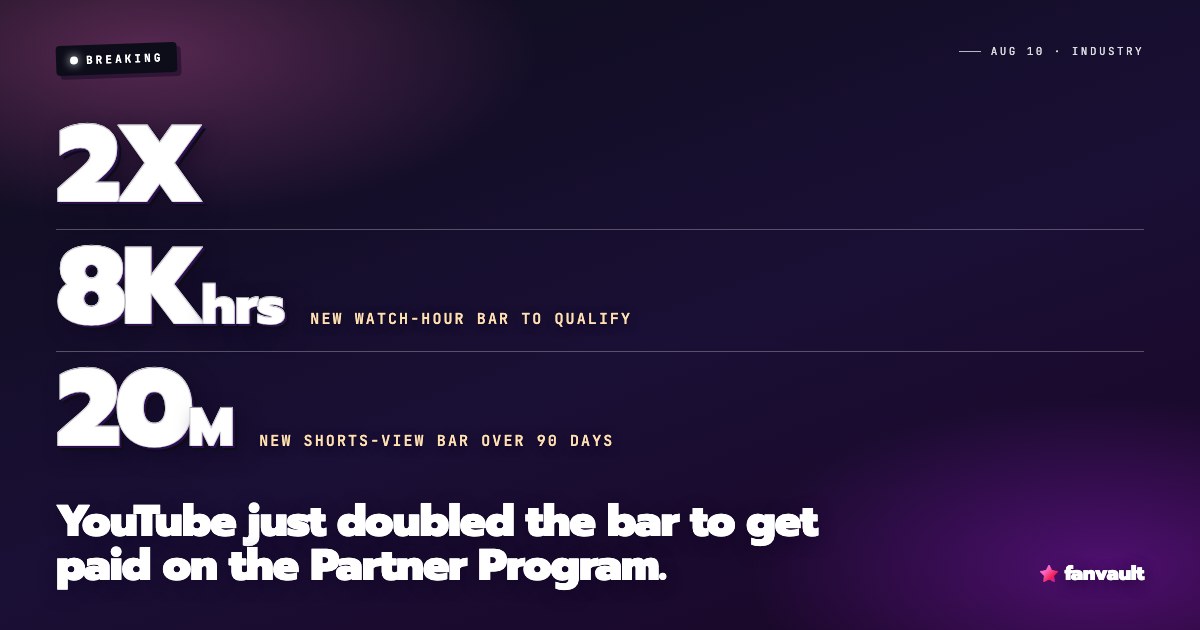
YouTube just moved the ad-revenue finish line, and it did it for the first time in eight years. Starting February 1, 2027, new YouTube Partner Program applicants will need 8,000 qualified watch hours over 365 days or 20 million qualified Shorts views over 90 days, double the current bar on both paths. If you were grinding toward the old thresholds, congratulations, you just started over.
⚡ Key Takeaways
- YouTube is doubling the Partner Program entry bar for the first time since 2018: 8,000 watch hours or 20 million Shorts views, up from 4K and 10M.
- The new thresholds hit new applicants February 1, 2027. All 3 million existing Partner Program channels are grandfathered in, but must re-accept updated terms by January 31.
- The Shorts Creators Pool ad share still requires 10M views over 90 days, and the 45% Shorts creator split stays put, so higher entry bars don't come with a better payout rate.
- At YouTube's own Shorts RPMs of $0.01 to $0.07 per 1,000 views, even a 20 million-view quarter earns roughly $200 to $1,400 gross before splits.
- Sub-threshold creators get a consolation prize: Shopping bonuses, brand-deal rewards, and 'trend boosts' instead of ad share. Fan funding (Super Thanks, Super Chats, memberships) is untouched.
- For the direct-to-fan monetization stack, this is a tailwind. When the ad-share door doubles in height, owning your storefront starts to look less optional.
What actually happened?
The announcement dropped on the official YouTube blog on August 10, and TechCrunch and Tubefilter both had the story up within hours. New applicants to the Partner Program after February 1, 2027 will need 1,000 subscribers plus one of two paths: 8,000 qualified watch hours over 365 days (up from 4,000), or 20 million qualified Shorts views over 90 days (up from 10 million). This is the first significant overhaul of the entry bar since 2018.
The 3 million channels already in the program are grandfathered in on the old thresholds, but they still have to review and accept an updated agreement in YouTube Studio by January 31, 2027 or lose monetization. Fan funding (Super Thanks, Super Chats, Channel Memberships) is untouched at the current, lower bar. The Shorts Creators Pool ad-revenue share stays gated at 10 million qualified Shorts views over 90 days, meaning even a channel that clears the higher entry bar can still drop out of short-form ad revenue if its velocity slips.
Why does this matter for creators?
The math on this is brutal for anyone still climbing. 4,000 watch hours was already about a year of consistent uploads for most hobby channels. 8,000 hours pushes the ramp to somewhere between 18 and 24 months of grinding before the first ad check lands.
The Shorts path is worse in proportion. 20 million qualified views over 90 days is not a discovery milestone, it is a full-time creator's KPI. And at YouTube's own Shorts RPMs of $0.01 to $0.07 per 1,000 views, hitting that 20M threshold pays roughly $200 to $1,400 gross before YouTube's 45% creator split kicks in.
"To keep pace with the growth of YouTube, which now sees over 200 billion daily Shorts views and over a billion hours of watch time on TV every day, we are updating the YPP entry requirements for ads and Premium revenue sharing for new creators."
YouTube, official blog post announcing the 2027 changes
What's the bigger picture?
The subtext is written on YouTube's own graph paper. Shorts is a firehose, 200 billion views a day per CEO Neal Mohan at Cannes Lions, and ad-revenue-share at pennies-per-thousand-views is not going to keep pace with it. YouTube's answer is to raise the door and layer in a set of alternative monetization programs for the creators locked below it: Shopping bonuses, brand-deal rewards, and trend boosts for creators who start or grow a trend.
Translation: YouTube does not want to pay new creators from the ad pool at Shorts scale. It wants to point them at commerce and sponsorships instead. That is a quiet rewrite of the creator ladder, announced on a Monday blog post. The old promise (hit 4,000 watch hours and you're on the payroll) is being replaced by a new one (hit our commerce metrics, or bring your own sponsors).
What does Fanvault think?
This is exactly the kind of platform move that keeps making the direct-to-fan stack look sharper. When the megaplatform ad-share door doubles in height and the ceiling on Shorts revenue barely moves, the argument for owning your monetization instead of renting it stops being philosophical. Fanvault takes 8% and creators keep 92%, with tiered memberships, paid DMs, tips, wishlists, and authenticated memorabilia auctions live from day one, no watch-hour gate and no revocable eligibility. A creator with 900 subscribers who is still 7,999 hours short of YouTube's 2027 bar can already run a full storefront on Fanvault today, and that is where the industry is actually headed.
The floor at YouTube just moved up. The creators paying attention are already building somewhere else.
Frequently Asked Questions
What are YouTube's new Partner Program requirements for 2027?
New applicants after February 1, 2027 will need
Do existing YouTube Partner Program channels have to meet the new bar?
No. All
Will YouTube Shorts creators earn more under the new rules?
Not directly. The Shorts Creators Pool ad-revenue share still requires 10 million qualified Shorts views over 90 days, and YouTube's Shorts creator split remains 45% versus 55% for long-form. At typical Shorts RPMs of $0.01 to $0.07 per 1,000 views, even clearing the higher 20M entry bar translates to only
What options do sub-threshold creators have now?
YouTube is layering in a set of incentive programs for creators sitting below the new entry bar: Shopping bonuses for creators who move product, brand-deal rewards for sponsored campaigns, and 'trend boosts' for creators who start or grow a trend. Fan funding (Super Thanks, memberships) also stays available at the current thresholds, per Tubefilter's reporting.
The subtext is that YouTube would rather point sub-monetization creators at commerce and sponsorships than pay them from the ad pool at Shorts scale. For creators who want ownership instead of eligibility, the direct-to-fan stack (paid DMs, memberships, drops, auctions) on off-platform storefronts is looking increasingly like the actual business.