Direct-to-fan payments are the creator-economy income streams that flow from a fan's card straight to the creator (subscriptions, tips, paid DMs, digital products, memorabilia auctions, live-stream gifts), bypassing the ad auction entirely. In 2025 those streams closed the gap on ad revenue at the top of the creator income mix, and 2026 data shows the crossover finishing: 95% of creators now earn at least partly direct-to-fan, while the ad share of the average creator's income keeps compressing.
⚡ Key Takeaways
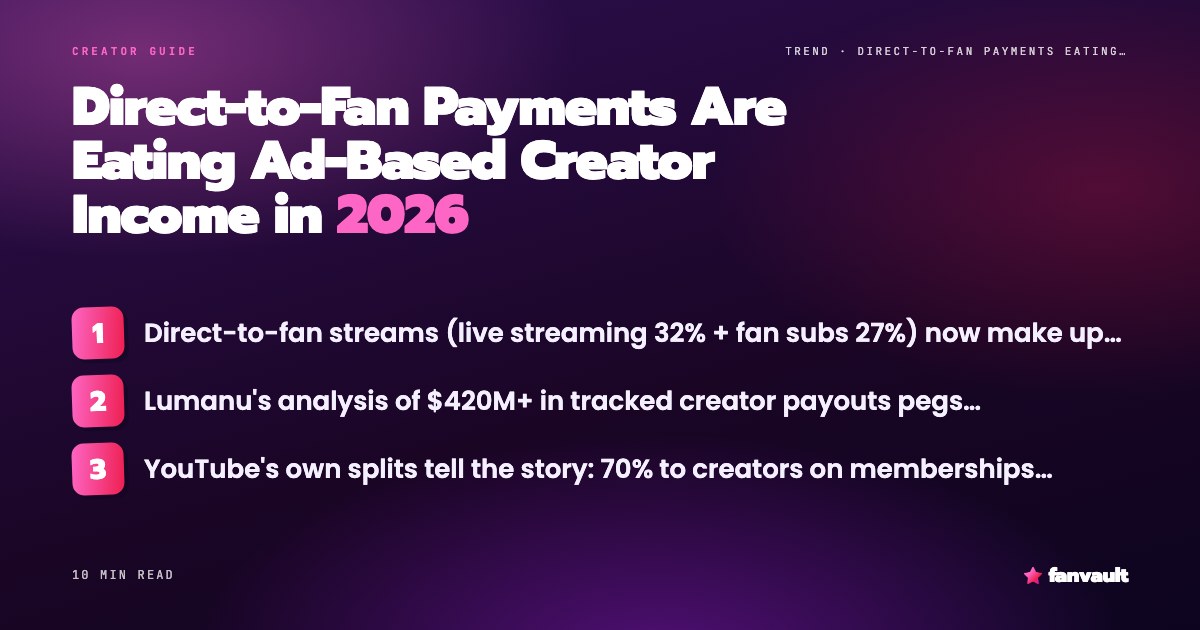
- Direct-to-fan streams (live streaming 32% + fan subs 27%) now make up ~59% of the average creator's income; platform ads sit at 29% and falling (Epidemic Sound, 3,000-creator survey).
- Lumanu's analysis of $420M+ in tracked creator payouts pegs platform-native ads at just 28% of creator income.
- YouTube's own splits tell the story: 70% to creators on memberships and Super Chats vs. 55% on long-form ads and 45% on Shorts.
- Substack crossed 5M paid subs in March 2025 (from 2M in 2023); Patreon hit $179M revenue in 2025 with per-patron support up 13% inside one year.
- 75% of six-figure Kajabi creators run 5+ direct revenue streams; the average serves just 309 paying customers from a ~4,000-person email list.
- Fanvault's 8% fee (vs. Fanvue 15%, Passes 10% + $0.30, Fanfix ~20%) puts the biggest slice of the shifting direct-to-fan dollar in the creator's account.
How big is the shift from ads to direct-to-fan in 2026?
The cleanest read comes from Epidemic Sound's 3,000-creator global survey, which pegs the top three 2025 income sources at live streaming (32%), ad revenue (29%), and fan subscriptions (27%), per Neal Schaffer. Live streaming and fan subs are both direct-to-fan, so add them and roughly 59% of the average creator's income now comes from a fan's card rather than a brand's media buy. Lumanu's analysis of more than $420M in tracked creator payouts landed at the same conclusion from the other side: platform-native ads made up just 28% of creator income, per Lumanu.
Goldman Sachs projects the entire creator economy grows from $250B in 2024 to roughly $480B by 2027, naming direct-to-fan monetization and commerce as the two growth engines. Ads keep growing in absolute dollars. They keep shrinking as a share of the mix.
| Creator income source | 2025 share | Direction |
|---|---|---|
| Live streaming (tips, gifts) | 32% | Direct-to-fan, rising |
| Platform ads | 29% | Ad-based, compressing |
| Fan subscriptions | 27% | Direct-to-fan, rising |
| Everything else | ~12% | Mixed |
Why are ad-based creator earnings breaking down?
The ad-side numbers are ugly for anyone who is not already a top-decile creator. YouTube's average CPM in 2026 sits near $3.50, YouTube Shorts RPM is under $1 in most regions, and CPMs drop 20-40% every January and February as advertisers reset budgets, per Mediacube. What growth exists gets concentrated at the top. YouTube's own creator report shows the top 10% of channels captured 62% of all ad payments in 2025, with median per-brand-campaign earnings of $3,000 against an $11,400 average.
The revenue splits haven't budged either. YouTube pays 55% to creators on long-form ads and 45% on Shorts, and those numbers have not moved since 2023. Any ad-income growth for a typical creator has to come from more views, not a better share. Meanwhile YouTube's fan-funding split for channel memberships and Super Chats pays creators 70%, per YouTube Help. The ad-monopoly platform is telling creators where the future is by pricing.
Where is the direct-to-fan money actually growing?
The subscription platforms show the steepest curves. Substack crossed 5 million paid subscriptions in March 2025, up from 2M in 2023 and 4M in November 2024, with 50+ writers earning over $1M/year. Patreon grew revenue 28% year over year to $179M in 2025, and average monthly support per patron climbed 13% (from $5.40 to $6.10) inside a single year. Neither number is set by an ad auction.
Digital products tell the same story. Kajabi announced $10 billion in cumulative creator earnings in August 2025 across courses, communities, coaching, and digital products. The reach math is the kicker: the average six-figure Kajabi creator serves just 309 paying customers from a ~4,000-person email list. Direct-to-fan economics do not require ad-scale audiences.
What does this mean for a creator planning 2026 income?
Three things follow. First, stack the surfaces rather than pick one. Kajabi's data shows 75% of its six-figure creators run 5+ direct revenue streams (memberships, PPV, tips, digital products, live coaching). Second, price for stability. Ad CPMs still drop 20-40% every Jan-Feb; subscription and tip income is fan-priced and non-seasonal. Third, don't confuse platform growth with creator growth: YouTube has paid creators over $100 billion in the last four years, per CNBC, but the median channel sees almost none of it.
- If your Shorts RPM is under $1, the extra view is not the growth lever. The extra paying fan is.
- If you're a mid-tier YouTube channel, you keep 15 more points on membership revenue than on ad revenue on the same platform.
- If you sell any digital or physical thing, the payout hits your bank on your cadence, not on the advertiser's Q1 reset.
Where does Fanvault fit in the direct-to-fan shift?
Fanvault sits on the direct-to-fan side of the split by design. The platform fee is 8%, so creators keep 92% of every subscription, tip, paid DM, wishlist gift, buy-it-now drop, or authenticated memorabilia auction. The alternative fees in the same competitive set are 15% on Fanvue, 10% + $0.30 on Passes, and ~20% on Fanfix. On $10K of monthly direct-to-fan revenue, that spread is worth roughly $700-$1,200 more in the creator's account every month, before layering in any storefront or auction income.
The direct-to-fan mix Fanvault ships in one account (tiered memberships, paywalled posts, paid DMs, tips, wishlists, a buy-it-now storefront, and authenticated memorabilia auctions) is the same stack of surfaces the Kajabi six-figure data says works. The 2026 story is not that ads are dead. It's that the marginal creator dollar, and specifically the stable one, now comes from a fan's card. Structure the year around that.
Frequently Asked Questions
Are ad-based creator earnings actually shrinking in absolute dollars?
Not yet at the platform level. YouTube paid creators over $100B in the last four years, a $30B jump in the most recent year alone. The shrinkage is share-of-mix and share-of-creator, not aggregate.
The top 10% of YouTube channels captured
What actually counts as direct-to-fan income?
Any dollar that moves from a fan's payment method to the creator without an ad auction in between: fan subscriptions, memberships, paid DMs, tips, live-stream gifts, PPV posts, digital product sales (courses, presets, ebooks), and physical or memorabilia sales through a creator's storefront.
Brand-sponsored posts are not direct-to-fan (a brand is paying, not a fan), and platform ads are not direct-to-fan by definition. Affiliate income sits in a gray zone: technically ad-adjacent, but priced by conversion rather than CPM, so it behaves more like commerce than like ad inventory.
Why is short-form ad revenue especially weak for creators?
Two reasons. YouTube Shorts RPM sits under $1 in most regions per Mediacube, and Shorts pays creators a 45% share versus 55% on long-form. The economics only work at massive view volumes.
That's why in 2026 short-form is best treated as a top-of-funnel channel that feeds a direct-to-fan surface (a subscription tier, a paid Discord, a storefront, a Fanvault profile) rather than as a monetization endpoint on its own.
Do I need a huge audience to make direct-to-fan work?
No, and that's the point. Kajabi's own data on six-figure creators shows the average one serves just
Because the fan pays the creator directly, revenue per fan is orders of magnitude higher than an ad view. A small paying audience beats a large ad-watching one for total income, and the payout doesn't reset every January when advertisers cut budgets.
How does Fanvault compare on fees to other direct-to-fan platforms?
Fanvault charges 8% per transaction and creators keep 92%. Fanvue charges 15%, Passes charges 10% + $0.30 per transaction, and Fanfix charges roughly 20%.
On $10K of monthly direct-to-fan revenue that gap is worth roughly $700-$1,200 more in the creator's account each month before layering in storefront or memorabilia auction income. Over a year, that's a mid-teens-thousands difference at $10K/month, and it compounds as the direct-to-fan share of a creator's income keeps growing.