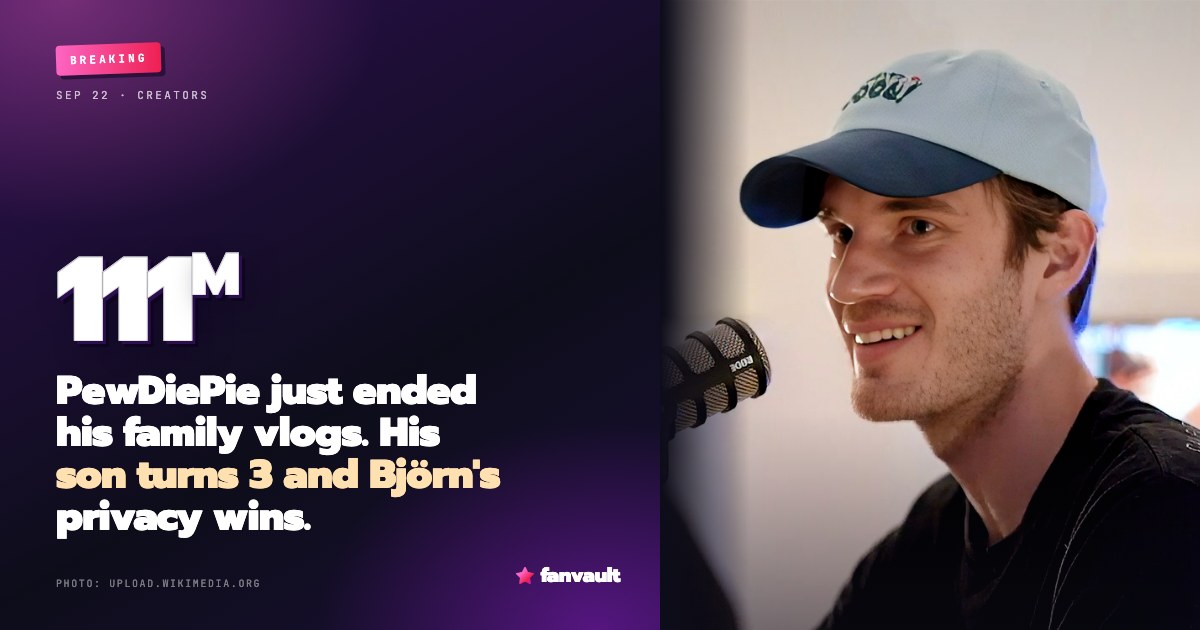
PewDiePie just posted his final family vlog. Felix Kjellberg uploaded "Thank you and Goodbye" on September 22, 2026, closing a Japan-based series he and wife Marzia have run since May 2022. The stated reason is their 3-year-old son Björn. The 111M-subscriber creator is walking away from a monetized format at the top of the market so a toddler can grow up off camera.
⚡ Key Takeaways
- PewDiePie posted "Thank you and Goodbye" on Sept 22, 2026, ending four years of Japan family vlogs at 111M subscribers.
- The stated reason: 3-year-old Björn should get to choose his own on-camera life later, not have it defaulted for him at age 3.
- This lands after Utah became the fourth U.S. state to legally regulate child influencers, following Ruby Franke's conviction.
- Kidfluencer money is real (Ryan Kaji clears $30M/yr, the category is worth $100B+ globally), and the top of the market just walked.
- Cultural signals from the OG of YouTube move the median creator faster than any state law does. Family creators should read the memo.
What actually happened?
The 36-minute finale documents a six-week trip through Sweden, Switzerland, and Italy, then lands the goodbye. Kjellberg telegraphed the wind-down four months earlier in a May 23, 2026 upload titled "Ending the vlogs," where he said appearing on camera should be Björn's decision when the kid is old enough to make it. Per Dexerto, Kjellberg and Marzia will still share family moments occasionally, but the regular vlog cadence is done.
The scale matters. PewDiePie's main channel sits at roughly 111 million subscribers with 29.5 billion lifetime views, per Social Blade. He held the most-subscribed YouTube crown for 2,063 straight days before MrBeast (now at 515M) overtook him, according to Wikitubia. This is the OG of YouTube quitting a format that most creators would never voluntarily close.
Why does this matter for creators?
Family vlogging has been the most legally and morally fragile lane in the creator economy for two years running. Ruby Franke's 8 Passengers channel racked up over 1 billion views before she was charged with child abuse in August 2023 and later pleaded guilty, as The Conversation documented. Her daughter Shari testified to Utah lawmakers in October 2024 as "a victim of family vlogging," a phrase that hit the record and stayed there.
"Now he's 3 years old, and we feel like it's a good time to end the vlogs. If he wants to be part of it, that should be his choice later."
Felix Kjellberg (PewDiePie), YouTuber, in the September 22, 2026 finale
What PewDiePie is doing is different from what a state legislature does. He is not being forced. He is doing it on the record with the exact language child-safety advocates have been pushing for a decade, that a minor cannot consent to a monetized on-camera career and that the burden falls on the parent to notice. Marzia added in the finale that the vlogs "put too much pressure on his appearance online," per TalkEsport.
What's the bigger picture?
The law has been catching up. Utah's HB 322 (2026) made it the fourth U.S. state, after California and Illinois in 2024, to force influencer parents to trust-fund a share of earnings for on-camera children and to grant those kids the right to erase content once they turn 18, PR Week reported. That is legislating around a global kidfluencer economy Rolling Stone estimates at more than $100 billion a year, with top earner Ryan Kaji reportedly clearing $30M annually.
Cultural signals from the OG of YouTube tend to move the median creator faster than any statute does. Every family creator now has to answer whether their format still holds up if the kid at the center of it gets a real veto later. The next 24 months will separate creators who preemptively refactor from creators who wait for a subpoena.
What does Fanvault think?
The Fanvault position is that "the audience wants my kid" was never a durable business model, and the platforms built to outlast that trap are the ones creators should be building on now. Fanvault takes an 8% platform fee and leaves creators with 92%, and the monetization stack (memberships, paid DMs, wishlists, authenticated memorabilia auctions) is built so adult creators can build recurring revenue from adult audiences. PewDiePie ending Björn's on-camera run is a public admission that the family-vlog premium is priced in child privacy, and that price is going up. Every creator with a toddler in frame should be reading the memo he just published.
The most-subscribed human on YouTube for 2,063 days just told the industry that some numbers are not worth the trade. The kids raised on camera in 2016 are turning 18 in 2034, and every one of them will get to answer for themselves. The countdown started today.
Frequently Asked Questions
Why did PewDiePie really end his family vlogs?
The stated reason is consent. Kjellberg said in the September 22, 2026 finale that appearing on camera should be Björn's decision when he is old enough to make it, and Marzia said the vlogs "put too much pressure on his appearance online." Both partners telegraphed the wind-down back in May 2026 in a video titled "Ending the vlogs."
The subtext is the context. Family vlogging has been the creator economy's most legally fragile lane for two years, and PewDiePie is the first top-tier creator to voluntarily close a monetized family format using the exact language child-safety advocates have been pushing for a decade.
Is PewDiePie quitting YouTube entirely?
No. Kjellberg said he will keep making videos and loves the community aspect, but wants to end the specific loop of regular family vlogs. He and Marzia plan to share occasional non-vlog uploads and stay in touch with fans through a monthly newsletter.
The
What happened with Ruby Franke and why does it matter here?
Ruby Franke's 8 Passengers family vlog channel racked up over 1 billion views before she was charged with child abuse in August 2023 and later pleaded guilty. Her eldest daughter, Shari Franke, testified to Utah lawmakers in October 2024 as "a victim of family vlogging," a phrase that helped catalyze the state's HB 322 in 2026.
The Franke case turned family vlogging from a genre with vague ethical concerns into a legally and criminally documented category of harm. PewDiePie ending Björn's run in 2026 is unthinkable without that shift in the two years prior.
What laws now govern child influencers in the U.S.?
Four states have moved so far. California and Illinois passed trust-account requirements in 2023 that took effect in 2024, forcing family creators to set aside a share of earnings tied to a child's on-camera appearance. Utah's HB 322 (2026) added the same trust requirement plus a right for on-camera children to erase content once they turn 18.
Analysts value the global kidfluencer economy at over