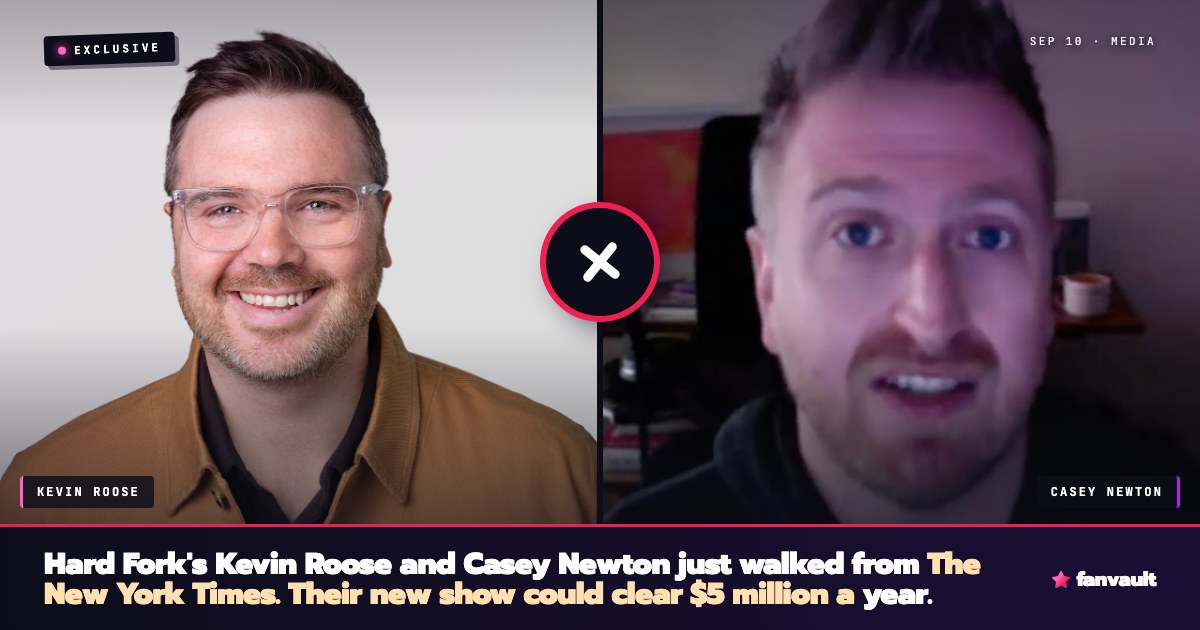
Kevin Roose and Casey Newton walked from The New York Times three months ago. Now their still-untitled AI show is in advanced talks for a deal worth up to $5M a year, with seven-figure offers already on the table. Bloomberg's Ashley Carman broke it Wednesday in her Soundbite newsletter. Two working journalists with a defined niche just repriced themselves seven figures higher the moment they left a masthead.
⚡ Key Takeaways
- Kevin Roose and Casey Newton's new AI podcast is in advanced talks for a deal worth up to $5M a year, with seven-figure offers already on the table.
- UTA is shopping the show with a partner-bankrolls-production, partner-takes-ad-sales structure. Hosts keep the audience and the IP.
- The duo left NYT in June after Hard Fork shipped 343 episodes and became the paper's flagship tech show.
- The Times reportedly sank $500K+ into a purpose-built Hard Fork studio that will sit unfinished when the show ends in August.
- Not Rogan's $250M or Cooper's $125M, but a real seven-figure floor for a two-person niche show with a compounding topic.
- The takeaway: distribution is cheap, audience trust is the moat, and the platforms that keep the least of a creator's revenue win.
What actually happened?
UTA is running a process where a single audio partner would bankroll production in exchange for the ad-sales rights, per Bloomberg. Offers are already at seven figures annually, with a ceiling reportedly near $5 million. The duo signed with UTA in mid-June, according to Variety, days after Roose announced his August exit from NYT after nine years as a tech columnist.
Hard Fork launched inside NYT Opinion in 2022 and pivoted hard into AI as the LLM boom took off. It had shipped 343 episodes by June 2025 and lived biweekly on Apple's tech chart. The Times, per SF Standard, had spent months and more than $500,000 converting a conference room into a dedicated Hard Fork video studio that will sit unfinished when the show ends in August.
The timeline moved fast. Roose published a Substack post titled "Leaving The Times" on June 15, 2026, and NYT told staff the next morning that both hosts were out, per Nieman Lab. Within a week the UTA signing was public. Ten weeks later, Bloomberg has the seven-figure package moving through UTA's Emerging Platforms audio group.
Why does this matter for creators?
Two working journalists with a middle-six-figure audience just got a seven-figure floor the second they left the building. That is the receipt on parasocial trust with no publisher taking a cut. The deal structure is the part every mid-tier creator should study: a partner bankrolls production, the partner takes ad-sales rights, and the hosts keep the show, the IP, and the audience.
Distribution is cheap now. Audience trust is the moat. The publisher's job used to be discovery, put a show in front of readers who did not know they wanted it. That job is now done by the algorithm.
What a publisher still offers is the studio, the ad-sales desk, and the brand halo. UTA just proved a creator can rent all three without giving up equity. Roose framed the whole bet in one line on his personal Substack.
"I'm not Going Independent, in the conventional journalist-to-Substack way. Our goal is to take the thing that makes Hard Fork work and extend it into new formats and directions."
Kevin Roose, "Leaving The Times" on Substack
Where does this go from here?
Casey Newton keeps running Platformer, which had more than 170,000 subscribers when it migrated from Substack to Ghost in January 2024, per Medium's coverage of the move. Roose has an AGI-focused book on the way. The new podcast becomes the third leg of a personal media stack that needs no masthead to distribute.
For scale, this is not Rogan money. His Spotify deal is $250M, and Alex Cooper's SiriusXM package is roughly $125M over three years, per Variety's podcast deals tracker. Roose and Newton are proving a different number: the new floor for a two-person niche show with a compounding topic and a real audience. That floor did not exist five years ago.
Meanwhile the Times has told staff it will "begin a search for the next hosts immediately," per media reporter Brian Stelter. Somebody will inherit the studio, the biweekly Apple chart slot, and none of the audience that made the show worth $5M a year on its way out the door. The audience left with the hosts. It always does.
What does Fanvault think?
This is the punchline on where creator monetization is going. Distribution is a commodity, audience trust is the moat, and the platforms that keep the least of a creator's revenue win. Fanvault takes 8% and creators keep 92%, the leanest fee in the competitive set (Fanvue takes 15%, Passes takes 10% plus 30 cents, Fanfix takes roughly 20%). The Roose-Newton deal is the legacy-media proof that the same math already runs the top of the podcast market, and Content Capital, Fanvault's sister platform, is the automation layer that lets a smaller creator run the same playbook without an agent or a studio.
Two people, one topic, seven figures, no publisher. That is the entire chart.
Frequently Asked Questions
Who broke the story about the Roose-Newton podcast deal?
Bloomberg's Ashley Carman reported it on September 10, 2026 in her Soundbite newsletter. She wrote that UTA is running a process where a single audio partner would bankroll production and take the ad-sales rights, with offers already at seven figures annually and a ceiling reportedly near
Why did Roose and Newton leave The New York Times?
Roose announced on his personal Substack in mid-June 2026 that he was leaving after nine years as a tech columnist to build a new AI-focused media company with Newton. He wrote that they wanted to start a company together and build something they would own, framing it explicitly as not the conventional journalist-to-Substack move. The plan is a new show plus other formats, with UTA representing the venture.
How does this deal compare to Joe Rogan or Alex Cooper's packages?
Not close in absolute dollars. Rogan's Spotify deal is
What happens to Hard Fork at NYT now?
The Times told staff internally it would 'begin a search for the next hosts immediately,' per media reporter Brian Stelter. The final Roose-Newton era episode is expected in August 2026. The purpose-built video studio, which SF Standard reported cost the Times north of