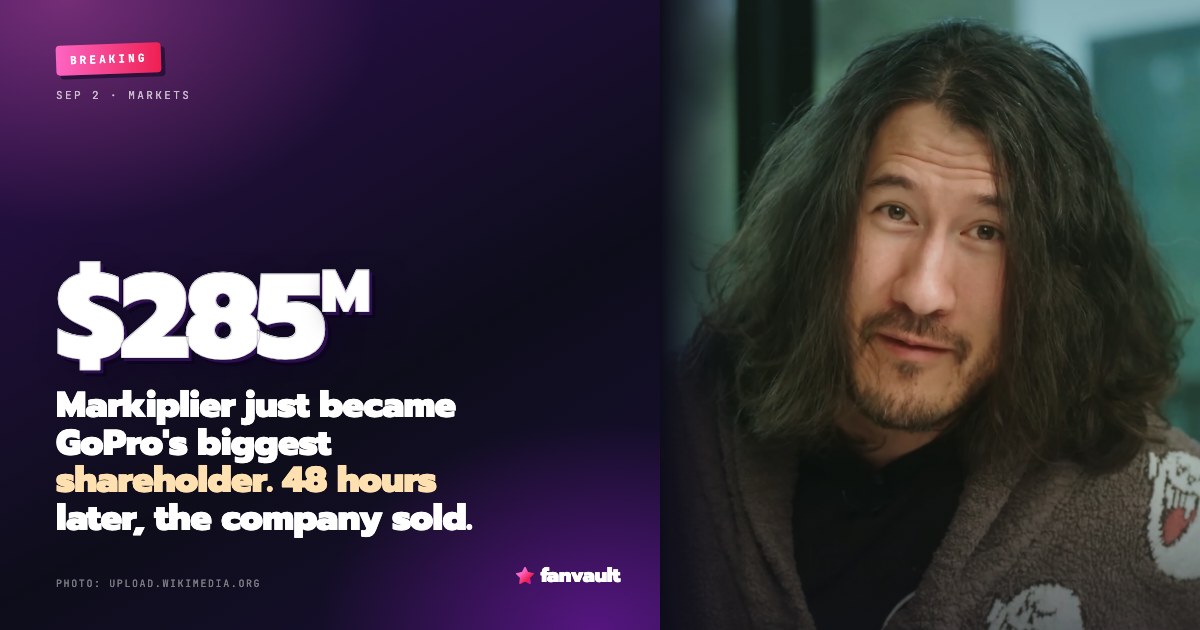
On August 20, YouTuber Mark Fischbach filed a Schedule 13G disclosing an 8.5% passive stake in GoPro, roughly 13.5 million shares. Bloomberg broke the story Sunday, August 31, and GPRO ripped 46% the next trading day. Forty-eight hours after that, GoPro sold itself to Starman Optical for $285 million. Markiplier walks with about $15.4 million in cash.
⚡ Key Takeaways
- Markiplier filed a Schedule 13G on August 20 disclosing an 8.5% passive stake in GoPro, roughly 13.5 million shares.
- Bloomberg broke the story August 31; GPRO closed up 46.06% the next day on 134M shares, over 14x average volume.
- Forty-eight hours after the news, GoPro announced a $285M merger with Starman Optical at $1.14 per share.
- Markiplier's gross cash payout works out to roughly $15.39M, plus about $1.54M in rollover equity.
- Short interest sat at 16.19% of float going in, so a single YouTuber's 13G lit a fuse on a heavily shorted sub-dollar name.
- First time on record a YouTuber has moved a NASDAQ-listed hardware company with an SEC filing instead of a tweet.
What actually happened?
Fischbach, better known to his 38.8M YouTube subscribers as Markiplier, had accumulated the position by July 13, per his SEC filing. One week before Bloomberg published, he posted a YouTube video praising GoPro image quality relative to the cinema cameras used on his sleeper-hit indie film, Iron Lung. Twelve trading days later, the company sold.
The Monday tape was violent. GPRO closed up 46.06% at $0.88 on 134M shares, over 14 times the 9.46M daily average, per Benzinga. Short interest sat at 16.19% of float going in, so his 13G lit a fuse on a heavily shorted sub-dollar name. After the bell, GoPro announced a definitive $285M merger with Starman Optical at $1.14 per share for 90% of outstanding shares, per the company release.
"I saw the stock and where it was, I was like that seems undervalued."
Mark Fischbach (Markiplier), speaking to Bloomberg via PetaPixel
Why does this matter for creators?
This is the moment creators stopped being marketing partners for hardware brands and became capital partners with governance rights. Markiplier didn't post a sponsored review. He filed a 13G. A trusted YouTube name with tens of millions of subscribers deployed personal capital into a distressed hardware ticker, publicly explained his thesis in the language of an investor, and 12 trading days later the company sold.
The receipts on scale: Fischbach has 38.8M+ YouTube subscribers, made the 2026 TIME100 Creators list, and just directed Iron Lung to roughly $50M worldwide on a $3M budget, per TIME. That is the kind of resume that lets a YouTuber file a 13G and have the C-suite of a public company take the call.
The signal to every top creator watching in 2026 is that audience trust plus a checkbook is a market-moving force that neither Wall Street nor legacy brands have priced in yet. It also inverts the usual power dynamic. Instead of GoPro paying a creator to promote a camera, a creator bought the camera company and then triggered its sale.
What's the bigger picture?
GoPro was a $110M market cap going-concern story on August 30. It was a $285M take-private-adjacent deal by September 2, per TechCrunch. The Starman merger wipes GoPro's roughly $92 million in debt, keeps founder Nick Woodman in charge, and repositions the company toward AI data-center optics and defense.
The event sits at the intersection of creator influence, meme-stock mechanics, and a distressed-hardware balance sheet, and it happened faster than any corporate playbook accounts for. By Tuesday, September 2, GPRO traded at $1.44 intraday, a 140% two-session move off the prior week's 60-cent low. Markiplier's rollover equity, worth roughly $1.54M on top of his cash payout, keeps him in the story past closing.
The pivot is more than a rebrand. Starman's U.S.-made optical transceivers plug directly into the AI data-center buildout, and combined with GoPro's 2,500-patent imaging portfolio, the new company will chase defense and government contracts, per Newsshooter. Target closing is by year-end 2026, subject to shareholder approval. GoPro cameras keep shipping in the meantime.
What does Fanvault think?
The Markiplier trade is the same principle Fanvault was built on, escalated one layer up. Top creators are no longer content to be the top of somebody else's funnel. They want equity, ownership, and the storefront itself. Fanvault runs on a flat 8% platform fee versus 15% at Fanvue, 10% plus $0.30 at Passes, and about 20% at Fanfix, because creators who move markets shouldn't hand a fifth of their revenue to middlemen who just host their profile page.
The memorabilia auctions, the conversational Telegram automation, the Content Capital agent that publishes across every network, they exist because the future creator is an operator. Markiplier just proved a YouTuber can move a NASDAQ ticker with a single filing. Any platform still treating creators like ad inventory is going to feel very quiet very fast.
The receipt is on file at the SEC, and the check clears at closing. Everyone else in the creator economy just watched the ceiling rise.
Frequently Asked Questions
How much did Markiplier actually make on the GoPro trade?
On 90% of his 13.5 million shares at the $1.14 cash price, Markiplier's gross payout is roughly
Did Markiplier cause the GoPro merger?
Formally, no. He filed as a passive investor and disclaimed board representation. Practically, the 46% Monday move on 14x average volume, on top of a 16.19% short-interest setup, gave GoPro's balance-sheet-constrained board sudden leverage to negotiate a definitive deal at $1.14 per share, more than double the prior week's low. GoPro CEO Nick Woodman said the merger will let the company grow across consumer, commercial and defense markets, per the company release.
Is this a meme-stock squeeze or a real strategic deal?
Both, and that's the point. GPRO had
What does this mean for other top YouTubers?
It means a passive 13G from a creator with tens of millions of engaged subscribers is now a valid corporate catalyst. Not a marketing lever, a market lever. Expect more top-tier creators to build public equity positions in the companies they endorse, and expect activist-style filings to eventually follow the passive ones.