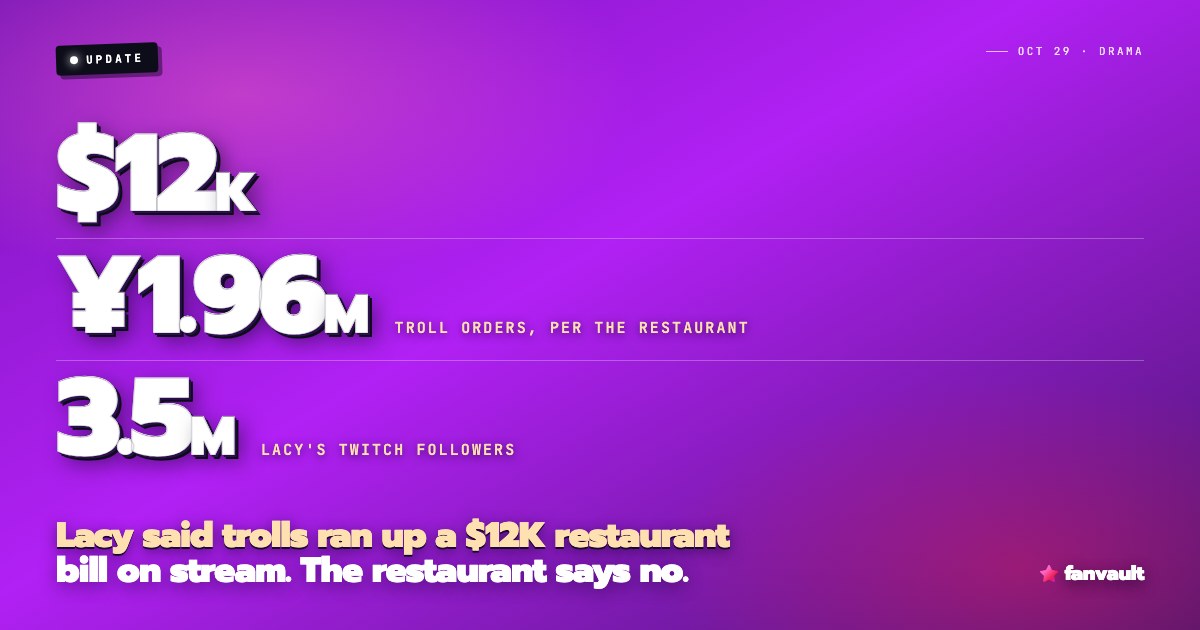
Twitch streamer Lacy told chat that viewers stuck him with an almost $12K bill at a Tokyo restaurant after his table's ordering QR code showed up on stream. Zauo Shibuya says that's not what happened: it charged his group only for what it ate and threw out the prank dishes. A day later, Lacy admitted he kept the story alive because he thought it was funny.
⚡ Key Takeaways
- Lacy told chat that trolls using his leaked table QR code ran up an almost $12K bill (about 1.6M yen) at Tokyo's Zauo Shibuya.
- Zauo says troll orders hit about 1.96M yen, but it charged only for food the group ate and threw out the prank dishes.
- A day later on X, Lacy blamed a language barrier and admitted: "I'm dumb and thought it was funny."
- The final amount Lacy paid is still unconfirmed by him, the restaurant, or any outlet.
- The correction traveled far less than the $12K clip, and an innocent restaurant took the heat in the gap.
- For streamers, anything actionable on camera is a liability, and inflated money stories cost credibility with paying fans.
What actually happened?
On October 28, Lacy (real name Nicholas Fosco) was streaming dinner at Zauo Shibuya with his girlfriend, influencer Darla Claire, when the table's ordering QR code appeared on camera. Chat did what chat does: because the system added orders to the table's tab, strangers could send dishes from anywhere, and a server eventually came over to ask about the pile-up, per Complex. Lacy told viewers the damage was about 1.6 million yen, or "almost a twelve thousand dollar bill," according to IBTimes UK.
Then the restaurant spoke. In an Instagram statement that spread on X as translated screenshots, Zauo confirmed that third parties had placed unauthorized orders worth roughly 1.96 million yen, more than Lacy's own number, as reported by NewSphere. But it said staff charged the group only for food it actually ate and discarded the prank dishes, which Dexerto framed as a flat denial of the $12K payment story.
Depending on the exchange rate, outlets converted the yen figures to anywhere from roughly $10,000 to $12,000, per Dexerto. The precision of the number was always shakier than the clip made it look.
On October 29, Lacy posted a walk-back on X. He blamed a language barrier, said he only paid for extra food that had already been made, and admitted he kept the bit going after learning the truth, per IBTimes UK. Neither he nor the restaurant has shared what he finally paid, and no outlet has confirmed a figure, according to IBTimes UK.
"I'm dumb and thought it was funny."
Lacy (Nicholas Fosco), Twitch streamer, post on X via IBTimes UK
Why does this matter for creators?
IRL streaming runs on stakes, and a money disaster is the cheapest stakes there is. The $12K number was the content. It was specific, painful and perfectly clippable, which is exactly why it outran the correction by a full news cycle.
Scale makes that worse. Lacy has more than 3.5 million Twitch followers, per Tech Times UK, and a story that size doesn't get un-told by one post on X.
The real victim was a restaurant that did nothing wrong. Zauo checked the orders, refused to bill the troll food, and still took the reputational hit until it published its own receipts. Lacy himself conceded the point.
"None of this was their fault, it was the people who sent the orders in and mine."
Lacy (Nicholas Fosco), Twitch streamer, post on X via IBTimes UK
There's a sharper lesson underneath. Once you're caught dressing up a money story for content, every money claim after it gets side-eyed. For creators who sell directly to fans, credibility about money isn't a vibe, it's the product.
Where does this go from here?
This isn't new. In January 2025, Niconico streamer Zokkun showed a Kura Sushi QR code on stream and listeners remote-ordered a pile of sushi to his table. IRL streaming keeps putting live, actionable surfaces on camera (QR codes, payment links, addresses, open tabs), and chat keeps finding them within seconds.
Expect two things. Restaurants in tourist-heavy cities will get warier of streamers filming at the table, and IRL streamers will need to treat their own camera frame like an attack surface. The audience is a revenue line, but it's also a cost line, and it can bill you in real time.
The story has already crossed borders, with Japanese coverage such as HuffPost Japan via Yahoo News running it as a US streamer apologizing after the shop set the record straight. That framing will follow Lacy's next trip abroad.
What does Fanvault think?
Streamer money should be real, not a bit, and Fanvault is built for that: streamers are one of its core creator groups, and on Fanvault they keep 92% of every transaction (an 8% platform fee, versus Fanvue at 15%, Passes at 10% + $0.30 and Fanfix at about 20%) through subscriptions, paywalled posts, paid DMs, tips and wishlists. A moment like this is exactly what the Fanvault storefront exists to monetize, with authenticated memorabilia, stream-worn apparel and limited buy-it-now drops listed with provenance metadata. A chat that wants to spend money on its favorite streamer should get a channel the creator controls, not a restaurant's QR code.
The bill was mostly fiction. The lesson isn't: your chat can spend your money, and your credibility, faster than you can type a correction.
Frequently Asked Questions
Did Lacy actually pay a $12K restaurant bill in Japan?
No confirmed source says he did. Zauo Shibuya says it charged his group only for what it ate, and Lacy later said he only paid for extra food that had already been made. Neither side has shared the final amount, per IBTimes UK.
How did viewers order food to Lacy's table?
The table's ordering QR code appeared on his October 28 stream. The system added orders to the table's tab, so viewers could send dishes from anywhere, according to Complex.
What did Zauo Shibuya say?
In an Instagram statement, the restaurant confirmed about 1.96 million yen in unauthorized orders, said staff check orders with customers, and said it charged only for food eaten while discarding the prank dishes, as reported by NewSphere.
Did Lacy apologize?
Yes. On October 29 he posted on X that a language barrier led him to think he owed the full amount, admitted he kept the story going after learning the truth, apologized for not correcting it sooner, and said he contacted the restaurant to make things right, per IBTimes UK.
What should IRL streamers take from this?
Anything a viewer can act on (QR codes, payment links, addresses, open tabs) can be used against you within seconds. And exaggerating money stories for content makes every later money claim harder for fans to trust.