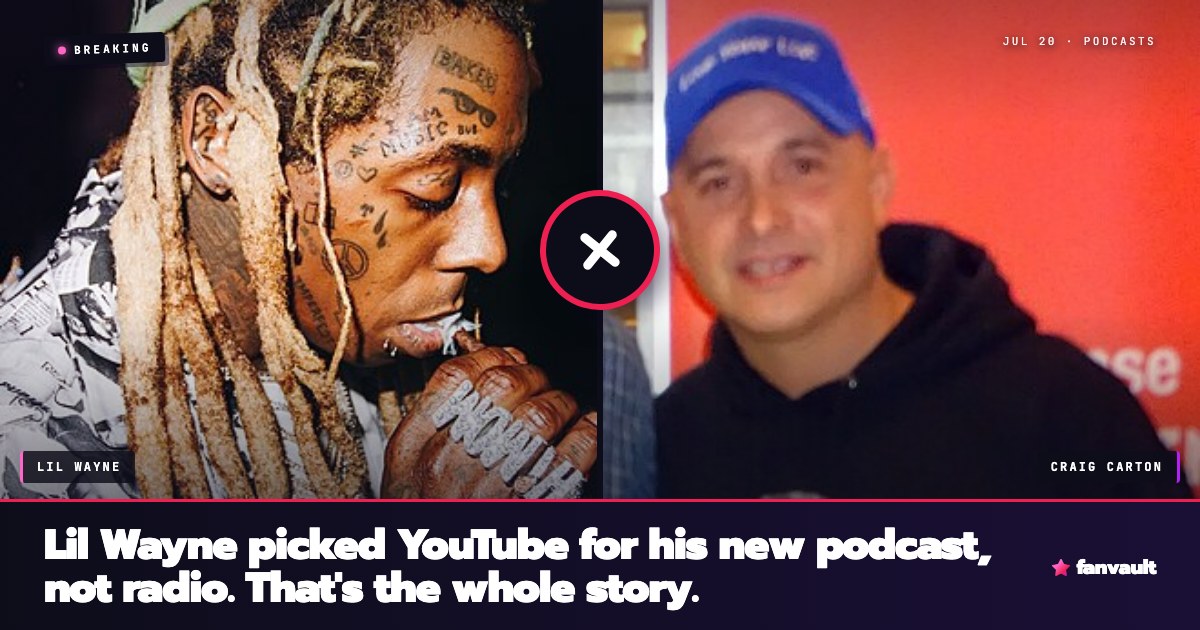
Lil Wayne isn't going to satellite radio, and he isn't going to cable. He's going straight to YouTube. On Wednesday, July 22, Wayne and Radio Hall of Famer Craig Carton launch "The Joint Venture Show," a weekly video podcast that pre-taped its pilot at Fanatics Fest with Eli Manning, Amar'e Stoudemire and Darrelle Revis. The tell isn't the guest list, it's the distribution.
⚡ Key Takeaways
- Lil Wayne and Craig Carton launch The Joint Venture Show on YouTube and every major podcast platform Wednesday, July 22, 2026.
- Pilot was pre-taped July 19 at Fanatics Fest with Eli Manning, Amar'e Stoudemire and Darrelle Revis on the couch.
- The real story isn't the guest list, it's that Wayne skipped satellite radio and cable for a creator-first YouTube launch.
- YouTube now serves 1B+ monthly podcast viewers and is the #1 US podcast listening platform.
- US podcast ad revenue is projected to hit $2.6B in 2026, and the broader creator podcast ad economy is on track for $44B this year.
- Wayne joins a market where the Kelces got nine figures from Wondery, Alex Cooper got $125M from SiriusXM, and Joe Budden stayed independent for $20M+.
What actually happened?
The Joint Venture Show debuts July 22, 2026 on YouTube and every major podcast platform, per Deadline. Magilla Entertainment (the shop behind Peacock's "O'ahu Shores" and Discovery's "Moonshiners") is producing. Wayne and Carton recorded the pilot on July 19 in front of a live audience at Fanatics Fest, with Manning, Stoudemire and Revis on the couch, per Billboard. New episodes will drop every Wednesday, swinging across sports, music, entertainment and pop culture.
Carton is not filler casting. He spent ten years co-hosting WFAN's Boomer and Carton, the most-listened-to show in that station's history, per Wikipedia. He was inducted into the New York State Broadcasters Association Hall of Fame in 2024. In January 2026 he started his third stint at WFAN hosting afternoon drive, per Inside Radio.
Wayne's last talk vehicle, Young Money Radio, lived on Apple Music with guests like Eminem, Lil Baby and Kevin Durant. This time he's skipping the streaming-service wrapper entirely. The show belongs to the hosts and to whichever platform can serve the file. That is a very different posture.
Why does this matter for creators?
Because a Grammy-winning rapper with 19.5 million Instagram followers just told the industry that legacy distribution is not the flex anymore, per HypeAuditor. He isn't renting a slot on a network. He's publishing directly. That is a signal you should not miss.
The economics back the move, per TechRT:
- YouTube now serves more than 1 billion monthly podcast viewers and has become the most-used platform for podcast listening in the US.
- US podcast ad revenue is projected to approach $2.6 billion in 2026.
- The creator advertising economy tied to podcasts is forecast to hit $44 billion this year, up from $37 billion in 2025.
- Global monthly podcast listeners crossed 584 million in 2025, up nearly 7% year over year.
"The best podcasts feel like you just kicking it with your people, talking the same way you do when nobody's listening."
Lil Wayne, Co-host, The Joint Venture Show
What's the bigger picture?
Look at what talent has been able to command in the last two years, and where they landed to command it:
| Deal | Reported value | Where it landed |
|---|---|---|
| Kelce brothers, New Heights | Nine figures | Wondery |
| Alex Cooper, Call Her Daddy | $125M over 3 years | SiriusXM |
| Joe Budden Network | $20M+ in 2025 | Independent |
Cooper's SiriusXM number comes from Complex. Budden's independent-network run rate comes from Yahoo Entertainment, which also reports he turned down a Rogan-scale $200 million offer to stay independent. That is the market Wayne is stepping into.
The mechanics of a video podcast make YouTube specifically the right room. Clips get sliced and shared. Algorithms surface them to people who never knew the show existed. Radio can't do that, and cable can't do that.
Zoom out further. YouTube alone has paid creators more than $100 billion over the last five years. Creator-owned or creator-adjacent formats are where the eight and nine figures live in 2026. Anyone still pitching talk franchises to legacy radio is fighting for the leftovers.
What does Fanvault think?
This is exactly the pattern Fanvault was built for. When a rap legend chooses YouTube plus every major podcast platform over the safety of a network deal, he is saying the ownership matters more than the wrapper. Fanvault runs on an 8% platform fee (creators keep 92%), with a storefront for authenticated memorabilia and auctions, paid DMs in-app or on Telegram, tips, and wishlists, all managed through a chat interface. Sister platform Content Capital handles the always-on content engine across Instagram, TikTok and X.
Wayne is showing the top of the talent pyramid what creator-first looks like. The infrastructure to run the same play at any scale already exists. The only question is which creators are paying attention.
The best podcasts really do feel like people kicking it with their people. The best creator businesses feel the same way. Wayne just picked his room.
Frequently Asked Questions
When does The Joint Venture Show debut and where can you watch it?
The show debuts Wednesday,
Who is Craig Carton and why is he co-hosting?
Craig Carton is a Radio Hall of Famer who spent a decade on WFAN's Boomer and Carton, the most-listened-to show in that station's history, per Wikipedia. He was inducted into the New York State Broadcasters Association Hall of Fame in 2024 and returned to WFAN in January 2026 for a third stint hosting afternoon drive, per Inside Radio. He and Wayne are longtime friends, and the show reunites a real relationship rather than manufacturing a co-hosting pair.
Why is this a bigger deal than a normal celebrity podcast launch?
Wayne is a Grammy-winning rapper with
What does this mean for creators who aren't Lil Wayne?
The wrapper matters less than the ownership. Any creator with a real audience can run the same play at their scale: publish where the audience already lives, own the format, and stack monetization surfaces underneath (subscriptions, tips, paid DMs, storefronts).
Platforms like Fanvault exist precisely to make that economically viable for creators outside the A-list, with an