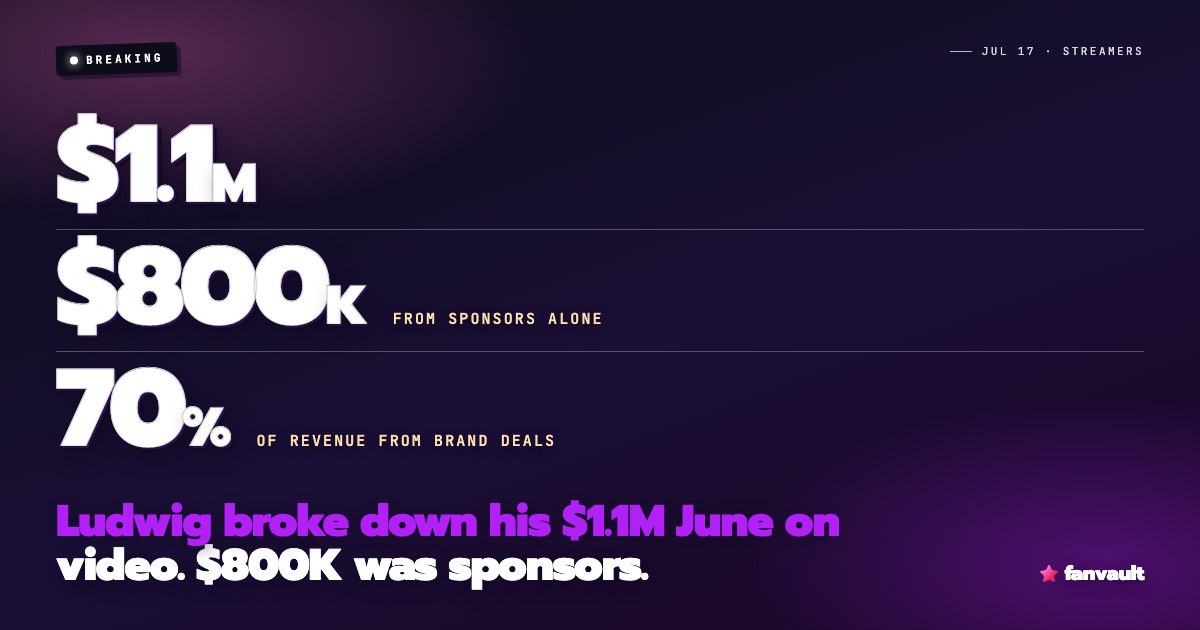
Ludwig Ahgren just told 120 aspiring streamers exactly how a top creator's income breaks down, and it lit X on fire. In June 2026, he grossed $1,135,400. Sponsors alone were $800,000 of that. Twitch subs, the platform that made him famous, delivered just $57,600.
⚡ Key Takeaways
- Ludwig grossed $1,135,400 in June 2026 and put every line item on a slide at Streamer University 2026
- Sponsors delivered $800,000 (70% of the pie); Twitch subs delivered $57,600 (about 5%)
- Payroll for his 15-person team cost $225,000, more than his Twitch and merch revenue combined
- The class was titled 'Stop Clipfarming, Start Making Money,' and the slide was the whole argument
- The top-creator P&L is a brand-deal pipeline plus a team, not a platform-payout stack
- Fanvault's 8% fee and automation layer is built for creators who can't afford to run a 15-person shop
What actually happened?
On July 17, a 7-minute-39-second clip from Ludwig's "Stop Clipfarming, Start Making Money" class at Streamer University 2026 went viral. Standing in front of 120 students at Hendrix College in Conway, Arkansas, he pulled up an income statement itemized to the dollar. Muaaz's clip shows sponsors at $800,000, YouTube ads at $270,000, Twitch subs at $57,600, and merch at $7,800. Total gross: $1,135,400 in one month.
Ludwig then showed the expense side, which most creators never publish. Payroll ran $225,000 for 15 employees, about $15K per head. Events cost $69,000, travel $55,000, and marketing another $10,000, per Sportskeeda's writeup of the class. Net take-home before taxes: roughly $776,400 for the month.
He framed the whole slide as pedagogy, not flex. Ludwig held the Twitch subathon record in 2021 (peaking near 283K concurrent subs), went YouTube exclusive later that year, and co-founded the creator studio Offbrand. He is arguably the most business-forward personality in streaming, and the class title was blunt on purpose.
Why does this matter for creators?
Look at the ratio. Sponsors were 70% of Ludwig's June revenue. The two platforms that built his audience, Twitch and YouTube, combined for 29%. Merch was a rounding error.
This is the mature-creator P&L most viewers never see, and it flips a lot of assumptions about where streaming money actually lives. Platform payouts are the smallest, slowest lever in a top creator's stack. The real business is a brand pipeline plus a team to service it. That is the entire thesis of the class Ludwig taught.
"Ludwig just said he made $1,135,400 in June. Here's the split: Merch $7,800, YouTube $270,000, Twitch $57,600, Sponsors $800,000. Start making relationships with Brands, even if you're small. It can pay off tons later on. A lot of them check DMs."
Muaaz, Creator commentator, on X
What's the bigger picture?
Ludwig's split is not an outlier at the top of the food chain. According to Press Farm, top streamers typically pull 40 to 70% of income from sponsorships, YouTube re-uploads, affiliates and merch, versus 30 to 60% from platform subs and bits. He sits at the extreme end of that range, but the shape is now standard for anyone with a real operation.
The macro backs it up. Global influencer-marketing spend is projected to hit $34 billion in 2026, with brands allocating up to a quarter of their digital budgets to creator campaigns, per Yahoo Finance. Visual Capitalist pegs the top 50 creators at a combined $1.02 billion between March 2025 and March 2026. The money is in brand budgets, not in platform payouts.
What does Fanvault think?
The uncomfortable follow-up to Ludwig's slide is the payroll line. Running a 15-person shop at $225K per month is how one stream becomes $25K of YouTube uploads and then a sponsor deck. Almost no mid-tier creator can afford that overhead, and that is the exact gap Fanvault was built to close.
Fanvault charges an 8% platform fee versus Fanvue's 15%, Passes' 10% plus $0.30, and Fanfix's roughly 20%, so creators keep 92% of every dollar. The conversational and Telegram automation layer does the storefront setup, listing, scheduling and DM triage work a team like Ludwig's does by hand. And the built-in storefront, with auctions and authenticated memorabilia, gives creators the same off-platform, high-ticket revenue lever top streamers already treat as their real business.
When a top streamer proves on video that platform subs are 5% of his pie, the case for keeping 92% of the other 95% writes itself.
Frequently Asked Questions
How much did Ludwig Ahgren actually make in June 2026?
Ludwig grossed
What percentage of Ludwig's income came from platform payouts versus brand sponsors?
Sponsors were
What is Streamer University 2026 and where did this class happen?
Streamer University 2026 is a five-day creator bootcamp run by Kai Cenat, held July 15 to 20 at Hendrix College in Conway, Arkansas, with 120 enrolled students. Professors this year include Ludwig, Pokimane, Duke Dennis, Lizzo, and T-Pain, per Streams Charts. Ludwig taught the class 'Stop Clipfarming, Start Making Money,' and the viral 7:39 clip is from that session.
What does this mean for smaller creators without a 15-person team?
It means the top-tier income model does not scale down cleanly. Ludwig's ratio (70% sponsors, 5% platform subs) is the output of a full operation: a sales side, editors turning streams into YouTube uploads, and someone reading brand DMs. Smaller creators have to buy that overhead from software instead of headcount. Platforms like Fanvault compress the workflow into a chat interface (storefront setup, listings, scheduling, DM triage) so a solo creator can run a mini-Offbrand without hiring one.
How does Fanvault's fee stack up against other creator platforms?
Fanvault takes