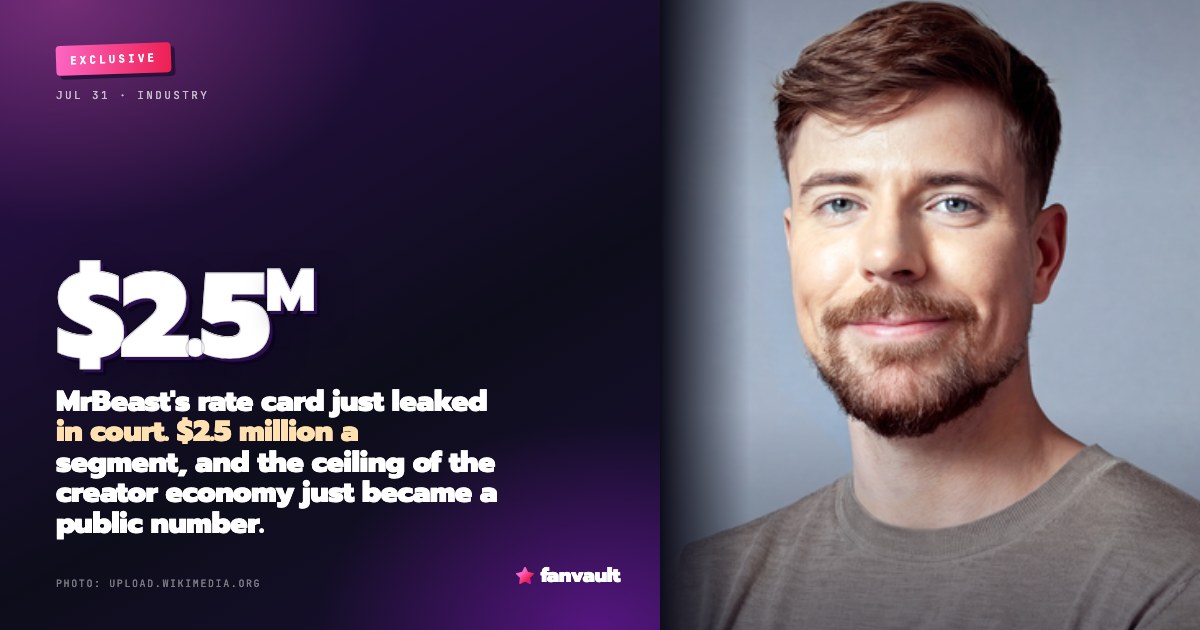
MrBeast charges brands about $2.5 million for a single 30-to-45-second sponsored segment on his main YouTube channel. A TikTok or Shorts cutdown costs another $500,000 on top. Putting his brand on your homepage runs up to $1 million a month. That is the actual rate card, unsealed on July 31 in court filings, and it just became every talent agent's opening bid.
⚡ Key Takeaways
- MrBeast charged brands about $2.5M for a single 30-to-45-second segment on his main YouTube channel in early 2024, per unsealed court filings.
- Add a TikTok or Shorts cutdown for another $500K. Putting his brand on your website: up to $1M a month.
- By mid-2024 his company had locked in $91M in brand agreements for the following year, including T-Mobile at $15M/four videos and Amazon at $12.5M/five.
- The Walmart pitch asked $8M to $10M for a single 'buy everything in a Supercenter' video, projected at 100M+ views.
- A typical mega-influencer YouTube deal pays $20K to $100K per video. MrBeast's already-outdated rate is 25 to 125x that top.
- The ceiling of the creator economy just became a public number, expect every top-tier negotiation to use it as anchor pricing for the rest of the year.
What actually happened?
Court exhibits in Jimmy Donaldson's long-running Virtual Dining Concepts litigation were unsealed last week, and inside them was the thing every brand strategist has been trying to price for a decade: MrBeast's actual rate card. Six full pitch decks. Multiple bespoke proposals to GM, Ford, LG, Slack, Sony, and Walmart, all dated between December 2022 and March 2023, when MrBeast had roughly half his current subscriber count.
The numbers, per Net Influencer and Business Insider's reporting on the filings: $2.5 million for one main-channel segment, plus another $500,000 for the short-form cutdown. The Walmart proposal from late 2022 asked for $8 to $10 million for a single video where Donaldson would try to buy everything inside a Supercenter, projected at over 100 million views. By mid-2024, his company had locked in $91 million in brand agreements for the following year. The biggest named deals: T-Mobile at $15 million across four videos, and Amazon at $12.5 million across five.
The pitch decks also tell you what MrBeast is actually selling. The Slack proposal cited internal messages where Donaldson said he had used the product "for years." The Sony pitch built three tiered packages around the INZONE gaming headset. This is not a media buy against demographics, it is a personal endorsement backed by a production apparatus that guarantees the video ships and the numbers land.
Why does this matter for creators?
Because every creator, every talent agent, and every brand buyer now has a public reference for the ceiling of the market, and it is far higher than most of them realized. The typical mega-influencer YouTube deal for a 1M+ subscriber channel pays somewhere between $20K and $100K per video, according to CreatorsJet. MrBeast's already-outdated rate is roughly 25 to 125x the top of that range. That gap is now the anchor in every top-tier negotiation for the rest of 2026.
The pricing model itself is the second story. Sponsors are not paying CPM against views anymore, they are paying an audience-access fee with a performance floor, priced on the creator as a distribution channel rather than the video as a media unit. Anyone still selling brand deals as "reach against my subscribers" is negotiating in the wrong currency, and probably leaving money on the table.
"Fortune 500 companies are finally recognizing the value MrBeast brings to brands. MrBeast serves as a trusted voice and helps translate brand messaging into digestible concepts to the everyday consumer."
MrBeast pitch team, Sony proposal (unsealed court filing)
Where does this go from here?
The leaked rate is 18 months old. In June 2026 MrBeast became the first individual creator to cross 500 million YouTube subscribers, roughly double the count he had when this pricing was in force. Whatever his rate card actually reads today, it is meaningfully higher than the $2.5M number the internet has spent the week arguing about. Expect brands to reallocate more upfront TV budget into premium creator inventory, and expect the tier just below MrBeast (Kai Cenat, Jynxzi, IShowSpeed, Emma Chamberlain) to use these figures as anchor prices before the quarter closes.
The uncomfortable follow-through is what happens further down the pyramid. Mid-tier creators (1M to 10M subs) will use the ratio to argue their own rates up, and agents will cite the T-Mobile and Amazon deals in every deck. But the pricing power stays concentrated at the very top, because these deals still assume you can move a Fortune 500's needle on your own. If you cannot, the rate card does not scale.
What does Fanvault think?
The ceiling moved. The floor did not. Even at $2.5 million gross, the take rates that platforms and middlemen pull out of everyday creator revenue haven't moved an inch, a creator selling paywalled content and memberships on the incumbent platforms still loses 15% to 20% off the top before they see a dollar. That is the exact gap Fanvault is built into: an 8% platform fee, creators keep 92%, with the storefront, memberships, wishlists, paid DMs, and authenticated memorabilia in one account, plus a Telegram-and-chat automation layer that runs the operational work MrBeast pays a full team to do.
The top of the market just got a bigger ceiling. The middle and long tail need better economics under it, or the leaked rate card is just receipts for how wide the gap has become.
Frequently Asked Questions
How much did MrBeast charge for a single brand deal in 2024?
According to court filings unsealed on July 31, 2026, MrBeast's rate for a single 30-to-45-second sponsored segment on his main YouTube channel was about
Why did MrBeast's rate card become public?
The exhibits came out of MrBeast's ongoing litigation with his former food-industry business partner over MrBeast Burger and Virtual Dining Concepts. Six pitch decks and multiple bespoke proposals were entered as court exhibits, then unsealed and first reported by Business Insider in late July 2026. The decks target brands including GM, Ford, LG, Slack, Sony, and Walmart, and are dated between December 2022 and March 2023.
How much has MrBeast's brand-deal business grown since then?
By mid-2024, his company had locked in
What does a normal mega-influencer YouTube deal actually pay?
Somewhere between
How does this affect creator platform economics for everyone else?
The top of the market moving does not automatically move the bottom. A creator selling paywalled content, memberships, and direct-to-fan products on the incumbent creator platforms still loses 15% to 20% off the top before they see a dollar. Fanvault charges