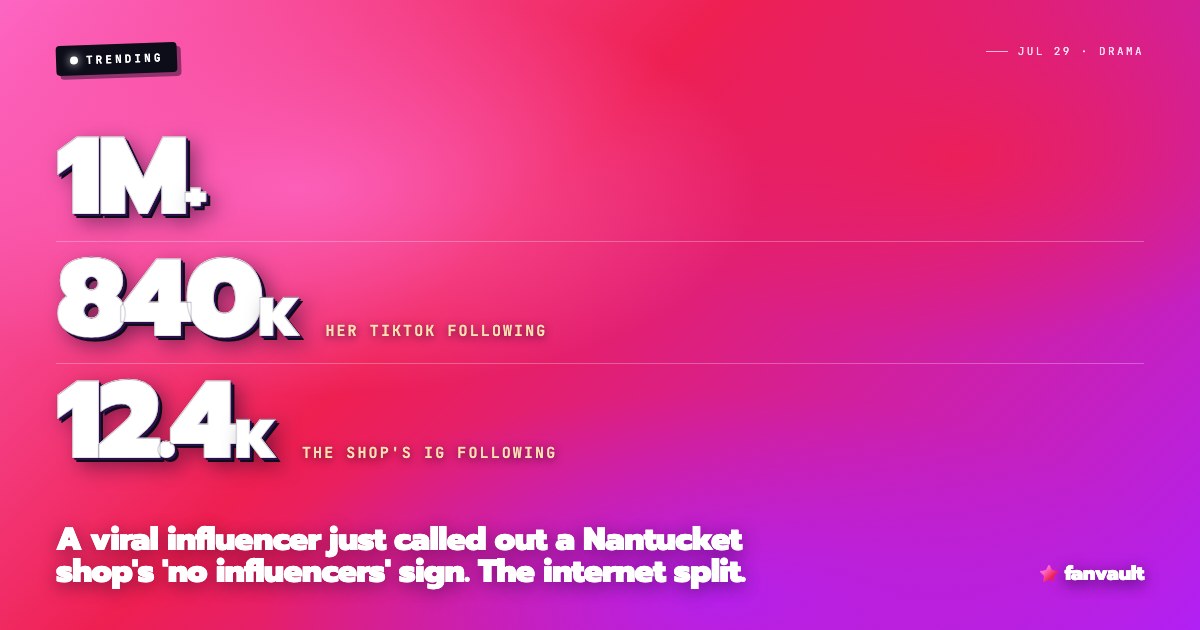
A third-generation Nantucket antique shop hung a gold-lettered "No influencers" quarterboard in its window on July 27, 2026. Two days later, Paige Paul, the 1M+ follower founder of the New England lifestyle brand Dairy Boy, torched the store in a since-deleted Instagram comment that accused it of dressing up misogyny as a tourism complaint. Inside 48 hours the fight had run in The Boston Globe, The Cut, E!, and Elite Daily.
⚡ Key Takeaways
- Four Winds Craft Guild, a 100-year-old Nantucket antique shop, hung a gold-lettered 'No Influencers' quarterboard on July 27, 2026 as a tongue-in-cheek jab at tourists who film reels but do not buy.
- Dairy Boy founder Paige Paul (1M+ Instagram, 840K TikTok) called the sign misogyny in a since-deleted comment; her flagship store sits two blocks away.
- The shop's owner told The Cut he had never heard of Paul, then dunked back on its ~12,400-follower Story: 'Imagine being so bored with life...'
- The story ran in The Boston Globe, The Cut, E!, Yahoo, and Elite Daily inside 48 hours.
- Coverage split: some backed Paul as a creator-CEO defending a legitimate industry, others sided with locals sick of being extras on their own island.
- The real fight, per a native-Nantucketer op-ed, is 'social media tourism,' not any one creator.
What actually happened?
Four Winds Craft Guild, a family shop nearing its 100th anniversary and known for the Nantucket lightship baskets that trace back to the 1800s, posted a photo of its new sign to Instagram on July 27. Owner John Sylvia later told The Cut it was "tongue-in-cheek," a poke at tourists who wander in phones-first, do not buy anything, and clog the aisles filming reels. He told the reporter he had never heard of Paul before the pile-on started.
Paul, who married ATP tennis pro Tommy Paul on July 14, 2026 and now goes publicly by Paige Paul, saw it differently. Her lifestyle brand Dairy Boy opened its first-ever flagship on Federal Street over Memorial Day weekend, per a People walkthrough, two blocks from Four Winds. She left a long comment calling the sign a proxy for policing (mostly female) creators out of physical spaces. The comment was screenshotted before she deleted it, and by July 28 Boston.com had the first mainstream write-up.
Four Winds did not back down. The shop reshared the sign to its ~12,400-follower Instagram Story and returned fire.
"If you call yourself a feminist but proudly put up a 'No Influencers' sign, it's worth asking who you are attempting to delegitimize, and why. Mocking women when they become powerful in a new industry isn't new."
Paige Paul, Founder, Dairy Boy, in the deleted Instagram comment, via Elite Daily
Why does this matter for creators?
Because the person at the center of it is not the archetype the sign was mocking. Paul is a founder with a retail lease, a payroll, an apparel line, and a co-founded charity (the Kids Outdoors Foundation) with her husband. That is what a top-of-market 2026 creator looks like, and reducing her to "influencer" reads as a category error.
The blowback also lands in a specific place. Nantucket is a town where a lightship basket now trends on TikTok for its coastal aesthetic, and every storefront is a potential set. Sylvia's underlying complaint was real; the tourists filming his craftsmen are not buying the baskets. But framing the fix as banning a profession, rather than banning a behavior (a plain "no filming" sign would have done it), is what turned a local grumble into a national story.
Where does this go from here?
Two days after the initial coverage, The Boston Globe ran a native-Nantucketer op-ed reframing the whole thing. The real issue, the writer argued, is not any one creator, it is "social media tourism," the flattening of a historic whaling island into an Instagram backdrop. That is a more useful fight than "influencers bad," and it is the one Sylvia was probably trying to have in the first place.
Expect more of these small-town flare-ups. Creators are no longer just posting from their bedrooms; they are opening physical stores in the same towns their audiences vacation in, which puts them in direct contact with locals who did not sign up to be extras. Paul's Federal Street flagship and Sylvia's Federal Street antique shop are, in a very literal sense, competing for the same sidewalk.
What does Fanvault think?
The word "influencer" is being asked to carry more weight than it deserves. When someone runs a brand with a lease, a payroll, and a product line, calling them an "influencer" is like calling a restaurant owner "a food poster." Fanvault is a creator monetization platform built for exactly this generation of operators, human and AI, giving them a storefront, tiered memberships, paywalled posts, paid DMs, tips, wishlists, and an authenticated memorabilia marketplace inside one account on an 8% platform fee (creators keep 92%). Founded in 2025 and AI-native from day one, our bet is that the Paige Pauls of the next five years will quietly outgrow the word "influencer" the same way "blogger" quietly turned into "media company."
A gold-lettered sign in a Nantucket window did not stop the creator economy. It just proved, again, that the arguments about it are behind the actual work.
Frequently Asked Questions
What is the 'No Influencers' sign at Four Winds Craft Guild?
It is a gold-lettered wooden quarterboard hung in the window of Four Winds Craft Guild, a third-generation Nantucket antique shop owned by John Sylvia. The shop posted a photo of it to Instagram on July 27, 2026. Sylvia told The Cut it was "tongue-in-cheek," a response to tourists coming in phones-first, filming the store and its artisans, and not buying anything.
Why did Paige Paul respond to it?
Paul, the founder of Nantucket-headquartered lifestyle brand Dairy Boy and wife of ATP tennis star Tommy Paul, saw the sign as a proxy for policing (mostly female) creators out of physical spaces. She left a long comment on the shop's Instagram post accusing it of dressing up misogyny as a hospitality complaint. She later deleted the comment, but it had already been screenshotted and reshared across TikTok. Paul argued that women disproportionately drive the creator economy, and that dismissing them as "influencers" is a way of dismissing a workforce that is disproportionately female.
What did Four Winds Craft Guild say back?
The shop reshared the sign to its
What does this have to do with the creator economy?
The Four Winds story is a physical-world flashpoint for a fight the creator economy has been having online for years: whether "influencer" is a legitimate profession or a slur. Paul's rebuttal, that treating "influencer" as a dirty word disproportionately delegitimizes women running real businesses, is the same argument creators have been making since the 2010s. The wrinkle in 2026 is that the top of the creator market now owns retail leases, signs payrolls, and moves product. That makes the "you're just an influencer" framing look increasingly out of date.