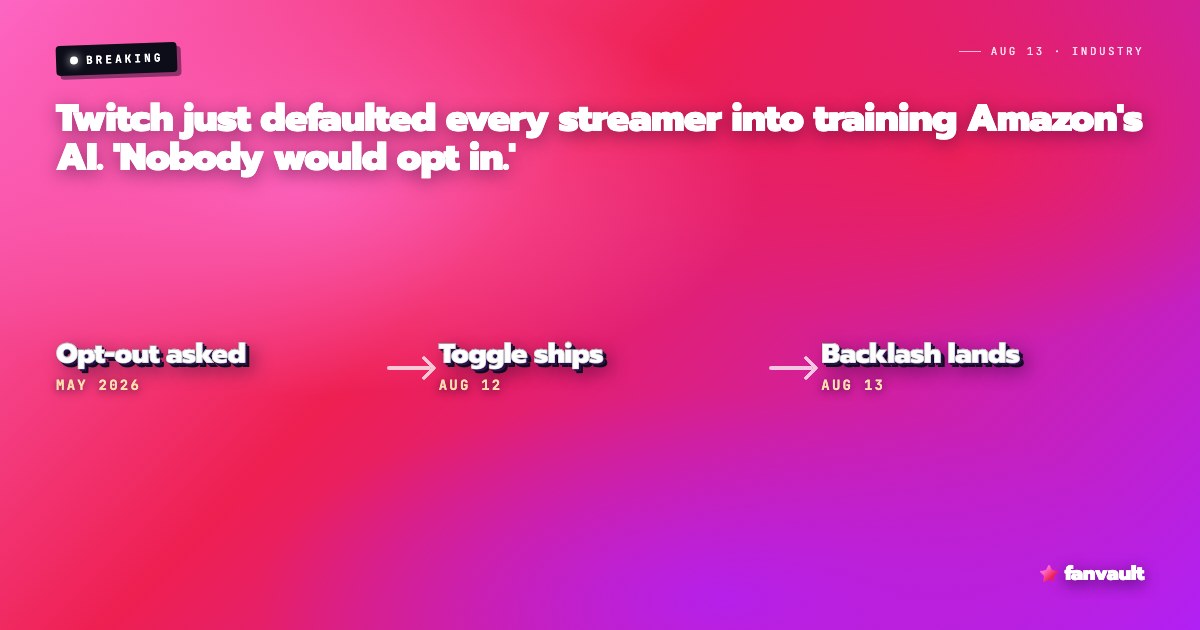
On August 12, Twitch quietly shipped an opt-out toggle confirming what every streamer had suspected: Amazon has been training its generative AI on their livestreams, VODs, clips, and chat by default. Roughly 7.3M monthly streamers were auto-enrolled with no email, no pop-up, no in-product announcement. Then Twitch's Chief Product Officer said the quiet part on a livestream: if it was opt in, nobody would opt in.
⚡ Key Takeaways
- Twitch defaulted every one of its ~7.3M monthly streamers into Amazon generative-AI training on August 12, with no email and no in-product announcement.
- The toggle scope covers livestreams, VODs, clips, chat logs, and every image and text field on a channel page.
- CPO Mike Minton, live on Patch Notes to ~3,000 creators: 'if it was opt in, nobody would opt in. That's honestly the answer.'
- The opt-out is scoped to future training only; anything Amazon has already ingested stays in the model.
- In 2024, then-CMO Minton had already told an Information event that Amazon uses Twitch content to train AI: 'yeah, for sure.'
- Twitch's terms of service still don't mention AI, ML, or generative; the broad 'derivative works' and 'sub-licensable' language has been doing the work all along.
What actually happened?
The toggle appeared under Streamer Dashboard, Settings, Security and Privacy, buried where a working streamer would never look. It covers livestreams, VODs, clips, chat logs, and the text and images on a channel page, all of which Amazon has been ingesting into its generative-AI models, per TechCrunch. Twitch's terms of service still contain no mention of "artificial intelligence," "machine learning," or "generative," per an analysis by WPStream. The broad "derivative works" and "sub-licensable" clauses were doing the legal work the entire time.
The same day, roughly 3,000 creators tuned into a Patch Notes livestream where CPO Mike Minton and Head of Community Mary Kish took questions. Chat filled with a single demand on repeat: make it opt in. Kish opened with, "we don't expect you to be happy or excited about this," per Aftermath. Minton answered the opt-in question directly, and gave the quote that has now spread across every gaming outlet.
Why does this matter for creators?
Every streamer built their archive under one set of terms, and the ground moved without warning. Twitch's own FAQ scopes the exclusion to "future" training, per eWeek, which means anything Amazon has already ingested stays in the model. The opt-out is a fig leaf on years of quiet extraction. When Minton was asked on stream whether Amazon had already trained on old VODs, he said he did not know what Amazon had used, per Shacknews.
This is not new posture from Minton either. At a 2024 event held by The Information, then serving as Twitch's chief monetization officer, he was asked whether Amazon uses Twitch content for AI training and replied, "yeah, for sure," per TechSpot. A UserVoice thread asking for an opt-out earlier this year sat with more than 13,000 upvotes and no visible action from the platform. The toggle exists now because the story could not be contained any longer.
"Why is it not opt in? Well, there's an honest answer, and I think most of you probably can appreciate this. If it was opt in, nobody would opt in. That's honestly the answer."
Mike Minton, Chief Product Officer, Twitch, on the Patch Notes livestream (via Tubefilter)
Where does this go from here?
The archive is the moat now, and every platform with broad terms of service is watching this test. Coverage cascaded within twenty-four hours across TechCrunch, Kotaku, Engadget, 404 Media, and The Register. High-profile streamers turned opt-out walkthroughs into their own posts on X. The pressure is real, but the design decision behind it is more instructive than the toggle itself.
The pattern reads clearly: default enrollment across roughly 11.4M monthly broadcasters, no email, minimum surface area for objection. It works because most streamers will never navigate three menus deep to disable it. The 60-day VOD retention limit is the one thin silver lining, meaning a channel that opts out tomorrow caps Amazon's future intake at roughly two months of video. Everything already trained on, however, stays in the model.
What does Fanvault think?
Every platform-vs-creator fight of the last decade has come down to one question: who owns the archive the creator built. Twitch just answered it with a toggle and a shrug, and let its own CPO admit on a livestream that the whole opt-in framing is a fiction because nobody would actually consent. Fanvault was founded in 2025, AI-native from day one, and takes an 8% platform fee so creators keep 92% of every transaction. The reason the storefront, the wishlists, the paid DMs, and the authenticated memorabilia all live in one creator-controlled account is because the incentives have to face the creator, not the parent company's model roadmap.
When the platform hosting you is also the platform harvesting you, the counter-move is infrastructure the creator actually owns.
The opt-out is on the dashboard. The corpus is already trained. Streamers get to pick which of those two facts they want to spend the next year arguing about.
Frequently Asked Questions
What exactly does the Twitch AI training toggle cover?
Everything Twitch hosts on a channel. Per TechCrunch and the platform's own FAQ, the default enrollment feeds livestreams, VODs, clips, chat logs, and the text and images on a channel page into Amazon's generative-AI models. It is not scoped to any one content type; if it lives on the channel, it counts as training data.
Does opting out delete what Amazon has already trained on?
No. Twitch's FAQ scopes the toggle to "future" training, per eWeek, and Minton refused on stream to say whether Amazon had already ingested years of old VODs. The one thin caveat is Twitch's 60-day VOD retention window, which caps future ingestion for anyone who opts out today at roughly two months of that channel's video. Anything trained on before the toggle appeared stays in the model.
How do I opt out as a Twitch streamer?
Streamer Dashboard, then Settings, then Security and Privacy, then flip the "Training for Generative AI" toggle off. The setting is per-channel and is not surfaced anywhere else in the product. If you stream from more than one account, each one needs to be disabled separately.
Do other creator platforms have the same default?
The pattern is spreading. YouTube and TikTok both have their own AI-training arrangements and have historically kept far longer content archives than Twitch's 60-day VOD window. The lesson for anyone building on a hosted platform is the same lesson every fee-heavy competitor teaches: the broad terms of service you signed years ago are the terms that will govern whatever the parent company wants to do next. A platform like