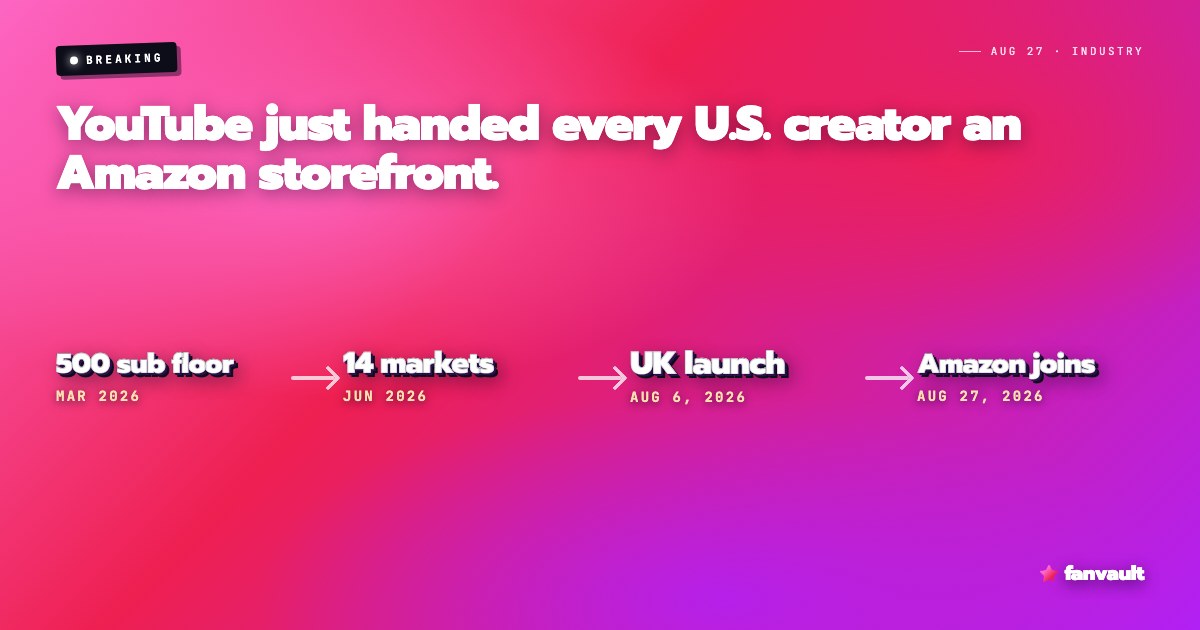
YouTube CEO Neal Mohan announced Thursday that Amazon is officially joining the YouTube Shopping affiliate program. Eligible American creators can now tag Amazon products in Shorts, long-form videos, and livestreams, and get paid through their AdSense check. The move plugs the biggest hole in YouTube's shopping stack, and it lands as viewers watched 35B hours of shopping content on the platform in the past year.
⚡ Key Takeaways
- YouTube's Shopping affiliate program just added Amazon, unlocking the biggest e-commerce catalog on earth for eligible American creators.
- Commissions run Amazon's standard 2 to 4 percent on most physical goods and get paid through AdSense, roughly two months after they lock.
- The auto-tag switch scans a creator's recent uploads and attaches eligible Amazon products without a human touching the video.
- Every American YouTuber's back catalog just became re-monetizable, and review, unboxing, gaming, and how-to niches will collect the compounding tail.
- The competitive read is TikTok Shop: $30B in American GMV during the first half of 2026 alone, and YouTube is going asset-light by renting Amazon's catalog instead of building its own.
- It's the same thesis platforms like Fanvault run on: collapse the creator's monetization stack into one account, one dashboard, one payout.
What actually happened?
On August 27, Mohan posted on X that Amazon was joining the YouTube Shopping affiliate program, and YouTube's official blog followed with the launch mechanics. Creators enrolled in the YouTube Partner Program plus either Amazon Associates or the Amazon Influencer Program can tag a curated Amazon catalog inside Shorts, long-form uploads, and livestreams. An opt-in auto-tagging switch lets YouTube scan a creator's recent uploads and attach eligible products automatically, per YouTube's announcement.
The commission math is Amazon's standard Associates rate, roughly 2 to 4 percent on most physical goods, and up to 20 percent in categories like Amazon Games. YouTube bundles it into the creator's monthly AdSense check, with a two-month lag between the month a commission locks and the month it hits the bank, according to PPC Land. Returns get clawed back from the next payout, and Tubefilter reports the catalog is curated rather than open, so creators can't link any random SKU.
Not every product is fair game. Amazon supplies YouTube with a curated list of trending items, and creators pick from that pool inside YouTube Studio's product picker, with requests for missing SKUs routed through YouTube Support without a guarantee. International sales get partial support, but if a viewer's purchase finalizes off Amazon's platform with a regional merchant, the creator doesn't collect on it.
Why does this matter for creators?
This is a rare zero-lift income upgrade for American YouTubers. Every review, unboxing, gaming, and how-to video already in their back catalog just became re-monetizable, either through YouTube Studio's product picker or the auto-tag toggle. The commissions are small per-sale, but they stack on top of AdSense, arrive in the same payout, and reach an audience that already watches shopping content on the platform in fantasy-league volumes.
The March 2026 subscriber-floor drop, from 10,000 subs to 500, opened the Shopping affiliate program to nearly every YouTube Partner Program member, per PPC Land. That means the Amazon integration doesn't just help the top of the leaderboard. Any mid-tier creator with a niche audience and an active Amazon Associates account is now sitting on a new revenue line they didn't have on Wednesday.
"Exciting news: Amazon is coming to our YouTube Shopping affiliate program!"
Neal Mohan, CEO, YouTube
Where does this go from here?
The subtext is TikTok Shop. TikTok's marketplace crossed $30B in American GMV during the first half of 2026 alone, blowing past eMarketer's full-year $20B projection by summer. YouTube isn't building its own marketplace and hiring warehouses, it's becoming the discovery layer for Amazon's, riding the largest e-commerce catalog on earth while TikTok is still fighting divestiture rulings.
For creators, the direction of travel is loud. Native creator shopping integrations grew 71 percent year over year, and creator-driven affiliate revenue now accounts for roughly a quarter of all American affiliate spend, according to Zebracat's affiliate breakdown. Every surface a fan already visits is turning into a checkout, and the platforms that make it painless will collect the compounding tail.
What does Fanvault think?
YouTube just proved the thesis Fanvault has been running on since 2025: creators don't want six dashboards, they want one. The Amazon integration collapses affiliate discovery, tagging, and payout into a single account with a single check, and that's the same collapse Fanvault built into its 8 percent-fee storefront, where creators keep 92 percent and run memberships, paid DMs, tips, wishlists, and authenticated memorabilia auctions from one profile. The winners of the next two years will be the platforms that stop making creators tape twelve tools together, and the ones that own the direct fan relationship rather than renting a catalog.
YouTube didn't build a storefront. It rented the biggest one on earth and handed the keys to every eligible creator in America. That's the smart play, and it just made every American YouTuber's back catalog a little more valuable overnight.
Frequently Asked Questions
When does Amazon tagging on YouTube actually launch?
It launched on August 27, 2026, when YouTube CEO Neal Mohan announced the partnership on X and YouTube's official blog detailed the mechanics. Eligible American creators in the YouTube Partner Program plus Amazon Associates or the Amazon Influencer Program can start tagging immediately, across Shorts, long-form videos, and livestreams.
How much do creators actually earn per Amazon sale on YouTube?
Creators earn Amazon's standard Associates commission, typically
Do you need a huge channel to qualify?
No. YouTube dropped the Shopping affiliate program's subscriber floor from 10,000 to
Can creators link any Amazon product they want?
Not exactly. Amazon supplies YouTube with a curated catalog of trending and highly requested products, and that's the pool creators can tag. Missing products can be requested through YouTube Support, but there's no guarantee the addition lands.
Why is YouTube doing this now?
TikTok Shop crossed
What does this mean for creator platforms like Fanvault?
It validates the thesis. Every major platform is racing to collapse creator monetization into a single dashboard with a single payout, and Fanvault has been running on that model since 2025, with an