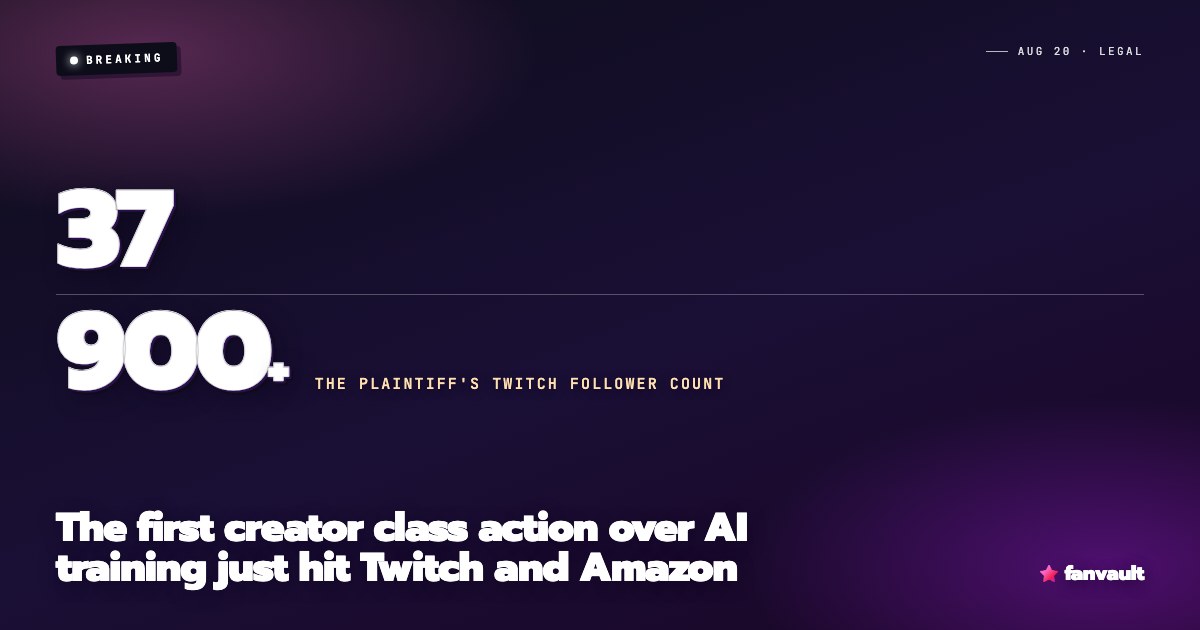
A Connecticut Twitch streamer just filed a federal class action against Twitch and Amazon, accusing them of scraping streams, VODs, chat logs, and channel data since 2024 to train Amazon's commercial AI. The complaint runs 37 pages, names a nationwide class of Twitch creators, and asks a judge to order every ingested clip deleted. It's the first case to put a legal price on creator livestreams as AI training data.
⚡ Key Takeaways
- Warren Pandiscia filed case 3:26-cv-08721 on August 20, 2026 in the Northern District of California, alleging Twitch and Amazon scraped his content since 2024.
- The 37-page complaint pleads four causes of action, including breach of implied contract, unjust enrichment, breach of express contract, and California's Unfair Competition Law.
- It is the first federal class action from a live-streaming creator over generative AI training, a fight previously led by authors, artists, and record labels.
- Twitch CPO Mike Minton triggered the suit by admitting on an August 12 livestream that the opt-out default exists because 'nobody would opt in.'
- Pandiscia is asking for class certification, deletion of every already-ingested clip, and disgorgement of Amazon's AI profits.
What actually happened?
On August 20, 2026, Warren Pandiscia filed case 3:26-cv-08721 in the U.S. District Court for the Northern District of California, San Francisco Division, per Courthouse News. Pandiscia has streamed on Twitch for nearly a decade and has just over 900 followers, which makes him an unlikely lead plaintiff and exactly the point. The complaint names Twitch Interactive and its parent Amazon.com as defendants and pleads four causes of action: breach of implied contract and the covenant of good faith, unjust enrichment, breach of express contract, and violation of California's Unfair Competition Law, according to Tubefilter. Pandiscia is asking for class certification on behalf of a nationwide class of Twitch creators, plus injunctive relief, damages, restitution, and disgorgement of Amazon's AI profits.
The trigger was Twitch's August 12 rollout of an AI training setting that auto-enrolled every account on the platform, as TechCrunch first reported. On the same day's Patch Notes Q&A livestream, Twitch CPO Mike Minton was asked why the setting was opt-out rather than opt-in and delivered what has become the case's most damning soundbite. Streamers went scorched-earth in chat within hours, and the discourse metastasized across X, Forbes, and Kotaku over the next 48 hours. Eight days later, Pandiscia's lawyers had turned that admission into a federal filing.
Why does this matter for creators?
Every prior generative AI class action has come from authors, artists, journalists, or record labels. Pandiscia is the first named plaintiff to argue in federal court that livestream footage, VODs, clips, chat logs, and channel metadata are commercial IP that a platform cannot silently re-license to its own AI division. If a judge certifies the class or the defendants settle, the creator economy gets its first real price tag on raw livestream data as training material. That precedent is going to travel.
The theory of harm is what makes this ugly for the defense. Pandiscia's complaint argues that once your content is inside a model it is never coming back out, which reframes the fight from privacy setting to permanent IP transfer. That framing is why the filing asks for disgorgement of Amazon's profits and an order forcing every already-ingested clip to be deleted, per PPC Land. It also explains why the smallest plaintiff on the docket is representing the biggest class.
Zoom out and every major streaming platform is running the same setup. YouTube, Kick, TikTok Live, and Instagram Live all sit on training-eligible pipelines that most creators never explicitly agreed to feed. Pandiscia's filing drags that arrangement into federal court, and it does it with a plaintiff whose 900-follower channel makes the class definition sing. The bigger a platform's AI budget gets, the more expensive that argument becomes.
"If it was opt-in, nobody would opt in. That's honestly the answer."
Mike Minton, Chief Product Officer, Twitch, on the Patch Notes Q&A livestream
Where does this go from here?
Twitch and Amazon have a few obvious plays. They can fight class certification, argue the terms of service already granted a training license, and try to keep the case in front of a judge who buys the platform-consent theory. They can also settle quietly, pay the class, and rewrite the toggle to opt-in, which is what most streamers wanted from day one, per Forbes. Neither path is cheap, and both leave the disclosure timeline as a permanent scar on the platform's relationship with its top talent.
The bigger read is that Amazon confirmed AI training on Twitch content back in 2024, when Minton was still Chief Monetization Officer, per Engadget. That timeline is what makes this dangerous. The scraping predates the opt-out setting by roughly two years, and it hands Pandiscia's lawyers a clean argument that any disclosure came long after the fact. Every other platform running the same "opt-out, if you can find it" playbook is watching this docket.
For working creators, the question stopped being whether platforms are training on your streams. It is now whether a court will finally make them pay for it, and whether the answer travels beyond Twitch to every service that treats creator uploads as free fuel.
Frequently Asked Questions
Who is Warren Pandiscia and why is a 900-follower streamer leading this class action?
Pandiscia is a Connecticut-based Twitch streamer who has broadcast on the platform for nearly a decade. He has just over
A class action needs a lead plaintiff who is representative of the class, and Pandiscia's channel looks like the median Twitch creator whose content is now training data. His lawyers are asking the court to certify a nationwide class on behalf of every Twitch creator whose streams, VODs, clips, or chat logs were ingested since 2024, per Courthouse News.
What is Twitch's AI opt-out setting and when did it change?
Twitch rolled out the setting on
On the same day's Patch Notes Q&A livestream, Twitch CPO Mike Minton confirmed the default was set that way because opt-in would have produced almost no participation. The suit argues this design is proof that Twitch understood consent was missing and rolled the feature out anyway.
What are the four causes of action in the lawsuit?
The 37-page complaint pleads breach of implied contract and the implied covenant of good faith and fair dealing, unjust enrichment in the alternative, breach of express contract, and violation of California's Unfair Competition Law under Business and Professions Code section 17200, per Tubefilter.
Pandiscia is seeking declaratory and injunctive relief, damages, restitution, and disgorgement of Amazon's AI profits. He is also asking the court to order the defendants to delete every piece of already-ingested creator content and to build a durable opt-out. The Unfair Competition Law claim is the one platform lawyers watch most closely, because California's UCL is where scraping cases tend to survive early motions.
Could this affect other platforms besides Twitch?
Every major streaming and social platform is running an opt-out default for AI training. YouTube, Kick, TikTok Live, and Instagram Live all sit on similar arrangements, most of which were rolled out with little user education.
If Pandiscia's suit clears class certification or the defendants settle for a public number, the resulting precedent gives creators a template to bring parallel actions elsewhere. The theory of harm, that ingested content can never be pulled back out of a trained model, is not Twitch-specific and travels wherever a training pipeline exists.