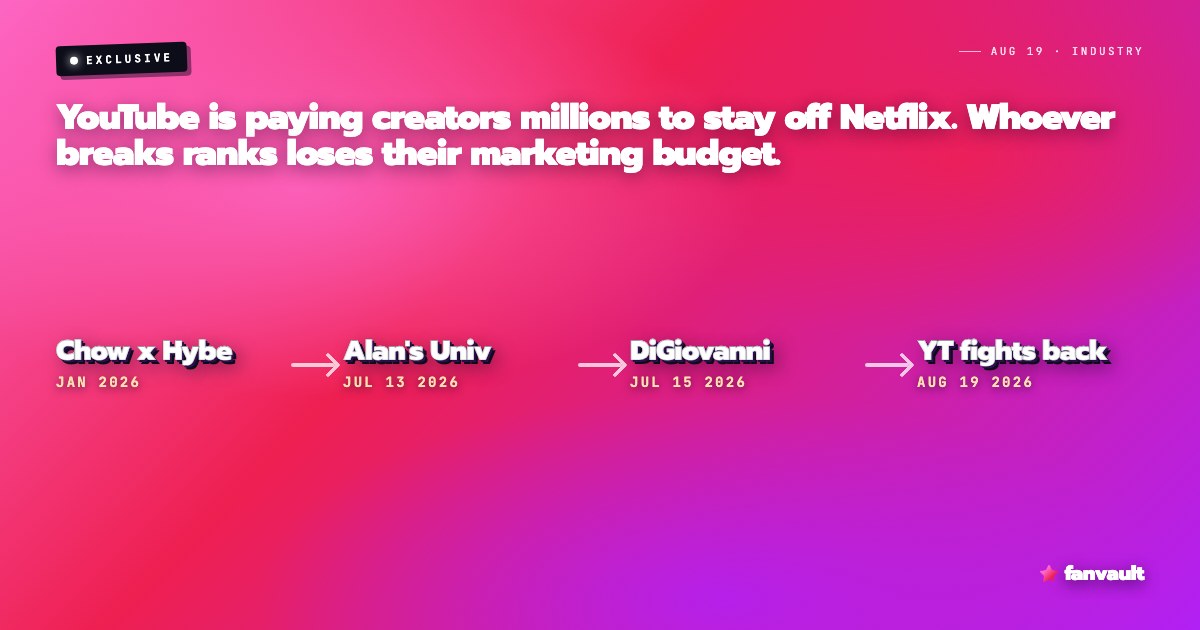
YouTube is now paying its biggest creators millions to keep their videos off Netflix, and warning the ones who cross-post that they will lose marketing pushes, live-event stage time, and cuts of major brand deals. Bloomberg broke the story on August 19, 2026. The friendly rivalry is over. The two most-watched platforms in America are now openly bidding for the same talent.
⚡ Key Takeaways
- YouTube is quietly offering top channels millions in program financing plus a cut of its biggest brand deals in exchange for exclusivity, Bloomberg reported August 19.
- The stick: cross-post to Netflix and YouTube may pull your marketing support, live-event stage time, and access to certain brand-deal proceeds.
- Netflix triggered the fight in July with day-and-date deals for Nick DiGiovanni's cooking channels and Alan Chikin Chow's Alan's Universe.
- YouTube CEO Neal Mohan reversed a years-long stance that cross-posting creators still funneled audiences home to YouTube.
- YouTube captures 13.4% of U.S. TV watch time to Netflix's 7.8%, and more than 44% of that watch time now happens on connected TVs.
- Takeaway for everyone below the top tier: build the parts of the business no platform can bench you from.
What actually happened?
According to Bloomberg's Lucas Shaw, YouTube is offering select top channels a mix of direct financing for specific programs plus a share of the revenue YouTube generates through its largest brand partnerships, all in exchange for keeping their content exclusive to YouTube for a set window. Multiple deals are reportedly close to closing. Neither YouTube nor Netflix has confirmed terms publicly.
The move reverses YouTube CEO Neal Mohan's long-standing public line. Mohan argued for years that creators who worked with legacy media (Netflix specials, Amazon shows, streaming spinoffs) still funneled their audiences back to YouTube, so the platform did not need to defend its turf. Bloomberg reported that Mohan and his team concluded in recent weeks that day-and-date cross-posting on Netflix was undermining YouTube's ability to sell that content to advertisers as exclusive. The neutrality window closed.
The pressure came from a real Netflix push. In July 2026, Netflix signed a non-exclusive day-and-date deal with celebrity chef Nick DiGiovanni, taking his back catalog plus new episodes from his Nick DiGiovanni and Nick's Kitchen channels as they release on YouTube, Deadline reported. Days earlier, Netflix picked up Alan Chikin Chow's scripted anthology Alan's Universe on the same terms, on top of a K-Pop series with Hybe America. Netflix is in talks with dozens more channels, including the Sean Evans franchise Hot Ones, which already has a Netflix spinoff called Extra Heat.
Why does this matter for creators?
The stick behind YouTube's carrot is the real story. Bloomberg reported that channels which also publish to Netflix may lose access to YouTube's marketing pushes, be cut out of live-event stage time, and get shut out of proceeds tied to certain major brand campaigns. That is not a partnership pitch. That is a supplier contract dressed up as a bonus.
For creators, this is the first time platform loyalty has been openly priced. YouTube paid creators, artists, and media companies $70B from 2021 to 2024 and hosts roughly 5 million channels in its Partner Program, per CNBC. The top few percent get to negotiate. Everyone else has to guess how the rules will move next.
"YouTube has told creators that channels which also publish to Netflix may be less likely to receive marketing support or stage time at YouTube events, and could be excluded from revenue generated through certain major brand campaigns."
Bloomberg, characterizing YouTube's messaging to creators, August 19, 2026
Where does this go from here?
YouTube's threat is possible because the leverage finally exists. YouTube captures 13.4% of U.S. TV watch time versus Netflix's 7.8%, per 2026 Nielsen data, and more than 44% of that YouTube time now happens on the living-room TV. That means YouTube is not defending a video website. It is defending a rival streamer that happens to be free.
Expect two things to accelerate. Netflix will keep chasing YouTube's biggest names because the economics of one non-exclusive licensing deal beat the economics of one Netflix original. YouTube will keep raising its lock-in offers to the same names, and mid-tier creators will find out the terms of the new market the hard way.
The middle tier is where the real risk sits. YouTube has told those creators nothing about how the exclusivity threshold gets set, and Bloomberg reported no public criteria for who gets included in the reallocated brand-deal revenue pool. Anyone building a business on the assumption of neutral platform reach just watched neutrality end.
What does Fanvault think?
Fanvault reads this the way any creator building a real business should. The platforms are finally showing their hand. YouTube's threat to bench cross-posters from marketing and brand-deal revenue is proof that "creator partner" was always a courtesy, not a contract. Netflix will not stay generous once the bidding war cools either.
The response is not to pick a side. It is to own the parts of the business a platform cannot revoke. On Fanvault, creators keep 92% of every subscription, tip, paid DM, and authenticated memorabilia auction, and the storefront runs itself through a conversational automation layer that reaches all the way into Telegram. When the biggest names on YouTube are being paid to sit out a competitor, everyone below them should be building the layer no platform can bench them from.
Distribution just became a competitive market again. Own the parts that stay yours.
Frequently Asked Questions
What is YouTube actually offering creators who stay exclusive?
YouTube's package has two parts, per Bloomberg. The platform is offering direct financing for specific programs and a cut of the revenue YouTube earns from its largest brand partnerships. In exchange, the creator's videos have to stay exclusive to YouTube for a defined window. Multiple deals are reportedly close to closing, though neither YouTube nor the creators have named public terms.
Which creators has Netflix already signed away from YouTube exclusivity?
Two so far, both non-exclusive day-and-date deals. Netflix picked up Alan Chikin Chow's scripted anthology Alan's Universe in July 2026, on top of a scripted K-Pop series with Hybe America announced in January, per Deadline. Days later, Netflix signed celebrity chef Nick DiGiovanni for his back catalog plus new episodes from his Nick DiGiovanni and Nick's Kitchen channels. Netflix is reportedly in talks with dozens more channels, including the Sean Evans franchise Hot Ones.
Why did YouTube change its position now?
For years, CEO Neal Mohan argued publicly that creators who worked with Netflix or Amazon still funneled their audiences back to YouTube, so the platform did not need to defend its turf. Bloomberg reported that Mohan and his team decided in recent weeks that day-and-date cross-posting on Netflix was undermining YouTube's ability to sell that content to advertisers as exclusive. YouTube already captures roughly
What should mid-tier creators do about this?
The lesson is not to pick a side. It is to own the parts of the business a platform cannot revoke: a direct storefront, direct fan relationships, product drops, paid memberships, custom requests, tips, and authenticated memorabilia. On Fanvault, creators keep