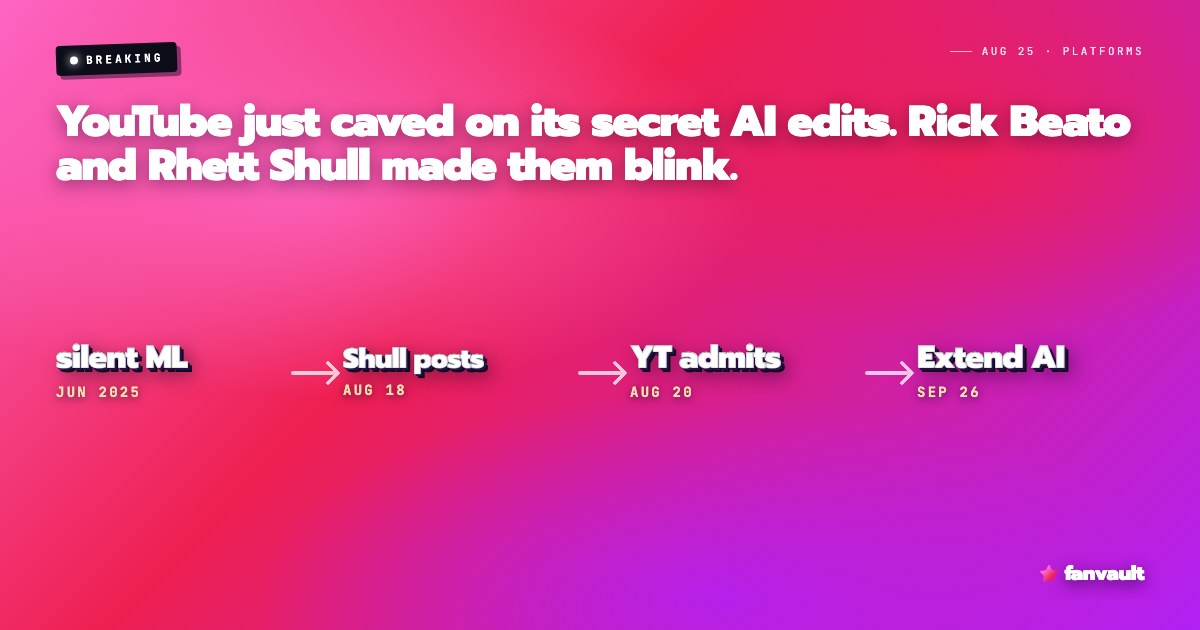
YouTube got caught. For months, the platform silently ran machine-learning "enhancement" over creators' Shorts, waxy skin, painted-on hair, warped ears, sharpened wrinkles, and served the doctored versions to viewers as originals. Then Rick Beato (5.1M+ subs) and Rhett Shull (~750K) posted side-by-sides. Within a week, YouTube admitted it, promised an opt-out, and creators had a new receipt for what platforms will do to their work when nobody is watching.
⚡ Key Takeaways
- YouTube spent months silently running ML "enhancement" over creator Shorts, waxy skin, painted-on hair, warped ears, and shipped the altered versions as originals.
- Rick Beato (5.1M+ subs) and Rhett Shull (~750K) posted side-by-sides; Shull's exposé cleared 500K views in days.
- YouTube confirmed the experiment on Aug 20, 2025 via creator liaison Rene Ritchie, insisting it was "traditional machine learning," not GenAI. Creators didn't buy the distinction.
- Within a week, YouTube committed to an opt-out, no firm ship date, an unusual reversal for a platform that rarely capitulates on product experiments.
- Then on Sept 26, YouTube launched "Extend with AI" for Shorts. The pattern: silent alteration first, opt-out under pressure, generative rollout on top.
- The real story is the lever: two named creators with cameras made YouTube blink in under a week. That is now the fastest known way to force a platform reversal.
What actually happened?
Guitar-YouTuber Rhett Shull noticed his uploaded Shorts looked wrong on playback, skin sanded smooth, edges over-sharpened, an "oil painting" quality that wasn't in his source file. He ran the comparison, uploaded a video titled "YouTube Is Using AI to Alter Content (and not telling us)," and it cleared 500,000 views in days. Rick Beato, whose Everything Music channel crossed 5 million subscribers earlier this year, cosigned on the same day, saying his own hair looked strange and his face looked made up.
The signal that broke it into mainstream press: this had been happening quietly since at least June 2025, per Tubefilter. On August 20, YouTube's head of editorial and creator liaison Rene Ritchie confirmed it on X, telling creators the platform was "running an experiment on select YouTube Shorts that uses traditional machine learning technology to unblur, denoise and improve clarity in videos during processing." No GenAI, he insisted. Just smartphone-style processing. By the end of the week, YouTube had committed to building an opt-out.
Why does this matter for creators?
The "traditional ML, not GenAI" defense is the tell. YouTube's PR team is drawing a line between machine learning and generative AI because they know creators can smell one and not the other. But the creators aren't buying the semantic distinction, and they shouldn't. Whatever you call the model, the platform was silently altering how creators looked on camera and shipping that altered version to their audiences as the real thing.
That is not a codec tweak. That is a platform inserting itself between a creator and the audience relationship they spent years building. If a musician's face looks waxy on their own Shorts, viewers don't blame YouTube's ML pipeline, they think the creator is running an AI filter, or worse, that the whole channel is fake. Trust is the actual product on this platform, and YouTube spent months quietly eroding it to A/B test a sharpening filter.
"If I wanted this terrible over-sharpening I would have done it myself. But the bigger thing is it looks AI-generated. I think that deeply misrepresents me and what I do and my voice on the internet."
Rhett Shull, YouTube creator, Interesting Engineering
What's the bigger picture?
This is the 2026 creator-economy fight in miniature. Platforms increasingly treat creator output as raw material they can "improve," clean up, upscale, remix, and creators are done pretending that's neutral. YouTube reversed course inside a week, not because of a regulator or a class action, but because two named creators with real followings shipped a side-by-side. That is a new lever, and every other platform running silent post-upload processing should be reading the room right now.
The kicker: on September 26, YouTube announced "Extend with AI" for Shorts, an explicitly generative feature, while the opt-out for the silent enhancement still had no firm ship date. The pattern is unmistakable. Silent alteration first, opt-out under pressure, generative rollout on top. Creators who don't want to be the training set or the test subject will have to keep documenting.
What does Fanvault think?
Ownership of your on-screen image now includes ownership of how the platform re-renders it before it hits the feed. This is the question every creator should be asking their platform in 2026, right next to the fee question: what do you actually do to my content between upload and playback? Fanvault's answer is nothing. The 8% fee is the whole take, no silent enhancement, no undisclosed ML pass, no experiment on "select" uploads. A creator monetization platform shouldn't be A/B testing your face.
Fanvue takes 15%. Passes takes 10% plus $0.30. Fanfix takes ~20%. None of them will publicly commit to leaving your uploads alone either, because none of them have had to. Beato and Shull just changed what creators are allowed to demand.
Frequently Asked Questions
What did YouTube actually do to creators' Shorts?
YouTube ran what it calls a "traditional machine learning" pass over select Shorts after upload, denoising, unblurring, and sharpening the footage before serving it to viewers. In practice, that produced waxy skin, painted-on hair, sharpened wrinkles in clothing, and warped ears. The changes were subtle enough to miss without a side-by-side, which is exactly how they went unnoticed from at least June 2025 until Rhett Shull's August exposé.
Is this generative AI or something else?
YouTube says no. Rene Ritchie, YouTube's head of editorial and creator liaison, was explicit: "No GenAI, no upscaling." He described it as similar to what a modern smartphone does when you record a video. Creators pushed back on the framing, per SiliconANGLE, because from a viewer's perspective the artifacts look identical to AI-generated content. The technical distinction is real; the reputational damage doesn't care.
Did YouTube apologize or reverse the experiment?
Not exactly. YouTube confirmed the experiment on August 20, 2025 and committed to building an opt-out mechanism after the backlash, per Dexerto. No firm launch date has been shared for that opt-out. The experiment itself was defended as legitimate processing, not withdrawn. In the meantime, on September 26, 2025, YouTube shipped "Extend with AI" for Shorts, a separate, explicitly generative feature.
Why does a sharpening filter matter this much?
Because creator identity is the product. When a viewer sees a musician's face look waxy on a Short, they don't attribute it to a platform's ML pipeline, they attribute it to the creator. That reads as an AI filter, a deepfake, or a channel gone synthetic. For creators whose whole business is the trust and recognition their audience has built up over years, a silent alteration to how they appear on camera is a direct hit to the brand, not a codec footnote.
What's the takeaway for creators on any platform in 2026?
Ask the platform question that isn't the fee question: what happens to my content between upload and playback? Every platform is threading AI into ingest, transcode, and delivery. Some are disclosing it. Most aren't. The Beato-Shull reversal proved that a well-documented side-by-side from a creator with a real following can force a platform to blink inside a week. That is now the playbook. Document, compare, publish, and don't accept "traditional machine learning" as an answer that closes the conversation.