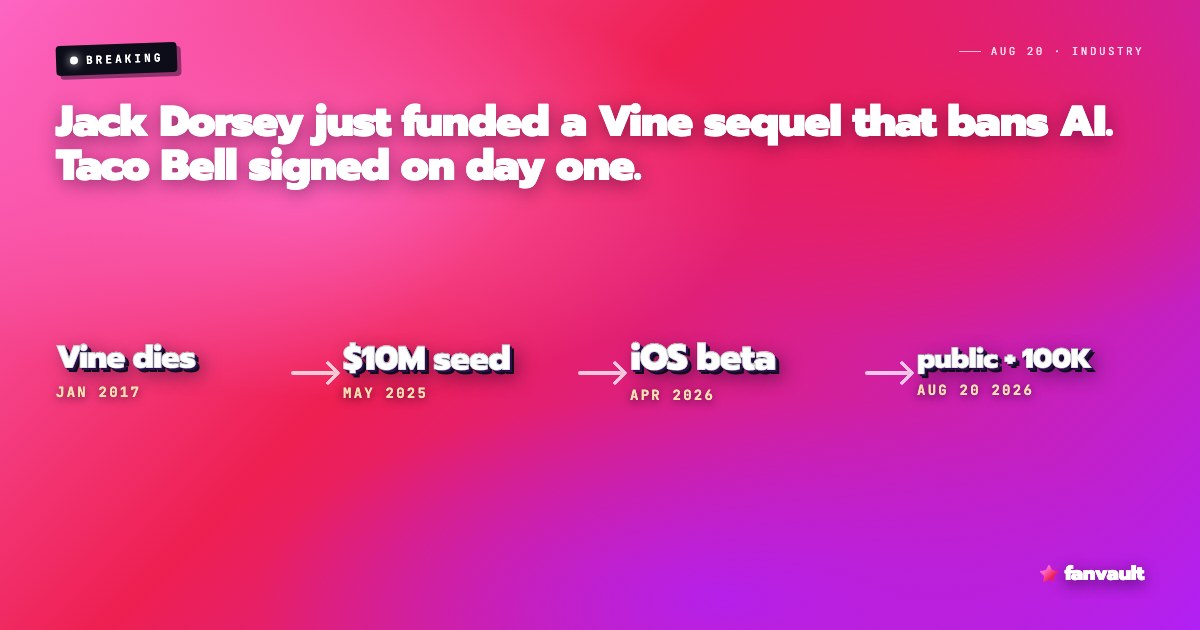
Jack Dorsey just backed the public launch of Divine, a six-second-loop app that bans AI-generated content at the pixel level and dropped its invite wall on August 20, 2026. Built on the decentralized Nostr protocol by ex-Twitter founding engineer Evan Henshaw-Plath, it opened with 2M+ restored Vine clips, roughly 100,000 users in days, and Taco Bell as its first brand partner. This is the first credible short-form platform launch since TikTok.
⚡ Key Takeaways
- Divine, the Jack Dorsey-backed Vine successor, opened globally on August 20, 2026 with an outright ban on AI-generated content.
- Every clip is cryptographically signed at the moment of capture via Guardian Project's ProofMode, with C2PA integration in progress.
- Built on the decentralized Nostr protocol, so creator profiles aren't hostage to any single company; Dorsey holds no equity.
- Shipped with 2M+ restored original Vine clips from ~100,000 legacy creators and Taco Bell as day-one brand partner.
- Hit ~100,000 users within days; no subs, PPV, tips, or storefront yet, so it's an audience play, not a revenue play.
What actually happened?
Divine dropped its invite-only wall globally on August 20, 2026, launching worldwide on iOS with a cryptographic capture pipeline built on Guardian Project's ProofMode, which signs every clip at the moment of filming, per Mediaweek. Anything not shot inside Divine's in-app camera gets blocked. The company is also implementing C2PA, the provenance standard already used by Sony, Canon, Adobe, Google, Meta, and OpenAI. Dorsey holds no equity; funding runs through his "and Other Stuff" nonprofit, which he seeded with $10 million in May 2025, per Engadget.
The launch shipped with a "classic" tab of more than 2 million restored Vine clips from roughly 100,000 original creators, painstakingly recovered from an old backup, per TechCrunch. Within days, Divine had racked up around 100,000 users, according to CNN Business. Taco Bell came in as the first brand partner, timed to its "Decades #TBTB" 2016-menu revival; fans got early access using the promo code TACO-BELL, per GamesBeat.
Why does this matter for creators?
The ban isn't a filter or a label. It's a cryptographic verification pipeline enforced at the moment of capture, and no other consumer social app in 2026 is treating "human-made only" as an enforceable product rule instead of a moderation aspiration. That reframes provenance from a compliance chore into a brand promise. For creators, the entire pitch of the platform becomes: your loops can't get drowned out by generated feed slop.
The Nostr rail matters just as much. Profiles live on an open protocol, not a walled garden, so no future acquirer can pull a repeat of what Twitter did to Vine in 2017 (when it shut the app down without warning). Divine is also experimenting with the AT Protocol behind Bluesky and has hinted at ActivityPub down the line. Portability is now the pitch, not a distant promise.
Rabble has been explicit about the ad-algorithm critique. In launch interviews he framed Divine as a place where creators no longer have to guess what the recommendation engine wants. If that pitch pulls a real audience, Divine becomes the first mainstream consumer app that treats freedom from optimization pressure as a shipped product feature. That's a promise other creator platforms have gestured at for years and never actually delivered.
"By stripping away the pressure to create content that gets picked up by an ad algorithm, we've uncovered what it is that people actually want to create. That's the magic of Divine."
Evan Henshaw-Plath (Rabble), CEO and founder, Divine, via GamesBeat
Where does this go from here?
The Taco Bell tie-in is the tell. Big brand-safety teams have been quietly panicking about running spend against feeds where too much of what sits next to their ad is AI-generated. Divine walking in with a marquee QSR deal on day one, per QSR Web, says the ad market will pay a premium to sit inside a "verified human" environment. Expect the next 90 days to bring more launch partners in categories that hate slop most: sports, music, fashion.
The obvious gap is monetization. Rabble hasn't ruled out ads eventually, but Divine today has no subs, no PPV, no tips, and no storefront. Creators betting big on Divine loops in 2026 are betting on future upside, not income. That's the specific slot every creator-monetization platform is now racing to fill.
What does Fanvault think?
Fanvault's read: Divine just proved the "where creators post" layer and the "how creators earn" layer are unbundling for good. A creator can build an audience on Divine, TikTok, and Instagram, then route monetization through a storefront that keeps 92% of every dollar at Fanvault's canonical 8% platform fee. Fanvue takes 15%, Passes takes 10% plus $0.30, and Fanfix takes roughly 20%. The winners of this cycle won't be the creators who pick one app; they'll be the ones who post everywhere and monetize once.
The ground under short-form video just moved. Human-made is now a product category, and the fastest way to earn from it is to sell somewhere that lets you keep almost all of it.
Frequently Asked Questions
What is Divine, and who is actually behind it?
Divine is a six-second-loop video app that opened to the public on
How does Divine actually enforce its AI content ban?
Every clip is captured inside Divine's own in-app camera and cryptographically signed at the moment of filming using Guardian Project's ProofMode software. Divine is also integrating C2PA, the provenance standard used by Sony, Canon, Adobe, Google, Meta, and OpenAI. Anything not shot through the app gets blocked. It's a verification pipeline, not a moderation policy that gets bypassed after the fact.
Why does it matter that Divine is built on Nostr?
Nostr is a decentralized open protocol, which means a creator's profile and followers don't live on Divine's servers. That's the specific safeguard against a repeat of what Twitter did to Vine in 2017 (when it shut the app down without warning and creators lost their audiences overnight). Divine is also experimenting with the AT Protocol behind Bluesky and has hinted at future ActivityPub integration, so portability sits at the identity layer, not the company layer.
How do creators actually make money on Divine right now?
They don't, at least not on Divine itself. There are no subscriptions, no pay-per-view, no tips, and no storefront on the app today. Rabble hasn't ruled out ads eventually, but for now Divine is an audience-building bet, not an income stream. Creators looking to monetize a Divine following in 2026 have to route the earnings through another platform (Fanvault charges
Is this really the biggest short-form launch since TikTok?
In credibility terms, yes. Divine hit around