On Friday, YouTube quietly rewrote what a channel actually is. Its 24/7 Stations format, the always-on FAST-style streams it launched with roughly 40 music artists at Coachella in April, is now opening to creators, podcasters, and media brands. Any invited channel can turn its back catalog into a linear, lean-back broadcast with a live chat sidecar. The living room just became creator territory.
⚡ Key Takeaways
- YouTube's 24/7 Stations format is now open to creators, podcasters, and media brands, invite-only, live everywhere except Portugal, Switzerland, and Türkiye.
- The mechanics: pick a playlist, hit Start Station, get an always-on live broadcast with a chat sidecar bolted on.
- 'Green Day TV' launched Aug 6 with 100+ hours of archival gigs and a Tré Cool variety show. That is the template for a creator-programmed channel.
- Two days before the expansion, Bloomberg reported YouTube offering top creators multi-million-dollar deals to keep their content off Netflix.
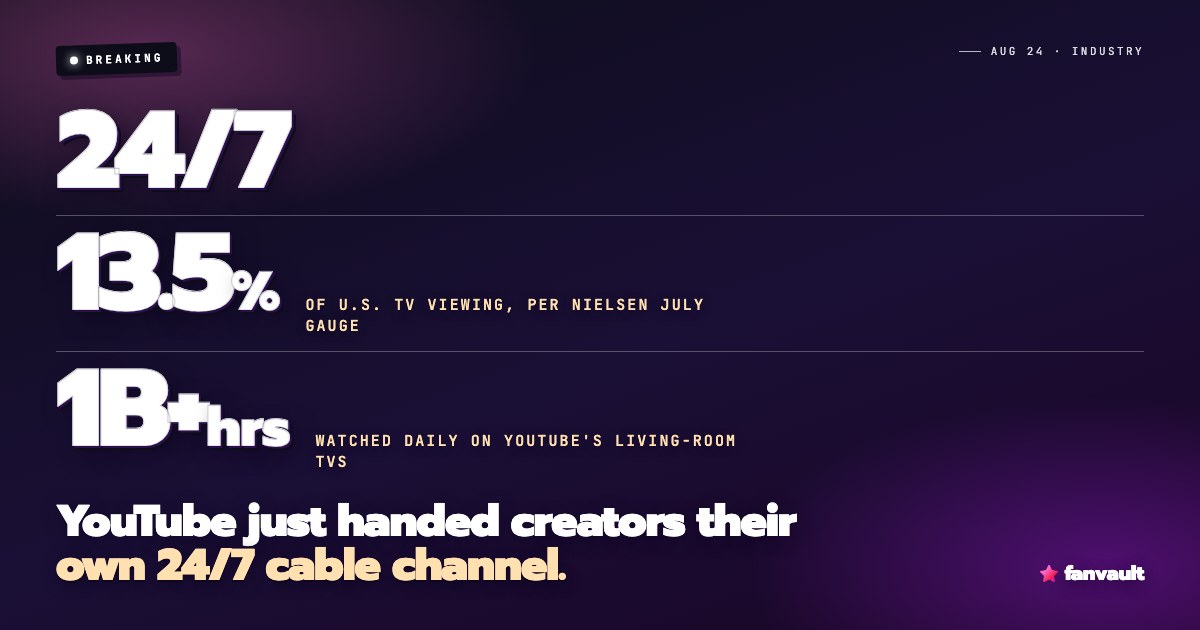
- YouTube already runs 13.5% of U.S. TV viewing and 1B+ hours a day on connected TVs. Creator Stations are how it turns that share into cable-style shelf space.
- The job description just changed. Creators are being asked to program channels, not upload videos.
What actually happened?
YouTube posted an update on Aug 21 saying Stations will now cover "creator content, media channels, podcasts, and select new music artists," per a support thread flagged by Tubefilter. The rollout is invite-only, with no public application, and it is live globally except in Portugal, Switzerland, and Türkiye, according to Social Media Today. The mechanics are minimal. A creator picks a playlist, clicks Start Station, and YouTube spins up a rolling live broadcast.
The early template is "Green Day TV," which launched Aug 6 with more than 100 hours of archival gigs, VHS tapes, deep cuts, and a Tré Cool variety show called "Transmission Unknown," per Rolling Stone. A band, in other words, is programming a channel. The trade press piled in on Monday: Tubefilter, Music Ally, Social Media Today, Netinfluencer, and BetaNews all pushed the story wider.
Why does this matter for creators?
The job description just quietly changed. A creator is no longer someone who uploads videos into a feed. They are being asked to program a channel: pick the playlist, sequence the drops, keep an always-on stream watchable enough that a viewer will leave it on the TV in the other room.
The winners will be creators with catalog depth and enough operational muscle to keep an always-on feed fed. Podcasters get a passive, drop-in surface for the first time. Media brands get something that behaves like a cable channel without a carriage negotiation. Single-viral-hit accounts get nothing.
There is also a leverage problem hiding inside the pitch. YouTube pays creators 55% of net Watch Page ad revenue under its published partner terms, and nothing in the Stations announcement changes that split. What changes is the shape of the demand: a lean-back TV audience worth more per hour, and the promotional weight of a Home-feed and Search recommendation slot YouTube can now aim at a channel it wants to succeed.
"A creator can come onto YouTube, go into our studio product, set up a playlist of videos. They click 'Start Station,' and we'll do all the work to start the livestream for them."
Kurt Wilms, Senior Product Management Director, YouTube
Where does this go from here?
The timing is the tell. Two days before Stations expanded, Bloomberg reported YouTube was dangling multi-million-dollar deals in front of top creators to keep their content off Netflix. Fortune followed with the stick: dual-platform posters risk getting pulled from YouTube marketing campaigns and losing certain brand-deal revenue shares.
Stations is the connective tissue in that pitch. YouTube already streams more than 1 billion hours a day on connected TVs, per StreamTV Insider, and it captured 13.5% of all U.S. TV viewing in Nielsen's July Gauge report. If YouTube wants to be the default living-room service, it needs channels that behave like channels, not just a rec feed of individual videos. Handing creators a 24/7 slot is how it turns their catalogs into shelf space inside the TV.
What does Fanvault think?
This is the year the platform stops treating creators as suppliers and starts treating them as networks with contracts, and Fanvault thinks creators need to negotiate accordingly. A 24/7 Station is real leverage if you own the catalog and have monetization that is not hostage to one platform's promo team. It is a trap if the Station is the only place fans can pay you, since YouTube keeps 45% of net Watch Page ad revenue. Fanvault's 8% platform fee, storefront, and automation layer exist for exactly this shift: run the channel on YouTube, run the business somewhere the fee is not set by the landlord.
The next question is who gets invited. YouTube says a "limited number of new creators" in this wave, no public application, no dedicated monetization split beyond the standard ad share. Whoever gets called first will effectively be YouTube's opening slate of creator-owned FAST channels. Everyone else has to build catalog and leverage now so they are ready when the invite arrives, or when a rival platform copies the format and picks up the phone instead.
Program a channel. Own the business. Do not hand both to the same landlord.
Frequently Asked Questions
What are YouTube Stations, exactly?
Stations are YouTube's take on always-on linear TV channels. A creator picks a playlist, clicks 'Start Station,' and YouTube spins up a 24/7 live broadcast with a live chat sidecar. Viewers can drop in mid-stream and just leave it running, similar to a FAST channel on Roku or Samsung TV Plus.
The format first rolled out for the Coachella 2026 festival with roughly 40 music artists, and expanded on Aug 21, 2026 to creators, podcasters, and media brands.
Who can create a Station right now?
The current wave is invite-only. YouTube says it is working with a 'limited number of new creators, podcasters, and media channels,' plus additional music artists, and there is no public application process.
Stations are live globally except in Portugal, Switzerland, and Türkiye. If you are a creator with a deep catalog and want to be considered, keep your channel in good standing with YouTube's Partner Program and watch for direct outreach from YouTube's creator partnerships team.
How does a Station change how a creator makes money?
Not much, at least not directly. YouTube pays creators
The bigger financial story is the exclusivity conversation Bloomberg reported: YouTube is offering top creators multi-million-dollar deals to keep their content off competing platforms like Netflix, with promo-campaign consequences for creators who post in both places.
Why is YouTube pushing this now?
Because YouTube wants to win the living room, and Stations is how it converts creator catalogs into cable-style shelf space on a connected TV. YouTube already streams more than
If YouTube wants to be the default streaming service, it needs channels that behave like channels, not just a recommendation feed of individual videos. Stations gives it that inventory without paying Hollywood-scale licensing fees, and it locks its biggest creators deeper into the ecosystem.