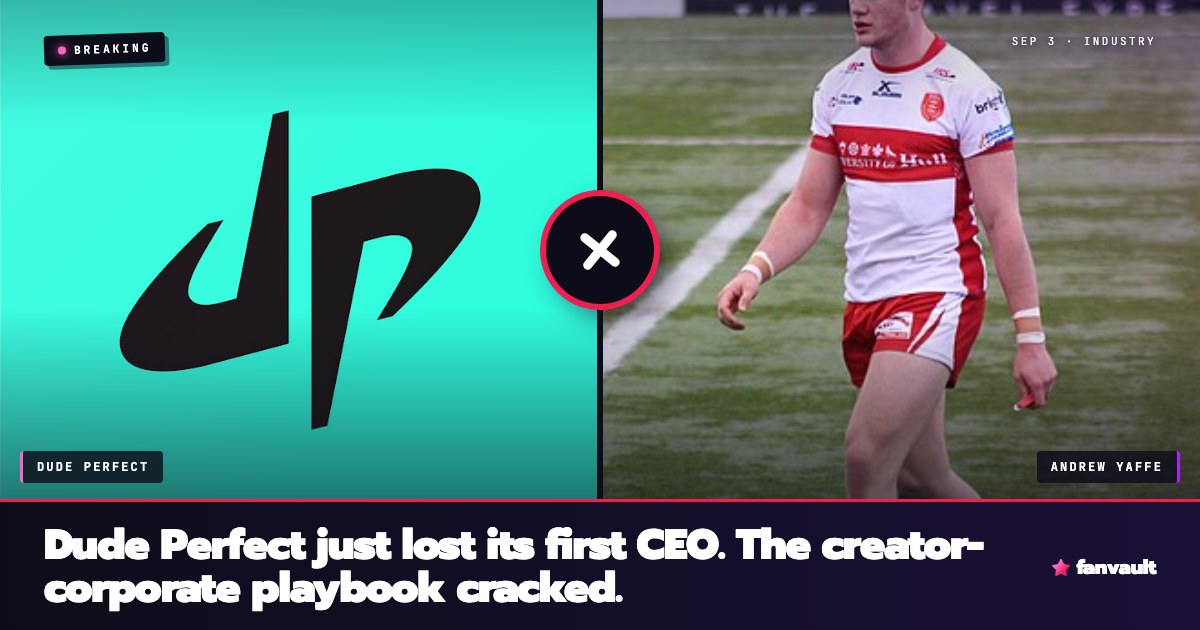
Dude Perfect just lost the CEO it hired to turn a YouTube brand into a real media company. Andrew Yaffe, the former NBA content chief brought in to steer the Frisco viral juggernaut into its next phase, announced on September 3 that he's out after less than two years. The board named an interim replacement the same day. The pitch was a nine-figure raise and a professional operator, and the reality lasted twenty-two months.
⚡ Key Takeaways
- Andrew Yaffe, Dude Perfect's first-ever CEO, is out after 22 months. Both sides call it mutual.
- Yaffe was hired in October 2024 from the NBA to professionalize the brand after its $100M+ Highmount Capital raise.
- Patrick Hurley of BP Capital Fund Advisors is now interim CEO. An external search is running.
- During his tenure Dude Perfect grew past 62M YouTube subs and signed State Farm, Disney, BODYARMOR and McDonald's.
- The tension is structural: private equity wants growth curves, audiences want the five original guys, and one CEO can't be both.
- Every creator brand raising nine-figure institutional money just got a case study in how hard the transition really is.
What actually happened?
Yaffe posted the news on LinkedIn and the company confirmed with a joint statement. Both sides describe the split as mutual, and both frame it in the same language: the board and the CEO developed different perspectives on where a 62M-subscriber creator brand should go next. Patrick Hurley, a principal at BP Capital Fund Advisors and a longtime Dude Perfect advisor, has been appointed interim CEO while an external search runs.
The timeline is tight. Yaffe joined in October 2024 from the NBA, where he had run social, digital and original content as EVP, per Variety. He arrived six months after Dude Perfect closed a $100M+ raise from private-equity firm Highmount Capital, with sources telling Variety the total commitment could run as high as $300 million. Reported revenue at the time of the raise was already north of $50M.
Why does this matter for creators?
Because this is the highest-profile test case yet for the creator-goes-corporate playbook, and the CEO chair just went cold. Five college friends from Texas A&M took institutional money, hired a professional operator, built a management team, and landed marquee deals with State Farm, Disney, BODYARMOR and McDonald's. And they still couldn't agree with the board on what the next chapter looks like. Every creator brand that raises private-equity money now inherits this exact problem.
Nobody involved is bad at their job. Yaffe ran content for the NBA, one of the smartest media operators in sports. The Dude Perfect founders have compounded an audience for fifteen years on original creative instincts most companies can't fake. The friction is structural: the operating logic of a hits-driven creator brand and the operating logic of a PE-backed media platform aren't the same thing, and neither side is wrong to want what they want.
"After two years of strong growth, Andrew and the Board decided that now is the right time for new leadership at Dude Perfect. As the social media landscape continues to evolve, they developed different perspectives on the company's next phase and the best path forward."
Joint statement from Dude Perfect and Andrew Yaffe, via Net Influencer
What's the bigger picture?
Private equity underwrites growth curves. Audiences show up for the five specific guys they came for. Those two things aren't always the same thing, and Dude Perfect just found the seam. During Yaffe's twenty-two months the company signed State Farm as the presenting sponsor of its flagship Overtime series, launched the 22-city Squad Games Tour, and rolled out the Almost Athletes podcast and the Dude Perfect Outdoors franchise.
None of that is failure. The YouTube channel has grown past 62M subscribers per Social Blade, up from roughly 60M when Yaffe arrived. The friction wasn't performance, it was direction. The board wanted a professional media company, the founders wanted to keep the DNA that made Nerf-basketball trick shots a nine-figure business, and the operator hired to bridge the two now has to hand it to somebody else.
Watch what happens next. The Squad Games Tour and the podcast are still shipping. The State Farm deal is still on the wall. But the operator who signed those contracts and picked the direction is gone, and interim CEOs don't tend to set new strategy.
What does Fanvault think?
The takeaway isn't that creators shouldn't raise money. It's that the monetization stack works best when it keeps the creator, not a board, in control of the next phase. Fanvault charges creators an 8% platform fee (creators keep 92%), well below Fanvue's 15%, Passes' 10% plus $0.30, and Fanfix's roughly 20%. The whole system (paywalled posts, tiered memberships, paid DMs, wishlists, and a full storefront with authenticated memorabilia auctions) is designed to run itself through a chat interface, in-app or on Telegram.
Dude Perfect's next CEO inherits a hard problem. The chair is worth taking. But the seam Yaffe just walked out of isn't going to close on its own, and whoever sits in it will find out fast whether the founders and the board are pointing at the same thing.
Frequently Asked Questions
Who is Andrew Yaffe?
Andrew Yaffe was Dude Perfect's first-ever CEO, hired in
Why did Andrew Yaffe leave Dude Perfect?
According to the joint statement issued by Dude Perfect and Yaffe, the two sides 'developed different perspectives on the company's next phase and the best path forward as the social media landscape continues to evolve.' The framing is mutual but the substance is unambiguous: the CEO and the board didn't agree on direction. Neither side has publicly detailed the specific disagreements.
Who is running Dude Perfect now?
Patrick Hurley, a principal at BP Capital Fund Advisors and a longtime advisor to Dude Perfect, has been appointed interim CEO. Hurley joined BP Capital in 2013 and serves as COO and Chief Compliance Officer on the firm's Investment Committee. The company has retained a search firm to identify a permanent replacement.
What did Dude Perfect accomplish under Yaffe?
During Yaffe's
What does this mean for the creator economy?
It means the creator-goes-corporate playbook is harder than the pitch decks make it look. A YouTube-native founder collective can accept a nine-figure check, hire a professional operator, land marquee sponsors, and still find that the board and the CEO disagree about what a creator brand's next chapter should be. Every founder considering institutional money should read the joint statement carefully. The tension between growth-curve capital and audience-first creative instinct is now a documented pattern, not a hypothetical.